
mark
China to Mexico Sea Freight Guide for Importers
The Complete Guide to China to Mexico Sea Freight
1. Introduction to China to Mexico Sea Freight
1.1 Overview of international shipping between China and Mexico
Shipping between China and Mexico represents one of the most dynamic corridors in global trade, bridging the manufacturing powerhouse of East Asia with Latin America’s expanding industrial landscape. Every month, thousands of containers traverse thousands of nautical miles, transporting everything from precision machinery components to raw materials critical for Mexican manufacturing plants. For engineers and procurement specialists, understanding this network is crucial because it directly impacts supply chain reliability and production timelines.
1.2 Importance of sea freight in global trade
Sea freight remains the backbone of international commerce due to its unparalleled capacity to move bulk goods efficiently. While air transport grabs headlines for speed, nothing beats the volume and cost-efficiency of shipping via the ocean. For industries reliant on heavy or oversized machinery, sea freight is the practical choice, enabling large-scale operations without breaking the bank or compromising on safety standards.
1.3 Key benefits of using sea freight over air freight
Opting for sea freight over air transport provides distinct advantages: cost-effectiveness for high-volume shipments, reduced environmental impact per ton, and the ability to transport oversized industrial equipment. Additionally, sea freight provides more flexible shipping schedules, which allows engineers and procurement teams to plan production runs without the constraint of sky-high air cargo rates.
2. Understanding the Basics of Sea Freight
2.1 Types of sea freight services (FCL, LCL)
Full Container Load (FCL) involves shipping an entire container exclusively for one customer, ideal for heavy or bulk machinery components. Less than Container Load (LCL), on the other hand, allows multiple shipments to share a container, providing cost savings for smaller batches but requiring careful coordination to avoid delays. Understanding these options is fundamental to optimizing logistics costs while ensuring timely delivery.
2.2 Common shipping terms and definitions
Terms like Bill of Lading, demurrage, and transshipment are the lingua franca of international sea freight. Engineers and purchasing managers need to familiarize themselves with these phrases because even minor misinterpretations can lead to costly delays or compliance issues.
2.3 How sea freight works from port to port
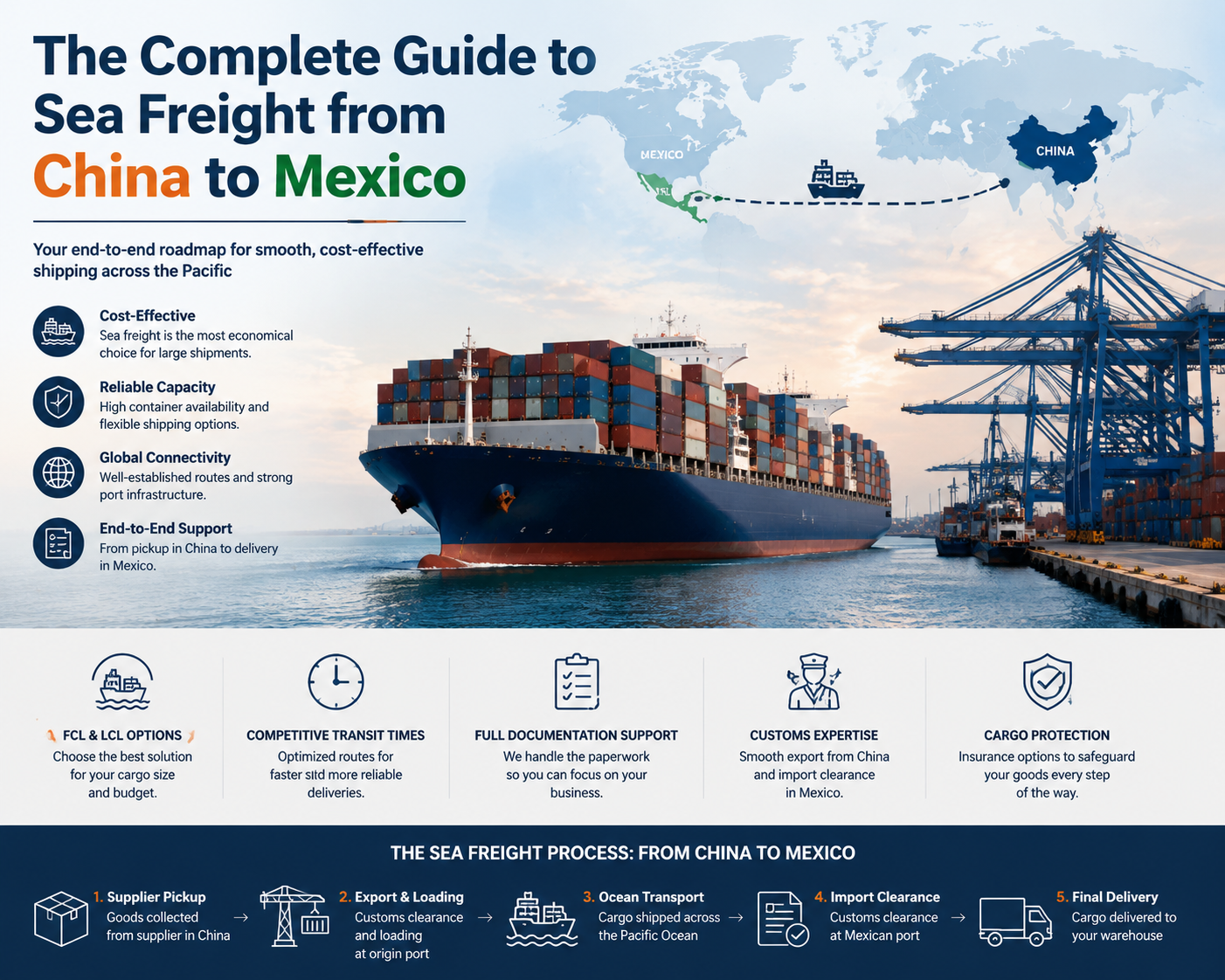
Sea freight begins with cargo preparation and documentation at the origin port, followed by loading onto a vessel, transit across oceanic routes, unloading at the destination port, and finally customs clearance. Each stage involves precise coordination among shipping agents, freight forwarders, and port authorities, underscoring the importance of meticulous planning for industrial supply chains.
3. Major Ports in China for Export
3.1 Shanghai Port: Overview and capabilities
Shanghai Port is a juggernaut in global shipping, equipped with state-of-the-art container handling systems and deep-water berths capable of accommodating the largest vessels. For Chinese exporters, it offers seamless connectivity to major Mexican ports, ensuring that heavy-duty industrial equipment can be shipped without the risk of bottlenecks.
3.2 Shenzhen Port: Key routes and facilities
Shenzhen Port serves as a strategic hub for southern China, specializing in high-tech and electronics cargo. Its modern infrastructure and efficient customs operations make it an excellent choice for shipments requiring rapid turnaround while maintaining adherence to regulatory standards.
3.3 Ningbo-Zhoushan Port: Advantages for exporters
Renowned for its deep-water berths and extensive hinterland connections, Ningbo-Zhoushan Port facilitates large-volume shipments efficiently. It also provides competitive freight rates, which can significantly reduce overall logistics costs for industrial supply chains.
4. Major Ports in Mexico for Import
4.1 Veracruz Port: Location and infrastructure
Veracruz Port is strategically located on the Gulf of Mexico, providing access to central Mexico’s industrial heartland. With specialized cargo handling facilities and customs processing capabilities, it plays a pivotal role in managing China to Mexico sea freight efficiently.
4.2 Manzanillo Port: Importance for cargo handling
Manzanillo Port is Mexico’s largest Pacific port and a crucial gateway for Asian shipments. Its extensive terminal capacity ensures smooth operations for both FCL and LCL cargo, making it indispensable for procurement engineers handling large-scale industrial imports.
4.3 Lázaro Cárdenas Port: Capacity and services
Lázaro Cárdenas Port offers modern infrastructure capable of handling mega-ships and high-volume cargo efficiently. It is particularly favored for heavy machinery and oversized components due to its deep-water berths and specialized container equipment.
5. Shipping Routes from China to Mexico
5.1 Pacific Ocean routes: Key considerations
Most China to Mexico sea freight voyages traverse the Pacific Ocean, making careful route selection critical. Factors such as maritime traffic density, weather patterns, and fuel efficiency influence both transit time and shipping cost, so engineers need to plan accordingly.
5.2 Transit times for different routes
Transit time varies depending on origin and destination ports, vessel speed, and transshipment stops. On average, a direct FCL shipment from Shanghai to Manzanillo takes around 18–22 days, but delays due to congestion or adverse weather are always a consideration.
5.3 Alternative routes and their pros and cons
Alternative routing, such as via the Panama Canal or through secondary ports, can sometimes reduce costs or improve scheduling flexibility. However, these options may increase complexity and risk, requiring careful evaluation by logistics planners.
6. Choosing the Right Shipping Method
6.1 Full Container Load (FCL) advantages
FCL ensures exclusive use of a container, reducing the risk of damage, theft, and delays. For bulk industrial equipment, FCL offers predictable transit schedules and more straightforward handling at ports.
6.2 Less than Container Load (LCL) advantages
LCL is ideal for smaller shipments or prototypes, allowing multiple consignments to share a container. This can significantly lower costs, though it requires meticulous coordination to avoid delays in consolidation and deconsolidation.
6.3 Factors to consider when selecting a method
Engineers must evaluate shipment volume, urgency, cargo fragility, and budget when choosing between FCL and LCL. These decisions can affect production schedules, inventory management, and overall supply chain efficiency.
7. Freight Forwarders and Shipping Agents
7.1 Role of freight forwarders in sea freight
Freight forwarders act as the operational backbone, coordinating shipment, documentation, and customs clearance. Their expertise ensures that cargo moves seamlessly from China to Mexico, mitigating risks associated with port congestion or regulatory compliance.
7.2 How to choose a reliable shipping agent
Evaluating shipping agents involves assessing track records, certifications, and network coverage. Trusted agents provide transparent pricing, real-time tracking, and responsive communication—critical for engineers managing high-value industrial cargo.
7.3 Benefits of using professional logistics services
Professional logistics providers can optimize shipping schedules, reduce costs, and handle unforeseen disruptions. Their involvement often translates to fewer delays, improved inventory turnover, and smoother integration into manufacturing workflows.
8. Costs Associated with China to Mexico Sea Freight
8.1 Freight charges and calculation methods
Freight costs depend on container type, cargo volume, weight, and shipping distance. Engineers need to account for these variables when planning budgets to ensure cost-effective procurement without compromising delivery timelines.
8.2 Additional fees (port charges, handling, documentation)
Beyond basic freight charges, additional costs include terminal handling fees, customs documentation, and port surcharges. Understanding these hidden fees helps avoid unpleasant surprises and maintain accurate project costing.
8.3 Strategies for cost optimization
Consolidating shipments, negotiating long-term contracts with carriers, and selecting optimal routes are practical ways to reduce expenses. Efficient planning can trim logistics costs significantly while maintaining operational reliability.
9. Shipping Documentation
9.1 Commercial invoice and packing list
A commercial invoice details the value, origin, and specifications of the cargo, while the packing list itemizes contents for customs inspection. Accuracy is crucial to prevent clearance delays and compliance penalties.
9.2 Bill of Lading and its importance
The Bill of Lading serves as both a receipt and a contract of carriage. Engineers should treat it as a legal safeguard that verifies ownership and shipment terms during transit.
9.3 Certificates and customs documents
Certificates of origin, quality inspection certificates, and other regulatory documents facilitate customs clearance. Maintaining meticulous records ensures compliance and reduces the risk of cargo detention.
10. Customs Clearance in China and Mexico
10.1 Export procedures in China
Export involves regulatory filings, cargo inspection, and payment of any applicable export duties. Precise documentation ensures smooth handover to shipping lines for international transit.
10.2 Import procedures in Mexico
Imports require customs declarations, payment of tariffs, and adherence to local regulatory standards. Familiarity with Mexican customs procedures expedites release and reduces demurrage charges.
10.3 Tips for smooth customs clearance
Engaging experienced brokers, double-checking documentation, and scheduling shipments during low-congestion periods are best practices to avoid delays.
11. Packaging and Cargo Preparation
11.1 Choosing the right packaging materials
Industrial cargo requires robust packaging—steel crates, reinforced pallets, or moisture-resistant wrapping—to withstand long sea journeys. Proper packaging minimizes the risk of damage and protects investment in high-value machinery.
11.2 Labeling and cargo identification
Clear labeling with handling instructions, container numbers, and destination details ensures efficient port operations and reduces errors during transit.
11.3 Securing cargo for long sea journeys
Cargo must be stowed securely using lashing, dunnage, and bracing. This prevents shifting during rough sea conditions and preserves structural integrity.
12. Transit Time and Delivery Schedules
12.1 Average shipping times from China to Mexico
Typical transit times range from 18 to 30 days depending on the origin port, vessel speed, and stops. Engineers must factor these durations into production and inventory planning.
12.2 Factors that can affect transit time
Weather, port congestion, customs inspections, and operational delays can significantly extend delivery times, requiring contingency planning for critical supply chain components.
12.3 How to track shipments effectively
Using advanced shipment tracking systems and maintaining communication with freight forwarders allows real-time monitoring, helping engineers mitigate risks associated with delays.
13. Insurance for Sea Freight
13.1 Types of cargo insurance available
Marine insurance policies include all-risk, named-peril, and total loss coverage, offering protection against theft, damage, or natural disasters. Selecting the right policy is crucial for high-value industrial cargo.
13.2 How to calculate insurance costs
Insurance premiums are typically a percentage of cargo value, adjusted for risk factors such as route, season, and cargo type. Engineers need to evaluate costs versus risk exposure for sound decision-making.
13.3 Importance of insurance for high-value cargo
High-value machinery or critical components must be insured to safeguard financial investment and ensure continuity in manufacturing operations in case of loss or damage.
14. Common Challenges in China to Mexico Sea Freight
14.1 Delays and congestion at ports
Port congestion, particularly in high-traffic hubs like Shanghai or Manzanillo, can add days or even weeks to transit. Strategic scheduling and early booking help mitigate this issue.
14.2 Handling damaged or lost cargo
Mechanical damage, shifting during transit, or misplacement can occur, especially in LCL shipments. Proper packaging and insurance coverage reduce associated financial risk.
14.3 Navigating regulatory changes
Customs regulations, environmental policies, and trade tariffs can shift rapidly. Staying updated on regulatory changes is crucial to avoid compliance penalties or shipment delays.
15. Tips for Efficient Sea Freight Management
15.1 Planning shipments in advance
Advanced planning helps secure favorable shipping rates, reduces port congestion issues, and aligns logistics with production schedules.
15.2 Communication with suppliers and freight forwarders
Maintaining a transparent information flow ensures real-time updates and quick problem-solving, which is critical for high-stakes industrial shipments.
15.3 Using technology for shipment tracking and management
Integrated logistics software allows engineers to monitor cargo, manage documentation, and optimize supply chain decisions efficiently.
16. Environmental and Sustainability Considerations
16.1 Reducing carbon footprint in sea freight
Optimizing vessel utilization, reducing idle times, and selecting fuel-efficient shipping options can lower emissions per ton transported.
16.2 Sustainable packaging options
Using recyclable materials, minimizing overpacking, and implementing reusable container solutions contribute to a greener supply chain.
16.3 Future trends in green shipping
Adoption of LNG-powered vessels, electric port handling equipment, and carbon-offset programs are transforming sea freight into a more environmentally responsible mode of transport.
17. Case Studies: Successful China to Mexico Shipments
17.1 Example of FCL shipment efficiency
A Shanghai-to-Manzanillo FCL shipment of precision gears demonstrated reduced transit time and damage risk through proper stowage and direct routing.
17.2 Example of LCL cost optimization
A Shenzhen-to-Veracruz LCL shipment of spare parts highlighted cost savings while maintaining timely delivery, thanks to optimized container consolidation.
17.3 Lessons learned from past shipments
Case studies underscore the importance of proper documentation, route selection, packaging, and proactive communication in ensuring seamless China to Mexico sea freight operations.
18. Conclusion and Key Takeaways
18.1 Summary of the sea freight process
From port selection, shipping methods, documentation, customs clearance, to delivery, each step requires meticulous planning and execution to maintain operational efficiency.
18.2 Best practices for exporters and importers
Prioritize reliable freight forwarders, optimize packaging, track shipments rigorously, and maintain compliance with customs regulations to streamline logistics.
18.3 Final recommendations for China to Mexico shipping
Invest in planning, use insurance strategically, and integrate technology-driven tracking solutions to ensure safe, cost-effective, and timely delivery across this critical trade corridor.
External Resources
```