Table of Contents
📋 What Is an MSDS: Chemical Compliance for Procurement Teams
1. Introduction: What Is an MSDS in Global Procurement
Definition and purpose of MSDS
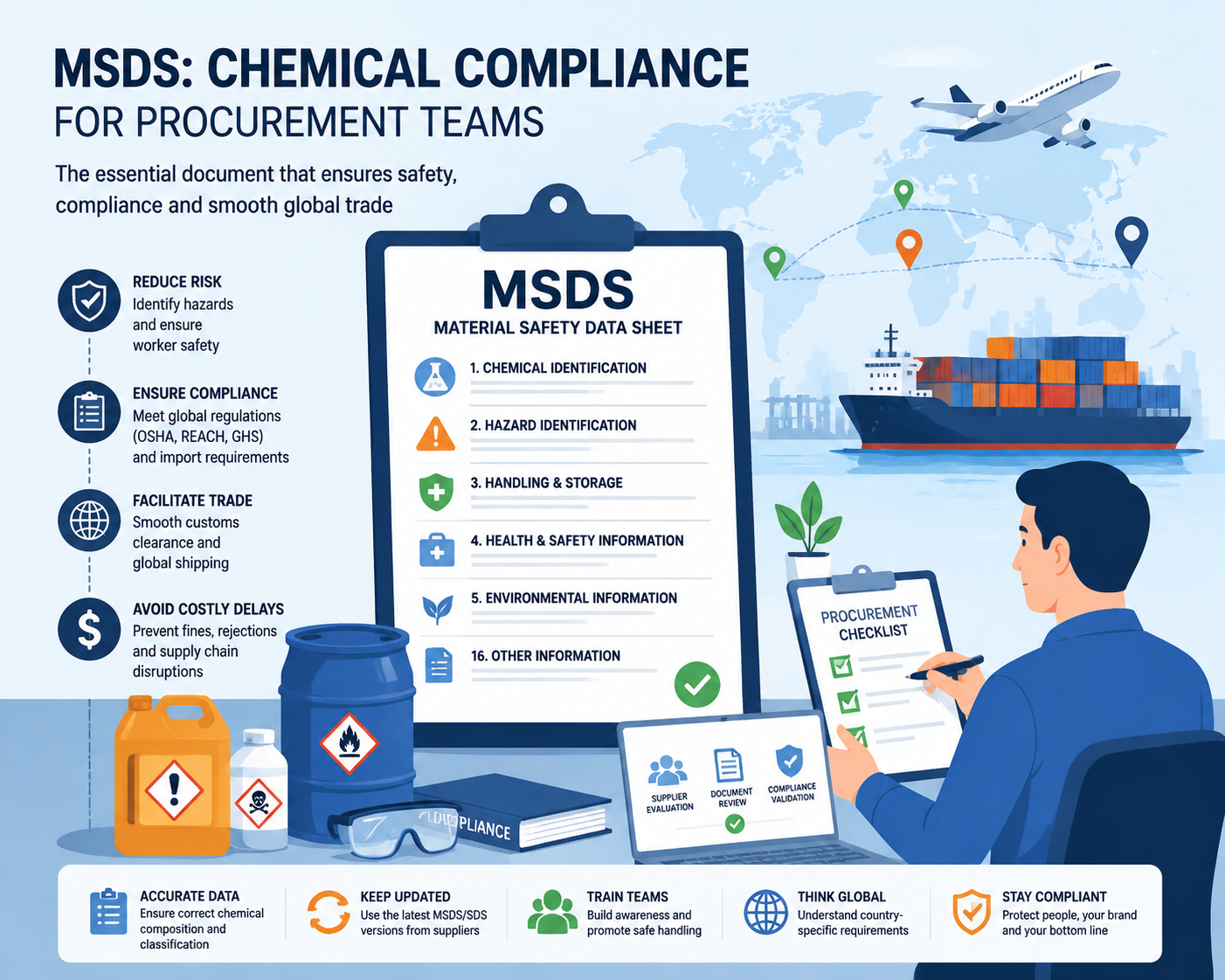
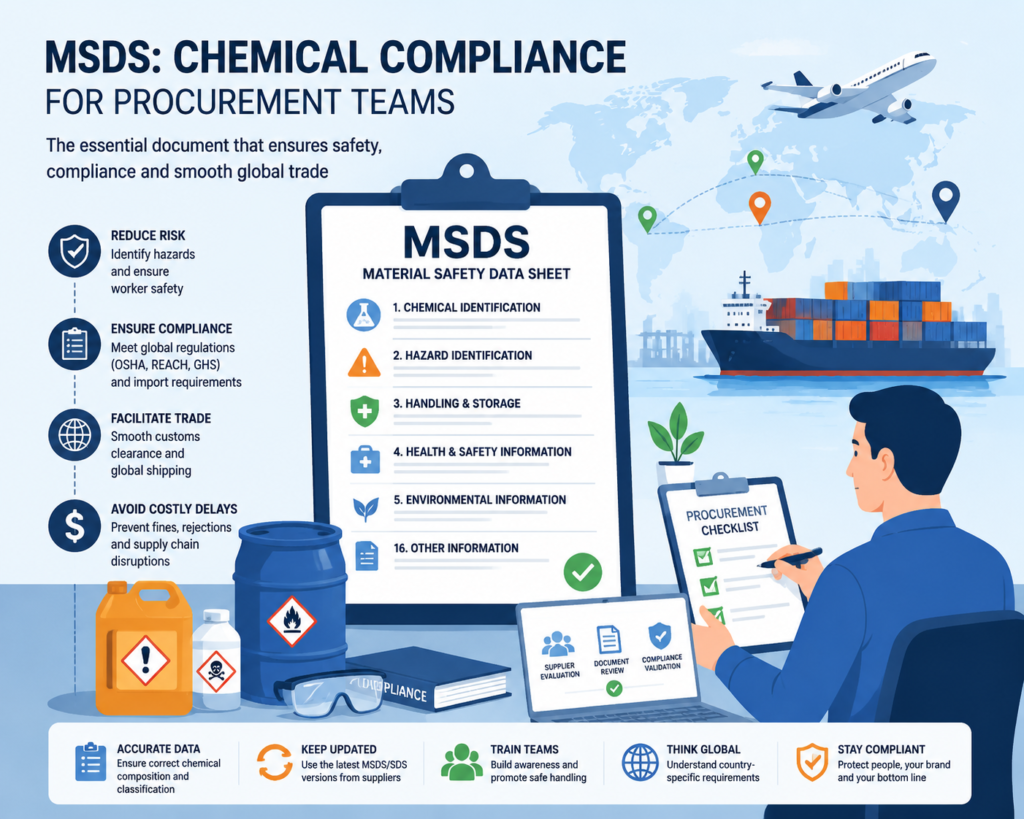
An MSDS, or Material Safety Data Sheet, functions as the backbone document for chemical transparency in global trade, laying out the hazardous properties, handling protocols, and safety safeguards of a substance in a structured technical format. In procurement workflows, it is essentially the “truth file” that tells whether a material is safe to buy, move, store, or integrate into production without triggering regulatory headaches. Without it, sourcing decisions become guesswork dressed up as strategy, and that’s a fast track to compliance chaos.
Why procurement teams rely on it
Procurement professionals lean heavily on MSDS documentation because it converts abstract chemical risk into quantifiable, auditable data that can be evaluated before a purchase order is ever signed. It acts like a filter at the front gate of sourcing, ensuring suppliers aren’t slipping in restricted or mislabeled materials that could derail production lines or customs clearance. In real-world terms, it’s the difference between a smooth inbound shipment and a “why is this container stuck at port” nightmare.
Role in international supply chains
In cross-border logistics, MSDS documents travel alongside cargo as part of the compliance passport, ensuring every node in the supply chain—from factory floor to final warehouse—understands what’s inside the box. Freight forwarders, customs officers, and carriers all depend on it to classify, segregate, and handle goods safely without exposing personnel or infrastructure to unnecessary risk. In short, it keeps the global machinery turning without sparks flying where they shouldn’t.
2. MSDS vs SDS: What Buyers Must Understand
Key differences in terminology
MSDS and SDS are often used interchangeably, but SDS (Safety Data Sheet) represents the standardized evolution under the Globally Harmonized System (GHS), while MSDS is the older, less structured format. The shift is not just semantic—it reflects a move toward unified hazard communication that eliminates ambiguity across borders. For procurement teams, confusing the two is like mixing metric and imperial systems in engineering specs; it may look similar, but it can derail compliance alignment.
Global transition from MSDS to SDS
Most major economies have transitioned to SDS formats, enforcing consistent 16-section layouts that improve readability and regulatory enforcement. However, legacy MSDS documents still circulate in certain supplier networks, particularly among smaller manufacturers or older product lines. This hybrid environment means procurement teams often need to “translate compliance dialects” on the fly to keep sourcing clean.
Regional compliance expectations
Different regions enforce hazard documentation with varying intensity, with Europe and the US pushing strict SDS adherence while some emerging markets still tolerate MSDS variations. Procurement engineers must therefore treat geography as a compliance variable, not just a logistics detail. Ignoring these differences is how shipments end up stuck in customs limbo with nobody willing to take responsibility.
3. Why MSDS Matters for Procurement Professionals
Risk reduction in sourcing decisions
MSDS documents serve as an early-warning system, flagging toxic, flammable, or reactive materials before they enter the supply chain pipeline. This allows procurement teams to eliminate high-risk suppliers before contractual commitments lock in exposure. In practical terms, it’s risk engineering at the purchasing desk level.
Supplier qualification requirements
Many OEMs and global brands now require validated MSDS documentation as a non-negotiable part of supplier onboarding. This ensures that upstream partners are not just cost-competitive but also compliance-aligned, which is increasingly a board-level concern. If a supplier cannot produce accurate MSDS data, they are effectively disqualified from serious procurement consideration.
Cost implications of non-compliance
Non-compliant materials can trigger customs fines, shipment delays, repackaging costs, or even product recalls, all of which hit procurement budgets hard. The hidden cost is not just financial but reputational, especially for global brands that rely on uninterrupted supply chain credibility. In procurement language, skipping MSDS checks is basically inviting “budget leakage with extra steps.”
4. MSDS in International Freight Forwarding
Documentation in cross-border shipping
In freight forwarding, MSDS documents are bundled with commercial invoices, packing lists, and shipping declarations to form the compliance packet required for hazardous goods movement. Without it, even benign-looking shipments can be flagged for inspection or rejection. Think of it as the passport that tells logistics networks the cargo is “allowed to travel.”
Integration with customs clearance
Customs authorities use MSDS data to classify goods under HS codes and determine whether additional permits or inspections are required. Any inconsistency between declared contents and MSDS information raises immediate red flags. In many cases, this is where shipments get stuck in bureaucratic “waiting rooms” for days or weeks.
Carrier requirements and restrictions
Airlines and ocean carriers impose strict acceptance rules based on MSDS classifications, often refusing cargo that lacks proper hazard documentation. Certain materials may require special packaging, labeling, or even complete exclusion from specific transport modes. For procurement teams, this directly impacts sourcing feasibility and lead time planning.
5. Regulatory Framework Behind MSDS
OSHA standards overview
In the United States, OSHA’s Hazard Communication Standard governs how chemical hazards must be documented and communicated through SDS formats. This regulation ensures that workers, handlers, and downstream users understand the risks before exposure occurs. It is essentially workplace risk transparency codified into law.
REACH regulation in Europe
Europe’s REACH framework places responsibility on manufacturers and importers to register chemical substances and provide detailed safety documentation. This system is highly data-driven and enforces traceability across the entire chemical lifecycle. For procurement teams, REACH compliance often dictates supplier eligibility within the EU market.
GHS global classification system
The Globally Harmonized System standardizes hazard classification, labeling, and documentation to reduce confusion across international borders. It provides a common “language of chemical risk,” ensuring that a hazard in one country is understood the same way in another. This is the backbone that modern SDS documentation is built upon.
6. Key Sections of an MSDS Document
Chemical composition details
This section breaks down the exact ingredients, concentration levels, and CAS numbers of the substance being shipped or procured. It allows procurement teams to verify whether restricted substances are present in trace or significant amounts. Without this clarity, sourcing decisions become blind guesses.
Hazard identification information
Here, the document outlines physical, health, and environmental hazards associated with the chemical product. It includes warning symbols, signal words, and risk phrases that indicate severity levels. This is where the “danger narrative” of the material is officially defined.
Handling and storage instructions
This section provides operational guidance on how the material should be stored, transported, and used safely. It often includes temperature ranges, ventilation requirements, and incompatibility warnings. For procurement teams, this directly influences warehouse planning and logistics design.
7. Hazard Classification Explained for Buyers
Physical hazards (flammability, reactivity)
Physical hazards describe how a substance behaves under stress conditions such as heat, pressure, or mechanical impact. Highly flammable or reactive materials require specialized handling protocols and transport restrictions. Ignoring this is like storing fireworks next to a welding station—technically possible, practically reckless.
Health hazards (toxicity, exposure risks)
Health hazards indicate potential harm to human exposure through inhalation, skin contact, or ingestion. These classifications directly impact worker safety protocols in manufacturing and logistics environments. Procurement teams must ensure that downstream users are not unknowingly exposed to harmful substances.
Environmental hazards and impact
Environmental classifications assess risks such as aquatic toxicity, soil contamination, and atmospheric effects. These factors increasingly influence ESG-driven procurement decisions. In modern supply chains, environmental compliance is no longer optional—it is reputational currency.
8. MSDS Requirements for Import Approval
Customs documentation checks
Customs authorities routinely cross-check MSDS data against declared shipment contents to verify accuracy. Any mismatch can trigger inspection, delay, or rejection at the border. This makes document integrity a first-line defense in procurement logistics.
Restricted and controlled substances
Certain chemicals are heavily regulated or outright prohibited depending on jurisdiction. MSDS documentation helps identify whether a product falls under controlled categories before shipment occurs. This prevents costly “return to sender” scenarios.
Country-specific import rules
Different countries enforce unique chemical import restrictions based on national safety policies. Procurement teams must align MSDS review with destination-specific compliance frameworks. A globally sourced product must still pass locally enforced rules.
9. Supplier Responsibilities in MSDS Provision
Accuracy of chemical data
Suppliers are responsible for ensuring that all chemical composition and hazard data is accurate and verifiable. Any misrepresentation can lead to legal liability and contract disputes. In procurement terms, trust is earned through data integrity, not sales claims.
Updating revised MSDS versions
When formulations change, suppliers must issue updated MSDS documents reflecting the new composition and risks. Outdated documents can create serious compliance gaps in ongoing supply relationships. Procurement teams must treat version control as a living compliance requirement.
Legal liability for misinformation
Incorrect MSDS information can expose suppliers to regulatory penalties, litigation, and shipment rejection. This shifts responsibility beyond logistics into legal accountability territory. In global trade, bad data travels faster than good intentions—and it costs more too.
10. Procurement Team Checklist for MSDS Review
Document completeness verification
Procurement teams must ensure that all required sections of the MSDS are fully populated and compliant with regulatory standards. Missing sections are a red flag that often signals weak supplier governance. A complete document is the baseline, not a bonus.
Consistency with product specifications
The chemical identity in the MSDS must match purchase specifications and supplier declarations exactly. Any discrepancy should trigger immediate clarification before procurement approval. This is where “trust but verify” becomes operational discipline.
Compliance validation before PO approval
No purchase order for chemical-related goods should be issued without MSDS validation. This step acts as a final gate before financial and legal commitment. Skipping it is essentially signing blind in a regulated environment.
11. Common MSDS Mistakes in Global Trade
Missing or outdated documents
One of the most frequent issues is suppliers providing expired or incomplete MSDS files. This often happens in fast-moving supply chains where documentation lags behind production updates. The result is compliance friction at exactly the wrong moment—usually at customs.
Incorrect chemical classification
Misclassification of hazard categories can lead to improper handling and transport decisions. This creates downstream safety risks and regulatory exposure. It’s a small data error with potentially massive operational consequences.
Translation and interpretation errors
In global procurement, MSDS documents are often translated across languages, introducing interpretation risks. Subtle wording changes can alter hazard severity or handling instructions. In compliance terms, translation errors are silent but expensive liabilities.
12. MSDS and Dangerous Goods Shipping Rules
UN classification alignment
MSDS data is used to align shipments with UN dangerous goods classification codes. These codes determine how materials must be packaged and transported internationally. Without proper alignment, shipments cannot legally move through regulated channels.
Packaging and labeling requirements
Hazardous materials must follow strict packaging standards including certified containers and standardized labels. These requirements are directly derived from MSDS hazard classifications. In logistics, packaging is not just protection—it is compliance infrastructure.
Air and sea freight restrictions
Certain chemicals are restricted or banned in air transport due to safety risks. MSDS documentation determines whether goods can be shipped by air, sea, or both. Procurement decisions often hinge on these transport limitations.
13. MSDS in China Export Compliance
Local regulatory requirements
China enforces chemical safety documentation requirements under national safety and export control frameworks. Manufacturers must ensure MSDS alignment with both domestic and international standards. This dual compliance is critical for export eligibility.
Manufacturer documentation standards
Chinese manufacturers are expected to maintain updated MSDS documentation for all regulated chemical products. Export readiness depends heavily on documentation accuracy and consistency. Weak documentation can block entire export batches.
Export inspection procedures
Export authorities may inspect MSDS documents as part of shipment clearance procedures. Any inconsistencies can delay or reject outbound cargo. This makes MSDS a critical checkpoint in export logistics flows.
14. MSDS in EU and US Import Markets
REACH and CLP alignment in Europe
The EU requires strict alignment with REACH registration and CLP classification standards for chemical imports. MSDS documents must reflect these regulatory frameworks precisely. Non-alignment can result in immediate market exclusion.
OSHA Hazard Communication Standard in US
In the US, OSHA mandates clear hazard communication through standardized SDS documentation. Employers and importers must ensure accessibility and accuracy of chemical safety data. This regulation prioritizes workplace safety transparency.
Customs enforcement practices
Both EU and US customs authorities actively enforce chemical documentation compliance. MSDS inconsistencies often trigger inspections or shipment holds. Enforcement is not theoretical—it is routine operational practice.
15. How MSDS Impacts Supply Chain Risk Management
Supplier risk assessment use cases
MSDS documentation plays a key role in evaluating supplier reliability and compliance maturity. It helps procurement teams identify high-risk vendors early in the sourcing process. This turns compliance data into strategic sourcing intelligence.
Insurance and liability considerations
Insurance providers often rely on MSDS data when assessing coverage for chemical shipments. Incorrect documentation can invalidate claims or increase premiums. In risk terms, documentation is financial protection infrastructure.
Supply disruption prevention
Proper MSDS management reduces the likelihood of customs delays, shipment rejections, and regulatory penalties. This ensures smoother flow across global supply chains. In procurement reality, fewer surprises equals stronger performance metrics.
16. Digitalization of MSDS in Modern Procurement
Electronic SDS databases
Modern procurement systems increasingly rely on centralized digital SDS repositories for instant access and verification. This reduces dependency on manual document handling. Speed and accuracy improve significantly with digitization.
Automation in procurement systems
Automated compliance tools can flag missing or outdated MSDS documents before purchase orders are approved. This reduces human error and improves governance consistency. It’s compliance without the spreadsheet chaos.
Integration with ERP and compliance tools
MSDS data is now being integrated directly into ERP systems for real-time supply chain visibility. This enables seamless alignment between procurement, logistics, and compliance teams. The result is a more synchronized and less error-prone ecosystem.
17. Best Practices for Procurement Teams Handling MSDS
Standard operating procedures
Procurement teams should establish clear SOPs for MSDS review, validation, and archiving. This ensures consistency across categories and suppliers. Structured processes reduce ambiguity and compliance drift.
Supplier onboarding workflows
MSDS verification should be embedded into supplier qualification and onboarding workflows. No supplier should enter the system without validated chemical documentation. This creates a compliance-first sourcing foundation.
Continuous compliance monitoring
MSDS management is not a one-time task but an ongoing governance process. Regular audits and document updates ensure sustained compliance across the supply chain. In modern procurement, vigilance is not optional—it’s operational survival.
Key external resources for procurement & chemical compliance