Table of Contents
Shipping Crate Cost Breakdown Every Pro Reviews
1. Introduction: Why Shipping Crate Cost Demands a Line-by-Line Review
The hidden impact of packaging on total landed cost
When brand procurement professionals gaze upon a supplier's quotation, the siren call of the per-unit product price often drowns out the more insidious whispers of ancillary expenditures, yet it is the humble shipping crate that frequently emerges as the silent budget assassin lurking within the total landed cost calculation. The disparity between a cursory glance at packaging line items and a forensic dissection of every constituent element can represent a differential of fifteen to thirty percent across a fiscal quarter, a margin that separates a profitable sourcing initiative from one that bleeds red ink with each container departure from port. Seasoned mechanical engineers understand that the structural integrity of a crate is not merely a matter of protective function but a direct vector for material science expenses, labor allocation, and logistical friction that compounds exponentially as shipment volumes scale toward the horizon.
Why procurement pros cannot rely on supplier lump-sum quotes
The aggregation of packaging costs into a monolithic lump-sum figure is an analytical abomination that obfuscates the granular reality of value distribution, leaving the procurement engineer adrift without a compass to navigate the treacherous waters of cost optimization. Such opaque quoting practices effectively handcuff the buyer's ability to perform any meaningful should-cost modeling, a fundamental tool in the procurement arsenal that permits the dissection of a supplier's margin structure and exposes inefficiencies ripe for negotiation. When a supplier presents a single all-encompassing figure for crating, they effectively preclude any substantive dialogue regarding material substitutions, process refinements, or volume-based incentives, transforming what should be a collaborative engineering partnership into a tacit acceptance of whatever cost burden the manufacturer chooses to impose.
How a detailed breakdown unlocks negotiation leverage
The procurement professional who commands a comprehensive line-by-line breakdown of crate costs wields a formidable implement of negotiation that transmutes the supplier relationship from one of passive acquiescence to one of informed parity and strategic advantage. By isolating each cost driver—from board feet of lumber to man-hours of assembly and kilograms of fasteners—the buyer can pinpoint precisely which line items deviate from industry benchmarks and initiate surgical interventions rather than blunt-force price reduction demands that suppliers reflexively resist. This forensic approach engenders a dialogue grounded in engineering reality rather than arbitrary percentage targets, facilitating a shared understanding of value creation that ultimately yields superior crate designs, more favorable pricing structures, and a procurement outcome that satisfies the dual imperatives of quality assurance and fiscal prudence.
2. Raw Material Expenses: The Foundation of Every Crate
Lumber grades and their direct effect on price per unit
The arboraceous bounty that constitutes the skeletal framework of any shipping crate presents a spectrum of quality gradations, from the knot-strewn irregularities of utility-grade stock to the pristine uniformity of select structural timber, each tier exerting a pronounced influence upon the ultimate per-unit cost that the procurement engineer must carefully calibrate against the protective demands of the cargo. Premium grades command a substantial premium owing to their enhanced load-bearing capacity, reduced incidence of warping, and superior nail-holding characteristics, yet many applications can tolerate lower-grade materials with judicious reinforcement strategies that achieve equivalent performance at a fraction of the expenditure. The savvy buyer will commission a stress analysis to determine the minimum acceptable lumber grade for their specific application, thereby avoiding the perennial trap of over-specification that plagues those who default to premium materials without rigorous engineering justification.
Plywood vs solid wood: cost differences and use cases
The perennial debate between plywood and solid wood as primary crate construction materials hinges upon a complex calculus of structural performance, dimensional stability, weight considerations, and prevailing market prices that fluctuate with the capricious whims of global commodity markets. Plywood offers the distinct advantage of cross-laminated construction that resists splitting and delamination under dynamic loading conditions, while simultaneously providing superior flatness and consistent thickness that facilitates automated assembly processes, yet its manufacturing complexity typically renders it more expensive per unit volume than rough-sawn solid lumber. Conversely, solid wood excels in applications requiring exceptional racking strength or where the crate will bear concentrated point loads that would induce premature failure in plywood panels, but its susceptibility to moisture-induced dimensional changes and the prevalence of natural defects necessitate more rigorous quality control inspections upon receipt.
Metal components: brackets, nails, and strapping adds up
The humble fasteners, corner brackets, and strapping bands that unite disparate wooden elements into a coherent protective structure are deceptively significant cost contributors that procurement professionals frequently dismiss as negligible line items, only to discover their cumulative impact when subjected to rigorous line-item scrutiny. Galvanized steel brackets, zinc-plated nails of appropriate gauge, and high-tensile polyester strapping each represent specialized inputs that command their own supply chain dynamics, with prices that oscillate in tandem with ferrous metal futures and petrochemical derivatives that underpin synthetic strap production. The engineering-minded buyer will conduct a fastener density analysis to optimize the spacing and type of connections, reducing material consumption without compromising structural integrity, while simultaneously exploring bulk purchasing agreements with metal component suppliers that can yield substantial economies of scale when aggregated across multiple crate orders.
3. Customization and Design Fees
Engineering drawings and CAD setup charges
The translation of a procurement engineer's conceptual protective requirements into a manufacturable crate design demands the specialized expertise of drafting professionals who operate sophisticated computer-aided design platforms, and the associated setup fees represent a non-recurring engineering expenditure that must be amortized across the production run with careful consideration. The creation of detailed shop drawings, complete with dimensional tolerances, assembly sequences, and material callouts, requires an investment of skilled labor hours that can range from a few hundred to several thousand dollars depending upon the geometric complexity and the degree of innovation required for unique product geometries. Procurement professionals who secure these CAD assets in their native file formats, rather than accepting read-only PDF outputs, position themselves advantageously for future competitive bidding, as the digital intellectual property enables seamless transfer to alternative suppliers without incurring redundant engineering charges.
Special cutouts, grooves, or interlocking joints
The incorporation of bespoke features such as precision cutouts for protruding components, receiving grooves for stabilizing inserts, or interlocking joinery that obviates the need for extensive metal fastening introduces an additional layer of manufacturing complexity that directly translates into elevated setup costs and extended production lead times. Each CNC router path, dado cut, or mortise-and-tenon joint requires specialized tooling, fixturing, and operator attention that escalates the per-unit labor component, particularly when these features demand tolerances measured in millimeters rather than the more forgiving dimensions of standard crate construction. The astute procurement engineer will conduct a value-engineering review of every custom feature, challenging the necessity of each with the incisive question of whether the incremental cost delivers commensurate protective benefit or merely represents an artifact of historical design inertia.
Branding stamps or stencils applied to each crate
The application of corporate logos, handling instructions, or regulatory markings to crate exteriors represents a seemingly minor cost element that, upon closer examination, reveals hidden expenses stemming from stencil fabrication, paint consumption, application labor, and quality control verification that can accumulate to a surprising total across large production volumes. Laser-cut stencil templates for repeatable marking can cost several hundred dollars to produce, while the per-unit application labor varies dramatically based upon whether the process is manual spray painting, roller stenciling, or automated ink-jet printing integrated into the production line. Procurement professionals should evaluate whether standardized international handling symbols suffice for their logistics requirements, thereby avoiding the premium associated with custom-branded crates that confer minimal functional advantage while consuming budgetary resources better allocated to protective features.
4. Size and Volume Pricing Tiers
How cubic dimensions shift material consumption
The relationship between a crate's external dimensions and its material consumption is distinctly non-linear, as each incremental increase in length, width, or height magnifies the surface area requiring sheathing material, the linear footage of framing lumber, and the volumetric space occupied during container stuffing, all of which conspire to elevate costs at a rate that surprises the unwary procurement professional. A crate of two cubic meters consumes substantially less than double the materials of a one-cubic-meter unit, owing to the geometric principle that surface area scales with the two-thirds power of volume, yet many suppliers construct their pricing schedules as if the relationship were directly proportional, thereby presenting an opportunity for the mathematically literate buyer to negotiate more rational tier structures. The astute procurement engineer will model this dimensional-material relationship explicitly, comparing supplier quotes against theoretical material consumption curves to identify pricing anomalies that warrant further investigation and potential adjustment.
Weight thresholds that trigger different material specs
The graduated escalation of crate construction requirements in response to product weight constitutes a critical inflection point in cost determination, as crossing certain thresholds necessitates upgraded lumber dimensions, additional structural reinforcement, and potentially the transition from nailed to bolted connections that dramatically alter both material and labor inputs. A component weighing 49 kilograms may be adequately protected by a crate constructed from 3/4-inch plywood and 2x3 framing, while a 51-kilogram item might demand 1-inch panels and 2x4 members, a seemingly minor specification increment that can increase material costs by twenty-five percent or more. Procurement engineers should precisely weigh their products and communicate accurate mass data to suppliers, as quoting on estimated weights inevitably leads to either cost overruns when the supplier over-specifies or catastrophic failures when underestimation yields insufficient structural capacity.
Economies of scale across small vs large batch orders
The fixed-cost components of crate production—engineering setup, tooling amortization, procurement overhead, and production line configuration—diminish as a percentage of unit cost when spread across larger batch quantities, creating a pronounced economy of scale that rewards procurement professionals who can consolidate their demand into fewer, larger orders. Suppliers achieve significant labor efficiencies through the learning curve effect, where repeated production of identical crates enables workers to optimize their assembly sequences, reduce material waste through better cutting yield planning, and minimize quality inspection time per unit through familiarity with common defect patterns. However, the procurement engineer must maintain a vigilant awareness of storage costs, cash flow implications, and demand forecasting uncertainty that accompany larger inventory positions, striking an optimal balance between scale economies and the flexibility afforded by smaller, more frequent orders.
5. Thermal and Moisture Barrier Add-Ons
VCI film and desiccant packets for corrosion protection
The insidious threat of corrosion during maritime transit, where saline atmospheres and temperature fluctuations conspire to oxidize ferrous surfaces, necessitates the deployment of volatile corrosion inhibitor films and moisture-absorbing desiccants that introduce additional cost layers demanding careful cost-benefit analysis. VCI materials function through the sublimation of amine-based compounds that condense upon metallic surfaces, forming a monomolecular protective layer that impedes electrochemical reactions, yet the efficacy of this protection depends critically upon proper sealing and the correct desiccant-to-air-volume ratio that must be calculated with precision. The procurement engineer must weigh the cost of these chemical protection systems against the alternative expense of applying rust-preventative oils, epoxy coatings, or the more drastic measure of specifying stainless steel or aluminum components that entirely obviate the corrosion concern.
Waterproof liners and exterior wax coatings
The application of waterproof liners and wax coatings represents a first line of defense against liquid water incursion, creating hydrophobic barriers that shed moisture and prevent the capillary wicking that can transform a modest humidity exposure into catastrophic product damage. Polyethylene film liners provide a cost-effective moisture barrier when applied with careful attention to seam sealing and overlap dimensions, while more sophisticated options such as aluminum foil laminates offer superior performance at a correspondingly elevated price point that must be justified by the value of the cargo. The exterior wax dipping process, common for wooden crates destined for tropical climates, encases the entire structure in a paraffinic seal that effectively excludes water while simultaneously beautifying the appearance, yet the process requires specialized equipment, increases crate weight, and adds a non-trivial sum to each unit that can approach twenty percent of the base crate cost for high-volume applications.
Cost per square foot for each barrier type
The procurement engineer equipped with cost-per-square-foot metrics for each barrier type possesses a powerful comparative tool that facilitates rational selection based upon protection requirements and budget constraints, enabling optimization across the entire crating specification. Polyethylene film typically ranges between 0.15 and 0.30 dollars per square foot, wax coating from 0.40 to 0.75 dollars per square foot of exterior surface area, while VCI film commands prices between 0.50 and 1.25 dollars per square foot dependent upon thickness and inhibitor loading concentration. These per-square-foot costs must be multiplied by the total surface area of the crate and adjusted for application methodology and waste factors to arrive at a realistic per-unit addition, a calculation that many suppliers perform incorrectly, thereby presenting the diligent buyer with opportunities to correct overestimations and secure fair pricing.
6. Testing and Certification Compliance
ISTA 3E or ASTM standard test fees
The validation of crate designs through standardized testing protocols, such as the International Safe Transit Association's 3E test sequence or various ASTM methodologies, represents a non-recurring engineering expense that can range from a few hundred to several thousand dollars depending upon test complexity and the certification body employed. These tests simulate the rigors of the logistics environment—vibration, compression, drop impacts, and atmospheric conditioning—providing empirical evidence of protective adequacy that offers procurement professionals defensible data for specification decisions and liability mitigation. The cost of testing must be amortized across the anticipated production volume, with smaller runs bearing a disproportionately high per-unit burden that may render formal certification economically irrational, yet the absence of test data exposes the buyer to the considerable risk of product damage claims that far exceed the testing expenditure.
Heat treatment certificates for ISPM 15 export rules
The phytosanitary regulations codified in ISPM 15 mandate that wooden packaging materials crossing international borders undergo heat treatment to temperatures of 56 degrees Celsius for a minimum of 30 continuous minutes, eradicating pest organisms that could establish invasive populations, and the certification of this process injects an additional cost layer that procurement professionals must incorporate into their cost modeling . Suppliers typically embed the cost of heat treatment into their base crate pricing, utilizing specialized kilns that subject entire pallet loads to the requisite temperatures while maintaining careful temperature logging that generates the documentary evidence required by customs authorities . The procurement engineer should request documentation of the heat treatment cycle parameters and verify that the supplier's process conforms to the standard, as non-compliant crates face rejection at destination ports with associated demurrage, destruction, or re-exportation costs that can dwarf the initial packaging expenditure.
Third-party inspection charges per container lot
The engagement of independent inspection agencies to verify crate construction quality prior to shipment constitutes a prudent risk mitigation strategy, yet the associated charges—typically ranging from 250 to 600 dollars per container lot—represent a cost element that procurement professionals must explicitly acknowledge and budget within their packaging line items. These inspections encompass dimensional verification, material confirmation, fastener density checks, and overall workmanship assessment, culminating in comprehensive reports that document compliance with the buyer's specifications and provide a valuable record for dispute resolution. The procurement engineer should structure inspection contracts to include non-conformance notifications that permit remedial action prior to vessel departure, thereby avoiding the far greater expense of destination-port rejections that entail not only monetary penalties but also extended supply chain disruptions.
7. Production Lead Time and Rush Premiums
Standard 7-day vs 3-day expedite surcharges
The temporal dimension of crate production introduces a significant cost variable, as the compression of manufacturing lead time from the standard seven-day cycle to an expedited three-day schedule triggers overtime labor, priority production line allocation, and potential overtime freight charges that suppliers reflexively pass through to the buyer in the form of surcharges frequently amounting to twenty-five to fifty percent of the base price. The acceleration of production necessitates a reordering of factory priorities that disrupts established workflows, requires expedited material procurement from local sources with associated price premiums, and demands additional quality control resources to maintain inspection standards under compressed timelines. Procurement engineers should meticulously evaluate the true urgency of their requirement, distinguishing between genuine supply chain emergencies and arbitrary schedule targets that can be accommodated through better planning, thereby reserving expedite premiums for occasions where the cost is justified by critical customer commitments or line-down situations.
Overtime labor costs passed to the buyer
The shift differentials and overtime premiums that factory workers command for after-hours and weekend production constitute a direct cost pass-through that procurement professionals must scrutinize, as the multiplication of base hourly rates by time-and-a-half or double-time factors can substantially inflate the labor component of crate pricing. These labor premiums compound with the additional overhead of supervisory staff, facility operation, and security personnel required to support extended production hours, creating a cascading cost effect that extends well beyond the direct wage differential. The diligent buyer will establish long-term forecast visibility that enables their supplier to incorporate crate production into regular scheduling rather than disruptive urgent insertion, thereby securing standard-rate labor and avoiding the fiscal consequences of last-minute demand amplification.
How lead time affects total project budgeting
The interdependence of lead time and total project cost extends beyond the immediate crate price premium, affecting freight booking status, inventory holding expenses, and the opportunity cost associated with delayed product availability that can ripple through entire downstream distribution networks. Shorter lead times may secure earlier vessel bookings at premium freight rates, while extended lead times permit the use of slower, more economical shipping options that reduce overall logistics expenditure, creating a trade-off that procurement engineers must optimize through careful scenario analysis. The fully loaded cost of lead time reduction must consider not only the expedite surcharge but also the impact upon payment terms, cash flow, and the potential for multiple product lines to share container space, all of which factor into the ultimate decision regarding acceptable production intervals.
8. Tooling and Mold Amortization for Reusable Crates
Upfront tooling investment for collapsible designs
The transition from single-use to reusable crate systems demands a substantial initial investment in precision molds, dies, and assembly jigs that enable the manufacture of collapsible designs featuring hinged panels, locking mechanisms, and stackable interfaces that justify their higher cost through extended service life. These tooling expenditures can range from a few thousand dollars for simple designs to tens of thousands for complex structures incorporating integrated latching systems, handling features, and identification tracking technology such as RFID embedded within the plastic components. Procurement professionals must secure ownership of these tooling assets, either through outright purchase or contractual provision that prevents the supplier from holding the buyer hostage to continued purchases while maintaining the flexibility to transfer production should performance or pricing considerations warrant a change in manufacturing partner.
Per-unit amortization rates over order volume
The distribution of tooling costs across the production volume occurs through a predetermined amortization schedule that reduces the per-unit burden as cumulative production increases, presenting procurement engineers with a critical decision point regarding the optimal amortization period and the associated financial exposure. A tooling investment of 10,000 dollars amortized over 1,000 units imposes a 10-dollar per-crate charge, while the same investment spread across 10,000 units yields a negligible 1-dollar addition that transforms the economic viability of reusable crate programs. The procurement professional must forecast their demand with sufficient confidence to select an appropriate amortization schedule, negotiating with suppliers for extended amortization periods that reduce early-unit pricing while recognizing the supplier's legitimate need to recover their capital expenditure within a commercially reasonable timeframe.
Break-even analysis for returnable crate programs
The determination of whether a reusable crate system represents a fiscally sound alternative to expendable packaging requires a rigorous break-even analysis that compares the total cost of ownership across the anticipated lifecycle, incorporating tooling amortization, per-unit production costs, transportation expenses for returning empty crates, and administrative overhead for tracking and maintenance. The reusable crate must survive multiple trips to justify its elevated initial cost, with typical break-even points ranging from five to fifteen cycles depending upon the relative cost differential between single-use and reusable options and the logistic efficiency of the return loop. Procurement engineers should model various usage scenarios, sensitivity testing their assumptions regarding trip frequency, damage rates, and return logistics costs to identify the threshold at which the reusable system achieves parity and thereafter generates the cumulative savings that reward the initial capital commitment.
9. Packaging Consumables and Interior Cushioning
Foam, corrugated inserts, and bubble wrap expenses
The interior cushioning materials that secure product within the crate envelope represent a consumable cost category that procurement professionals frequently underestimate, as the cumulative expense of polyethylene foam, corrugated partitioning, and bubble-wrap padding can approach twenty percent of the total crate cost in applications demanding comprehensive protection. The selection among foam types—closed-cell polyethylene, open-cell polyurethane, or expanded polystyrene—involves complex trade-offs among cost, cushioning performance, weight, and recyclability that demand careful engineering analysis aligned with the fragility characteristics of the product. The procurement engineer should consider custom-molded foam inserts that precisely conform to product contours, as these offer superior protection with reduced material consumption compared to bulk padding approaches, although the associated tooling costs necessitate the same amortization considerations applicable to crate molds.
Adhesive tapes, edge protectors, and corner guards
The ancillary consumables that unite cushioning materials to the crate interior and provide protection against sharp edge abrasion represent a significant cost aggregation that can escape detection in high-level quote summaries, yet their cumulative expense across thousands of crates assumes material importance. High-strength carton-sealing tape, filament-reinforced strapping tape, and specialized carton-closure adhesives each carry distinct price points and application labor requirements that must be evaluated for cost-effectiveness relative to alternative closure methods such as hot-melt adhesive or staple fastening. Corner guards, whether fabricated from molded plastic, corrugated fiberboard, or extruded aluminum, provide essential protection against handling damage but introduce an additional cost layer that must be justified against the anticipated handling environment and the value of the product at risk.
Consumable cost as a percentage of total crate price
The ratio of consumable packaging costs to the total crate price serves as a valuable benchmarking metric that enables procurement professionals to compare supplier offerings and identify outliers that may indicate either over-engineering or insufficient protection that could compromise product safety. Industry averages typically place consumables between twelve and twenty-five percent of total crate cost, with higher percentages in applications involving complex internal fixturing and lower percentages in bulk commodity shipments where minimal interior support suffices. The procurement engineer should request itemized breakdowns that separate structural materials from consumables, enabling apples-to-apples comparisons across suppliers and facilitating the identification of cost-saving opportunities through material substitution or specification refinement.
10. Logistics and Freight Preparation Charges
Forklift palletizing and shrink-wrapping labor
The labor and equipment resources necessary to position completed crates upon export pallets, securing them with stretch wrap and strap bands, represent a preparatory cost element that procurement professionals must explicitly acknowledge within their packaging budgets, as these activities consume significant warehouse labor and material resources. The palletizing process demands careful attention to load distribution, stack height optimization, and unit load stability, with the complexity of these considerations increasing proportionally to the number of individual crates consolidated upon each shipping pallet. Procurement engineers should collaborate with logistics providers to establish pallet configuration standards that maximize container utilization while minimizing handling damage, negotiating with suppliers for inclusion of these preparatory services within the FOB pricing structure rather than accepting them as separate charges that erode the apparent competitiveness of the quoted crate price.
Custom skid heights for container stuffing efficiency
The specification of skid or pallet heights represents a critical dimension that directly influences the volumetric efficiency of container stuffing, as even minor deviations from optimal height can result in wasted vertical space that reduces the number of crates per container and increases the per-unit freight cost. A container with a usable internal height of 2.39 meters may accommodate pallets of 1.15 meters stacked two-high, whereas a skid height of 1.20 meters necessitates a single tier with substantial headspace that constitutes unproductive cubic footage. The procurement engineer must coordinate with both the crate supplier and logistics provider to determine the optimal palletization scheme that balances crate dimensions, pallet specifications, container geometry, and lifting equipment capabilities to achieve maximum shipping density.
Marking and labeling for ocean or air waybills
The application of shipping marks, handling labels, and compliance markings to each crate constitutes a necessary administrative preparatory charge that encompasses both the physical labels and the labor to affix them, representing a line item that procurement professionals should scrutinize for both cost accuracy and regulatory conformity. Required markings typically include the consignee and consignor information, port of destination, measurement and weight declarations, handling instructions in pictographic format, and country-of-origin statements that satisfy customs documentation requirements. The procurement engineer should verify that all mandatory markings are included within the supplier's base price, seeking clarification regarding any proposed additional charges for this essential service and ensuring that label placement meets both regulatory mandates and practical handling visibility requirements.
11. Export Documentation and Administrative Fees
Packing list generation and commercial invoice copies
The preparation of precise packing lists that itemize the contents of each crate, including product descriptions, quantities, weights, dimensions, and harmonized tariff codes, demands administrative effort that suppliers frequently incorporate into their overhead structures, yet some suppliers attempt to bill this documentation service as a separate line item. The commercial invoice, which serves as the basis for customs valuation and duty assessment, must be meticulously prepared with accurate declared values, currency specifications, and terms of sale that correctly reflect the commercial transaction without inadvertently creating customs compliance exposure. Procurement professionals should specify document requirements in their RFQ, requesting that these services be incorporated into the total crate price rather than presented as unbundled add-ons that complicate benchmarking and obscure cost transparency.
Certificate of origin and customs bond processing
The certification of product origin, required for preferential duty treatment under various free trade agreements, entails additional administrative processing that may incur fees depending upon the certifying authority and the complexity of the qualification process. The customs bond, which guarantees compliance with import regulations and payment of potential duties, often constitutes a significant financial instrument that certain suppliers attempt to charge as a pass-through expense to the buyer. The procurement engineer should clarify who bears responsibility for both the customs bond and the associated processing fees, ensuring that these costs are either included within the FOB or CIF quotation or separately identified with sufficient specificity to permit comparison among competing suppliers.
Administrative overhead built into each quote line
The ancillary administrative functions that support export operations—compliance review, document verification, regulatory monitoring, and record retention—represent legitimate overhead costs that suppliers must recover through their pricing structures, yet the magnitude of this overhead should bear reasonable relationship to the complexity and volume of the transaction. The procurement professional should request a breakdown of administrative charges as a separate line item or as a percentage addition to the material and labor costs, enabling assessment of whether the supplier's overhead allocation reflects efficient operations or inflated administrative burden. A supplier whose administrative overhead consistently exceeds five percent of total crate cost warrants closer scrutiny, as efficient manufacturers typically operate with overhead ratios of two to three percent for straightforward crating operations.
12. Minimum Order Quantity (MOQ) Penalties
How MOQ below 50 units raises per-unit setup cost
The production of crate batches below fifty units triggers a disproportionate escalation in per-unit costs, as the fixed setup expenses—engineering preparation, material procurement, machine configuration, and quality verification—must be distributed across an insufficient quantity, resulting in a per-crate burden that can double or triple the price available for larger volume orders. The setup cost for a typical crate production run encompasses saw calibration, pneumatic tool setup, assembly jig placement, and first-article inspection, consuming between four and eight man-hours that remain constant irrespective of whether the run comprises ten units or a thousand. Procurement engineers contemplating small-batch orders should negotiate explicitly for setup cost sharing, requesting that the supplier identify the fixed component of their quotation so that the buyer understands the actual marginal cost of additional units and can make informed decisions regarding whether to consolidate orders or absorb the small-batch premium.
Supplier minimum profit margins on small trials
Suppliers routinely maintain minimum profit margin requirements that translate into elevated per-unit pricing for initial trial orders, recognizing that small quantities impose significant administrative burden, disrupt production scheduling, and offer limited opportunity for learning curve benefits and subsequent revenue capture. A supplier may accept a fifteen percent margin on a thousand-unit order while demanding forty percent or more on a fifty-unit trial, effectively subsidizing the development cost and risk premium associated with the new customer relationship. The procurement engineer should view these elevated margins as temporary accommodations that will diminish as volume commitments materialize, documenting the initial pricing with clear agreements regarding future pricing tiers that will apply upon attainment of specified cumulative quantities.
Strategies to pool orders across SKUs for savings
The consolidation of multiple product SKUs into a single crate production order presents an effective strategy for achieving volume pricing without accumulating excessive inventory, as the supplier can combine engineering setup, material procurement, and production runs across different crate sizes to spread fixed costs more broadly. This pooling approach requires careful coordination of material specifications and production scheduling, yet the resulting savings can be substantial enough to justify the additional administrative effort and advance planning. Procurement professionals should evaluate their total crate demand across all SKUs and geographic destinations, approaching suppliers with aggregated volume projections that position them as substantial customers worthy of preferential pricing even when individual order quantities appear modest.
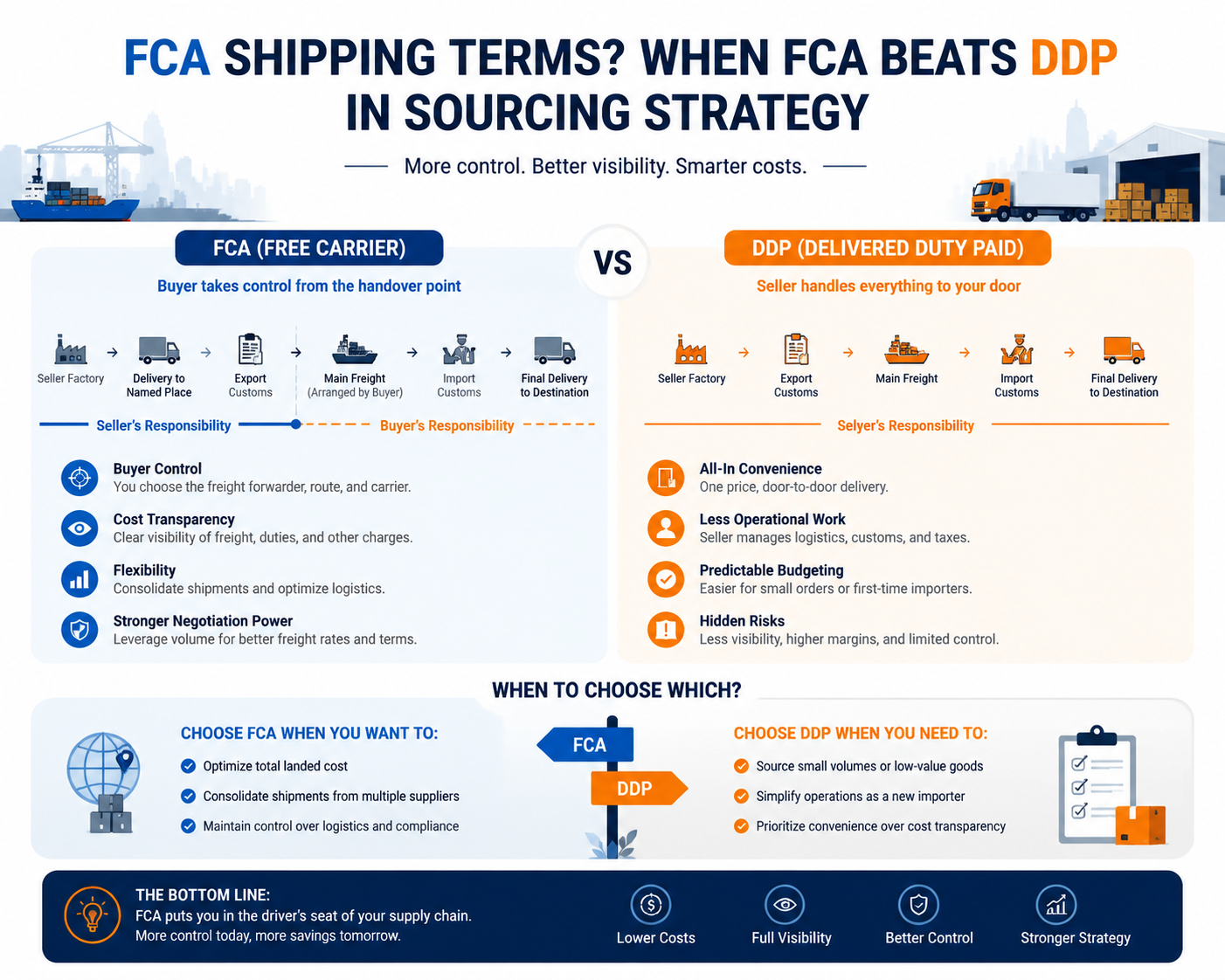
13. Delivery Terms: EXW, FOB, or CIF Cost Impact
Who pays inland trucking to the Chinese port
The selection among EXW, FOB, and CIF incoterms fundamentally determines the allocation of logistics costs along the supply chain, with the inland trucking expense from the factory gate to the Chinese seaport representing a significant variable that can vary dramatically based upon the manufacturer's geographic location . EXW terms place the full responsibility for arranging and paying for inland transportation upon the buyer, compelling the procurement engineer to either manage this logistics component directly or engage a freight forwarder who can provide competitive trucking rates through volume leverage. FOB terms incorporate the inland trucking and port handling charges into the supplier's quotation, offering convenience but potentially disguising the actual transport cost and limiting the buyer's ability to select preferred logistics providers .
Port handling and documentation under each Incoterm
The port handling charges, including terminal handling fees, documentation preparation, customs clearance at origin, and loading onto the vessel, are distributed differently under each incoterm, with FOB placing these responsibilities on the supplier while EXW leaves them entirely to the buyer's account. The CIF incoterm extends the supplier's responsibility to include ocean freight and marine insurance, providing a fully delivered cost quotation that simplifies budgeting but reduces buyer control over carrier selection and insurance placement. Procurement engineers must calculate the delivered cost under each incoterm scenario, accounting not only for the quoted price differences but also for the procurement organization's internal capacity to manage the associated logistics activities efficiently.
Hidden fees when switching between FOB and CIF
The transition from FOB to CIF pricing can introduce hidden fees that procurement professionals may not immediately recognize, as suppliers embedding freight and insurance costs often incorporate premiums for their own profit margins, currency risk buffers, and general administrative overhead that exceed the equivalent costs available through independent freight forwarders. The supplier's freight quotation may include discretionary service charges, documentation fees, and currency conversion spreads that remain invisible within a bundled price structure, potentially inflating the total cost by percentages that undermine the apparent simplicity of the CIF arrangement. The diligent procurement engineer will request a detailed reconciliation of the difference between FOB and CIF pricing, comparing the implied freight and insurance charges against market rates to determine whether the supplier's quotation represents fair value or opportunistic margin enhancement.
14. Currency Fluctuation and Payment Term Surcharges
USD-RMB exchange rate buffers added by suppliers
The volatility inherent in the USD-RMB exchange rate induces suppliers to incorporate buffer margins within their quoted prices, protecting against adverse currency movements that could erode their profitability during the interval between quotation and payment settlement. These buffers, typically ranging from two to five percent of the invoice value, effectively constitute an insurance premium that the buyer pays for the supplier's assumption of currency risk, yet many procurement professionals accept this buffer without recognizing its negotiable character. The procurement engineer should propose alternative currency risk-sharing arrangements, such as mid-point exchange rates with adjustment clauses that trigger only when currency movements exceed a specified threshold, potentially reducing the buffer while maintaining fair risk allocation.
Discounts for TT vs LC and early payment windows
The selection among payment instruments—telegraphic transfer, letter of credit, or documentary collection—introduces significant cost differentials that procurement professionals must incorporate into their total cost calculations, as banks impose substantial fees for letter of credit issuance and confirmation that can reach several hundred dollars per transaction. Suppliers frequently offer discounts for telegraphic transfer payments, reflecting the reduced administrative burden and immediate availability of funds, with early payment discounts of one to three percent available for remittances made within ten days of invoice date. The procurement engineer should conduct a discounted cash flow analysis that compares the cost of various payment options against the organization's cost of capital, selecting the instrument that optimizes the balance between transaction cost and cash flow management.
How payment terms affect final invoiced amount
The negotiated payment terms—whether 30 days from invoice date, 60 days, or 90 days—directly influence the supplier's working capital requirements and, consequently, the pricing they offer, as extended terms necessitate higher margins to compensate for the cost of carrying the associated accounts receivable. Suppliers may embed a de facto interest charge within their pricing for buyers who demand extended payment periods, a cost that can be difficult to identify within a bundled quotation but can be approximated by comparing quotations from suppliers with varying term flexibility. Procurement professionals should request separate quotations at different payment term scenarios, enabling the organization to select the combination of price and payment terms that minimizes total financing cost when considering both supplier pricing and the buyer's own working capital constraints.
15. Bulk Discount Structures and Volume Rebates
Tiered pricing at 100, 500, and 1000+ units
The implementation of tiered pricing structures that reduce per-unit costs at specified volume thresholds constitutes the most transparent mechanism for volume-based discounting, enabling procurement professionals to plan their order quantities with explicit knowledge of the pricing impact of their volume decisions. A typical tier structure might offer a five percent discount at 100 units, ten percent at 500 units, and fifteen percent at 1000 units, with the marginal cost reduction between tiers offering insight into the supplier's fixed-cost recovery and their willingness to incentivize larger commitments. Procurement engineers must evaluate these tier thresholds against their own consumption patterns, determining whether the purchase of additional units to reach a higher tier is justified by the per-unit savings, the carrying cost of inventory, and the risk associated with extended demand forecasts.
Annual rebate agreements for consistent reorders
The establishment of annual rebate agreements, wherein the supplier returns a percentage of total annual spend to the buyer at year-end, offers an alternative discount mechanism that rewards consistent purchasing without requiring the buyer to commit to minimum order quantities at each transaction. These rebates, typically ranging from two to five percent of annual crate expenditures, provide a powerful incentive for supplier loyalty while preserving buyer flexibility to adjust order quantities based on evolving demand conditions. Procurement professionals should negotiate these rebate agreements with clear terms regarding the calculation basis, payment timing, and any offset rights in the event of supply quality or delivery failures that might warrant reduction of the rebate amount.
Combining crate and product orders for better rates
The aggregation of crate purchases with the primary product procurement from the same manufacturer presents an opportunity for enhanced volume discounting, as the supplier can allocate overhead across a broader revenue base and potentially offer combined pricing that reflects economies not achievable through separate purchasing arrangements. This consolidation approach requires the procurement engineer to negotiate package pricing that explicitly references both the product and packaging components, ensuring that the discount allocation is transparent and that the crate pricing remains competitive relative to the packaging market. The supplier's willingness to offer such combined discounts varies with their organizational structure and internal transfer pricing policies, necessitating procurement professionals to understand the supplier's cost centers and decision-making authority to structure proposals that align with their operational reality.
16. Supplier Location and Regional Cost Variations
Coastal factory vs inland factory freight differentials
The geographic location of a manufacturing facility relative to the nearest export port introduces a substantial cost differential that procurement professionals must incorporate into their supplier selection criteria, as inland factories face trucking distances of hundreds of kilometers that add significant freight expense to each container dispatched. A coastal factory may incur inland trucking costs of 200 to 300 dollars per container, while an inland facility situated 500 kilometers from port might face charges of 800 dollars or more, a differential that can amount to ten dollars per crate for high-density container loads. The procurement engineer should calculate the total delivered cost including these inland transportation components, rather than comparing ex-factory prices in isolation, ensuring that the ultimate selection reflects the fully landed cost rather than merely the manufacturer's base price.
Provincial raw material availability and pricing
The availability and cost of raw lumber, plywood, and metal components vary significantly across Chinese provinces, reflecting local forestry resources, industrial infrastructure, and transportation networks that influence the input costs that suppliers pass through to their customers. Suppliers in timber-rich provinces such as Fujian or Guangxi may enjoy lumber cost advantages of fifteen to twenty-five percent compared to manufacturers in industrialized provinces where timber must be imported from other regions. Procurement professionals should map their supplier's location against raw material availability, using this information to inform negotiation strategies and to assess whether the supplier's pricing reflects their geographic cost advantage or opportunity for margin expansion.
Labor cost differences across manufacturing hubs
The regional variation in manufacturing labor costs, driven by local minimum wage regulations, labor availability, and the cost of living, introduces another geographic dimension to crate pricing that procurement engineers must evaluate when comparing supplier quotations from different regions. Coastal manufacturing hubs such as Guangdong and Zhejiang typically command higher labor rates than inland provinces such as Anhui or Jiangxi, differences that can translate into per-crate cost variations of five to fifteen percent for labor-intensive crate designs. While lower labor costs may suggest a pricing advantage for inland suppliers, procurement professionals must also consider productivity differences, quality control capabilities, and logistics accessibility that can offset wage differentials and create a more complex cost equation than simple wage comparisons imply.
17. Quality Control Rejects and Replacement Liability
Who bears cost for damaged crates upon arrival
The allocation of financial responsibility for crates that sustain damage during transit, or that fail to provide adequate protection resulting in product damage, constitutes a critical liability determination that procurement professionals must address explicitly within their supplier agreements. The question of whether damage responsibility lies with the supplier, the freight forwarder, the marine insurer, or the buyer themselves depends upon the incoterm selection, the specific contract terms, and the demonstrated cause of the damage, with disputes often arising when responsibility allocation remains ambiguous. Procurement engineers should incorporate clear damage liability clauses within their purchasing contracts, specifying the conditions under which suppliers must provide replacement crates, absorb the cost of rework, or contribute to the cost of product damage claims.
Rework charges for non-conforming dimensions
The discovery of dimensional non-conformance during quality inspection at the destination port introduces the potential for rework charges that can significantly elevate the total cost of a crate order, particularly when the non-conformance requires extensive modification to achieve fit within the intended shipping container. Suppliers may attempt to pass rework costs to the buyer, arguing that the dimensional deviations were within acceptable tolerances or that the buyer provided inaccurate initial specifications, making the burden of proof a critical element of contract negotiation. Procurement professionals should establish clear dimensional tolerances within their specifications, coupled with inspection protocols that detect non-conformance prior to shipment, thereby avoiding the disruptive and expensive scenario of rework at destination.
Warranty periods and free replacement clauses
The inclusion of warranty provisions that guarantee crate performance for a specified period following delivery offers procurement professionals a measure of protection against latent defects that might not be apparent during routine receiving inspection. A standard warranty might cover defects in material or workmanship for a period of 90 days from delivery, requiring the supplier to provide free replacement crates or refund the purchase price if defects manifest within that window. Procurement engineers should negotiate warranty terms that align with their typical inventory consumption cycle, ensuring that the warranty period extends sufficiently to identify defects that could affect products stored for extended periods prior to distribution.
18. Total Cost of Ownership Over the Crate Lifecycle
One-way vs reusable crate amortization over 5 trips
The total cost of ownership comparison between single-use and reusable crate systems hinges critically upon the number of trips achieved by the reusable option, with five trips typically representing the breakeven point beyond which the reusable system begins to deliver cumulative savings. A single-use crate costing 50 dollars that protects a product through one journey must be replaced for each shipment, while a reusable crate costing 150 dollars that survives five trips effectively costs 30 dollars per journey before considering return logistics, maintenance, and repair expenses. Procurement engineers should conduct sensitivity analyses across various trip counts, evaluating the financial impact of conservative versus optimistic usage assumptions and incorporating the potential for reusable crate damage that reduces the expected service life.
Storage space costs for knockdown vs rigid designs
The volumetric efficiency of crate storage during both empty and filled states introduces a cost dimension that procurement professionals frequently overlook, as the space consumed by rigid, non-collapsible crates in warehouses and return logistics channels represents real estate that carries significant carrying cost. Knockdown designs that disassemble into flat panels offer substantial storage density advantages, reducing the warehouse footprint required for empty crate storage by sixty to eighty percent and enabling more efficient utilization of return container capacity. The procurement engineer should quantify the storage cost differential between rigid and knockdown designs, incorporating these figures into the total cost of ownership calculation to ensure that the apparent price advantage of one design is not eroded by hidden storage expenses.
Disposal or recycling fees at the destination country
The end-of-life disposal or recycling of wooden crates introduces cost obligations that vary dramatically by destination country, with environmental regulations in the European Union requiring documented recycling or energy recovery processes that carry associated fees. Some countries impose landfill diversion taxes or require the use of certified waste disposal contractors, costs that procurement professionals should anticipate and incorporate into their sourcing decisions. The procurement engineer should investigate destination-country disposal requirements prior to selecting crate materials, as certain jurisdictions may impose premium costs for the disposal of treated or painted wood that can affect the total cost of ownership and influence material selection decisions.
19. Benchmarking Your Quote Against Industry Averages
Price per cubic meter reference ranges for China exports
The establishment of reference price ranges for shipping crates exported from China, expressed as cost per cubic meter of crated volume, provides procurement professionals with a valuable benchmarking tool that enables rapid identification of quotations that deviate from market norms. Current industry reference ranges typically fall between 45 and 75 dollars per cubic meter for standard single-use crates, with custom designs, premium materials, or value-added features justifying movement toward the upper end of this range. The procurement engineer should obtain multiple quotations from diverse suppliers to establish a proprietary benchmark set that reflects their specific product characteristics, shipment destinations, and quality requirements, enabling more nuanced comparisons than generic industry averages can provide.
How to request comparable quotes from 3-5 suppliers
The procurement professional's ability to secure genuinely comparable quotations across multiple suppliers hinges upon the development of a comprehensive request for quotation that specifies every material, dimension, process, and certification requirement with sufficient detail to eliminate subjective interpretation. The RFQ should include technical drawings, material specifications with grade designations, assembly drawings with fastener types and spacing, and complete certification requirements, ensuring that each supplier responds to an identical specification set. Procurement engineers should request quotations on a consistent incoterm basis, typically FOB Chinese port, with explicit instructions regarding the separate identification of material, labor, and administrative components that facilitate detailed benchmarking.
Red flags when a quote deviates more than 15%
A quotation that deviates by more than fifteen percent from the average of comparable quotes should trigger immediate investigation, as such variance typically indicates either exceptional quality or cost advantages, specification misunderstandings, or opportunistic pricing that warrants closer examination. For quotations below the fifteen percent threshold, procurement professionals should verify that the supplier has not omitted essential line items, reduced material grades, or shortened warranty periods to achieve their pricing advantage, potentially creating hidden costs that negate the apparent benefit. For quotations above the threshold, the buyer should request detailed justification for the premium pricing, focusing on the material quality, manufacturing processes, or value-added services that distinguish the offering and justify the cost differential.
20. Final Checklist Before Approving Any Crate Quote
Verify all line items match your RFQ specifications
The final review of a crate quotation demands meticulous cross-referencing against the original RFQ specifications, ensuring that each line item corresponds precisely to the materials, dimensions, processes, and certifications requested in the initial solicitation. The procurement engineer should construct a comparison matrix that lists each RFQ requirement alongside the corresponding quote line, highlighting discrepancies that may indicate either supplier error or intentional specification downgrades that could compromise crate performance. This verification step serves as the final defense against the insidious creep of specification deviations that accumulate into significant cost or quality impacts across large order volumes.
Confirm certifications and test reports are included
The procurement professional must verify that all required certifications—heat treatment certificates, third-party inspection reports, material test certificates, and compliance declarations—are explicitly included within the quotation and scheduled for delivery with the shipment. A quotation that omits certification line items may appear competitively priced, yet the subsequent cost of procuring these documents independently or the risk of regulatory non-compliance can eliminate any apparent cost advantage. Procurement engineers should incorporate certification verification into their approval workflow, requiring suppliers to provide sample documentation prior to order placement to confirm that their processes and documentation practices conform to regulatory requirements.
Clarify revision change fees for future design updates
The inevitability of future design modifications to the protected product necessitates advance clarification of the cost structure for crate design revisions, as suppliers often incorporate substantial charges for changes that occur after the initial design phase. The procurement professional should negotiate explicit pricing schedules for design changes, distinguishing between minor modifications that require only drawing updates and major revisions that demand new tooling or substantial engineering analysis. This forward-looking approach ensures that subsequent product design iterations do not generate unexpected crate costs that undermine the viability of evolving product specifications, establishing a collaborative framework that accommodates innovation without fiscal surprises.