Table of Contents
ARO Meaning in Shipping and Payment Terms Decoded
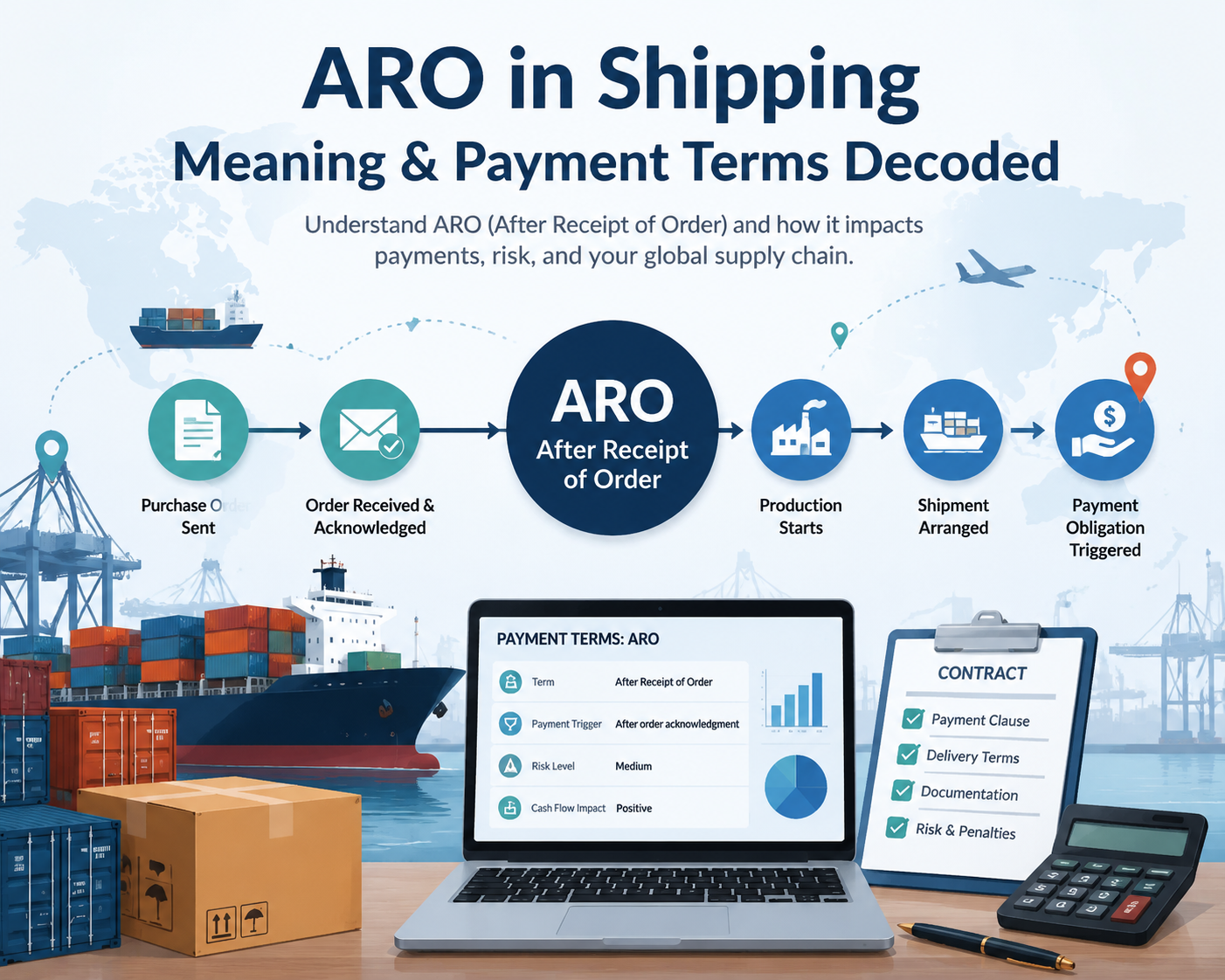
ARO in global logistics and procurement frameworks represents a critical timing and payment trigger mechanism that influences how international trade transactions are executed, financed, and controlled across complex supply chains. Key references for global trade standards can be explored via Trade Finance Overview, Incoterms Reference, World Trade Organization, and U.S. International Trade Administration.
1. Introduction: Why ARO Matters in Global Shipping
ARO definition in international logistics context
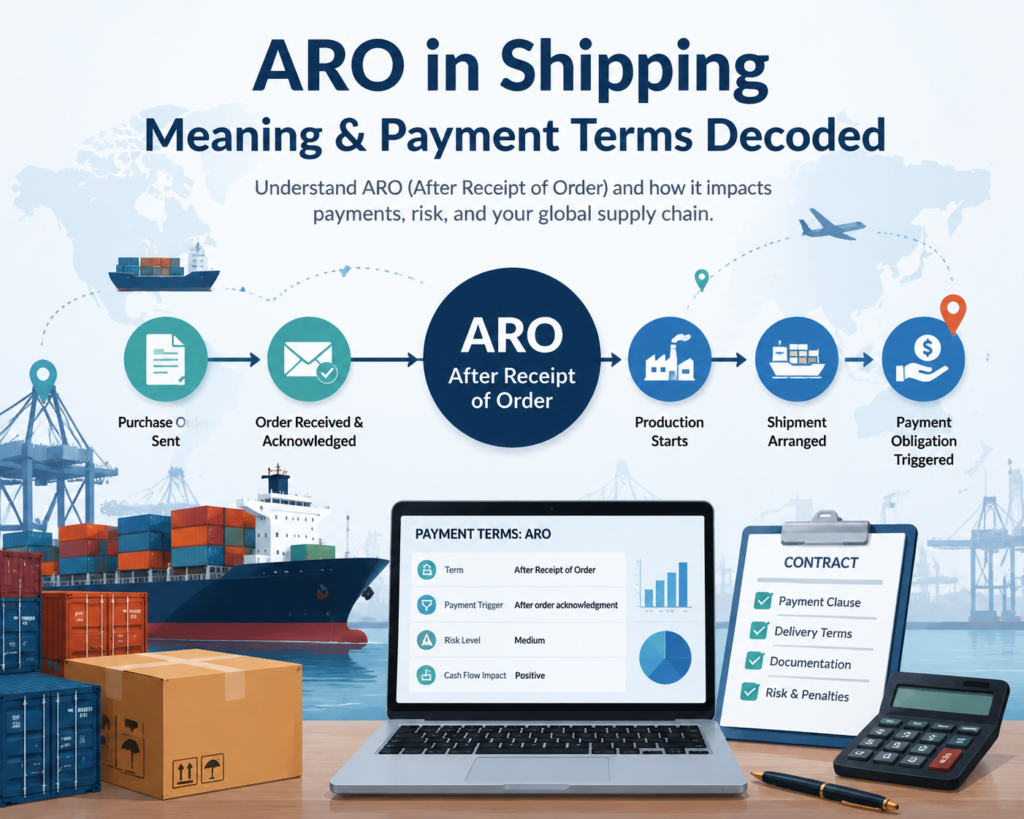
ARO in shipping contracts typically stands for “After Receipt of Order,” functioning as a temporal activation point that determines when commercial obligations begin. It serves as a structured timestamp in procurement workflows, ensuring that operational and financial cycles are aligned with order acknowledgment rather than vague assumptions. In global logistics, this precision prevents timing ambiguity that often disrupts cross-border execution.
Why procurement teams care about ARO terms
Procurement teams treat ARO as a financial control lever that directly influences cash flow timing and supplier accountability. When properly applied, it synchronizes sourcing activities with production cycles, reducing unnecessary capital lock-up. In high-volume sourcing environments, overlooking ARO is equivalent to sailing blind in volatile freight conditions.
Connection between ARO and payment risk control
ARO plays a pivotal role in mitigating payment risk by clearly defining when financial obligations are activated. This reduces disputes caused by mismatched interpretations of delivery and invoicing timelines. For purchase engineers, this clarity becomes a structural safeguard against premature or disputed payments.
2. What Does ARO Mean in Shipping Contracts
Full expansion of ARO in trade agreements
ARO refers to “After Receipt of Order,” marking the formal acknowledgment of a purchase order by the supplier. This transforms a commercial intent into an actionable operational trigger. It sets the foundation for production planning and financial execution.
Common usage in freight forwarding documents
In freight forwarding documentation, ARO is frequently used to define when service execution timelines commence. It appears in booking confirmations and rate agreements, signaling operational readiness. Forwarders use it as a coordination anchor between production and logistics scheduling.
Differences between ARO and similar payment terms
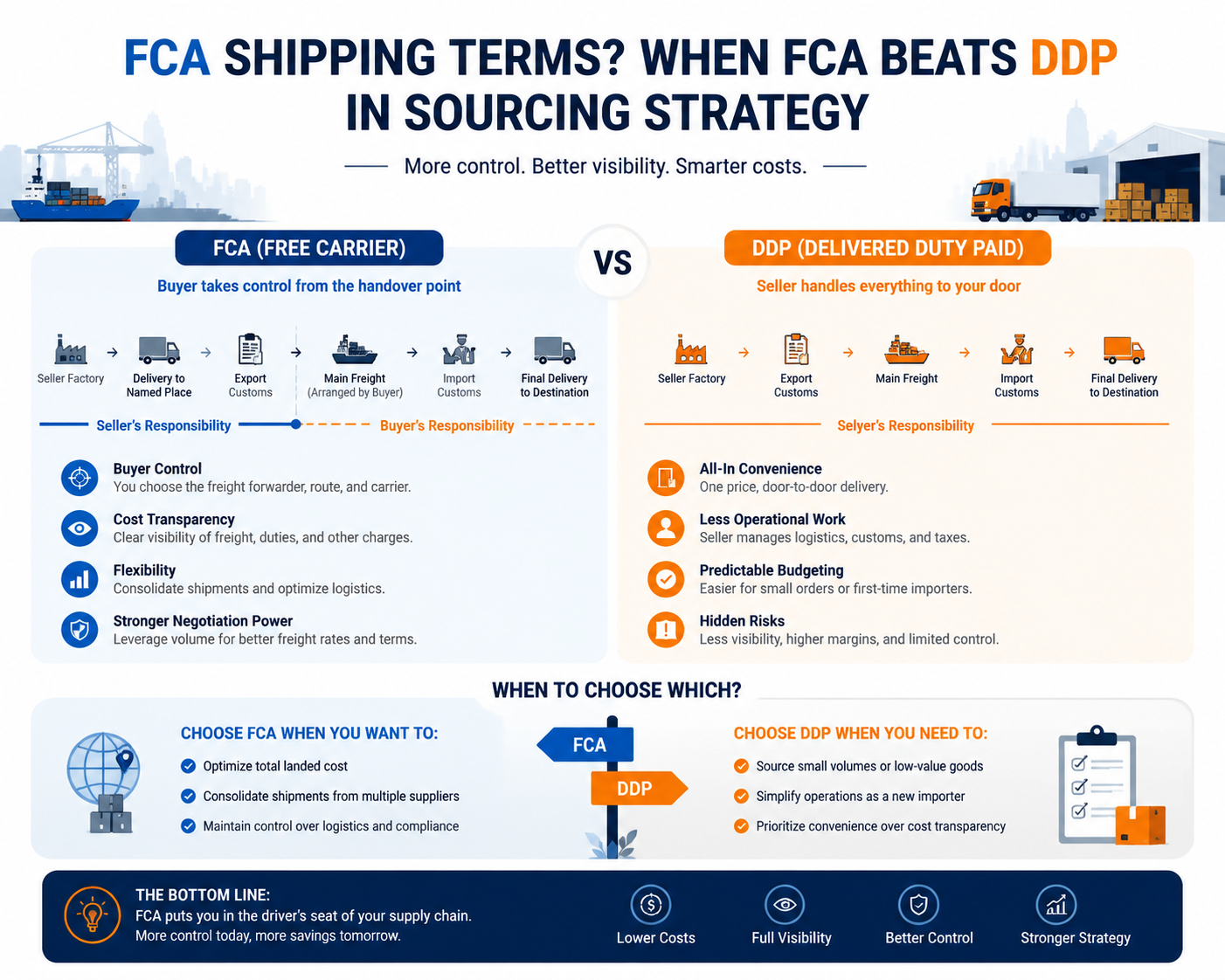
Unlike Incoterms such as FOB or CIF, ARO does not define risk transfer or logistics responsibility. Instead, it governs timing of financial obligations, making it a purely contractual temporal marker. This distinction is essential for avoiding misinterpretation in global trade contracts.
3. ARO vs Other Payment Terms in Logistics
ARO vs COD in international shipping
Cash on Delivery (COD) delays payment until goods are physically delivered, while ARO triggers obligations immediately after order acknowledgment. These two mechanisms represent opposite ends of the payment timing spectrum. Procurement teams often choose based on risk appetite and supplier reliability.
ARO vs advance payment structures
Advance payment requires capital outflow before production begins, increasing buyer exposure. ARO provides a more balanced structure by activating payment obligations after order confirmation rather than upfront transfer. This makes it more favorable in large-scale sourcing operations.
ARO vs net terms in supplier agreements
Net terms define payment windows after invoicing, while ARO defines the starting point before invoicing occurs. This positions ARO earlier in the financial lifecycle, influencing procurement planning more than accounting cycles. It creates a foundational timing layer beneath standard credit terms.
4. How ARO Impacts Procurement Decisions
Supplier selection under ARO conditions
Suppliers capable of handling precise ARO execution are often preferred in global sourcing strategies. Order acknowledgment speed and reliability become key selection criteria. This reflects operational maturity and responsiveness.
Budget planning implications for buyers
ARO introduces a forward-shifted financial obligation model that must be integrated into procurement budgeting systems. It affects when liabilities are recognized in cash flow forecasts. This requires more granular financial planning discipline.
Risk exposure during sourcing cycles
Improper handling of ARO timing can expose buyers to premature payment obligations or delayed production cycles. These mismatches can cascade into inventory shortages. Effective control of ARO reduces systemic procurement risk.
5. ARO in Freight Forwarding Operations
Role of freight forwarders in ARO transactions
Freight forwarders act as execution coordinators ensuring ARO timing aligns with logistics scheduling. They bridge communication gaps between suppliers and buyers. Their coordination role is critical in global shipping efficiency.
Documentation flow under ARO arrangements
Documentation under ARO requires synchronized purchase orders, booking confirmations, and shipping instructions. Any delay can distort contractual timelines. This creates a tightly controlled documentation ecosystem.
Operational checkpoints tied to ARO payments
Key checkpoints include order confirmation, production initiation, cargo readiness, and booking finalization. These stages are indirectly influenced by ARO activation. They function as operational gates in logistics execution.
6. Payment Timing Under ARO Terms
When payment obligation is triggered
Payment obligation begins immediately upon supplier acknowledgment of the purchase order. This can occur digitally or through formal documentation. The timing establishes the financial baseline of the transaction.
Alignment with shipment milestones
ARO must be aligned with production and shipment milestones to avoid financial mismatch. Misalignment can lead to early payment before goods are ready. This creates liquidity pressure on procurement teams.
Impact on cash flow forecasting
ARO serves as a predictive anchor in cash flow models for procurement finance teams. It shifts financial planning earlier in the cycle. This improves forecasting accuracy when properly integrated.
7. Risk Factors in ARO Payment Structures
Supplier non-performance risk
One major risk is supplier failure after order acknowledgment, leaving payment exposure unbalanced. This creates vulnerability in international procurement cycles. Strong supplier vetting is essential.
Shipment delay exposure
Delays in production or logistics execution can amplify financial strain under ARO terms. Even minor disruptions can escalate into operational bottlenecks. Time sensitivity becomes a critical factor.
Financial settlement disputes
Disputes often arise due to differing interpretations of ARO activation timing. These conflicts can delay payments or shipments. Clear contractual definitions reduce such risks significantly.
8. ARO and Incoterms Relationship
Interaction between ARO and FOB terms
FOB defines risk transfer at shipment point, while ARO defines payment initiation timing. These operate independently but must be aligned. Misalignment creates contractual inefficiencies.
ARO under CIF and CFR structures
Under CIF and CFR terms, logistics costs are embedded, but ARO still governs payment timing. This creates layered contractual complexity. Procurement teams must manage both dimensions carefully.
Misalignment risks between Incoterms and ARO
When ARO and Incoterms are misaligned, operational and financial expectations diverge. This can disrupt supply chain execution. Harmonization is essential for smooth global trade.
9. Contract Clauses Linked to ARO
Payment trigger clauses
These clauses define exact conditions under which ARO becomes enforceable. Precision is essential to avoid ambiguity. Even minor wording issues can create financial disputes.
Delivery confirmation requirements
Contracts often require formal acknowledgment proof before ARO activation. This ensures mutual understanding between parties. It strengthens contractual clarity.
Penalty and dispute clauses
Penalty clauses define consequences for non-compliance with ARO terms. Dispute resolution mechanisms ensure continuity of trade. These clauses protect both parties operationally.
10. ARO in Cross-Border Trade Compliance
Customs clearance implications
Although ARO does not directly affect customs, it influences documentation timing. Poor synchronization can delay clearance. This impacts overall logistics flow.
Regulatory documentation alignment
ARO timing must align with export-import documentation cycles. This ensures smoother regulatory processing. It reduces inspection delays.
Country-specific considerations
Different jurisdictions interpret trade documentation differently. This affects ARO execution practices. Local compliance knowledge is essential.
11. ARO and Supply Chain Cash Flow Management
Working capital optimization strategies
ARO helps optimize working capital by structuring payment timing more predictably. This improves financial efficiency. It reduces unnecessary capital lock-up.
Payment scheduling for procurement teams
Structured ARO scheduling allows better control of financial outflows. It enhances predictability in procurement operations. This supports stable cash planning.
Impact on inventory financing
Inventory financing is often adjusted based on ARO timing. Early obligations may require external financing. This adds financial structuring complexity.
12. Common Misunderstandings About ARO
Confusion with delivery-based terms
Many mistakenly associate ARO with delivery milestones rather than order acknowledgment. This leads to misinterpretation. Clear education is necessary.
Misinterpretation in supplier negotiations
Negotiation errors often occur when ARO is misunderstood as flexible. This creates contractual friction. Proper definition avoids confusion.
Overlooked contract details
Small details in ARO clauses are often ignored but highly impactful. These oversights can affect financial outcomes. Attention to detail is crucial.
13. How Procurement Teams Should Negotiate ARO
Structuring favorable payment milestones
Negotiating ARO requires aligning payment milestones with operational progress. This reduces financial strain. It ensures realistic contract execution.
Leveraging volume for better terms
Higher order volumes provide leverage in negotiating ARO conditions. Suppliers often concede flexibility at scale. This strengthens buyer position.
Reducing financial exposure in contracts
Procurement teams should structure contracts to minimize early financial exposure. Conditional triggers help achieve this. It improves risk balance.
14. ARO Risk Mitigation Strategies
Using trade insurance solutions
Trade insurance protects against supplier default risks under ARO structures. It reduces financial vulnerability. It is widely used in global trade.
Implementing escrow or third-party payment systems
Escrow systems ensure funds are released only upon agreed conditions. This adds transactional security. It builds trust between parties.
Supplier performance verification methods
Regular audits and tracking ensure compliance with ARO obligations. This improves reliability. It strengthens supplier relationships.
15. Real-World ARO Shipping Scenarios
Manufacturing supply chain example
In manufacturing, ARO triggers procurement of raw materials and production scheduling. Timing precision is essential. Delays can disrupt entire workflows.
Retail import procurement case
Retailers use ARO to align inventory with seasonal demand cycles. This improves supply accuracy. It enhances market responsiveness.
High-value cargo transaction example
For high-value shipments, ARO defines early financial commitment thresholds. This reduces opportunistic risk. It ensures transactional discipline.
16. ARO in Chinese Freight Forwarding Practice
How Chinese exporters apply ARO terms
Chinese exporters commonly embed ARO in purchase confirmations and invoices. This standardizes trade expectations. It streamlines cross-border operations.
Role of logistics providers in execution
Logistics providers coordinate ARO timing with production and shipping schedules. They ensure operational alignment. Their role is execution-critical.
Common industry practices in China export trade
Hybrid models combining ARO with deposits are widely used in China. This balances risk between buyers and suppliers. It reflects practical trade adaptation.
17. Digitalization and ARO Payment Tracking
Use of ERP systems in ARO management
ERP systems integrate ARO tracking into procurement workflows. This enhances transparency. It improves financial control.
Blockchain and payment transparency trends
Blockchain enables immutable recording of ARO transactions. This reduces disputes. It strengthens trust in global trade.
Real-time shipment-payment synchronization
Modern systems synchronize payments with logistics milestones in real time. This reduces manual reconciliation. It improves efficiency.
18. Future Trends of ARO in Global Logistics
Shift toward automated payment terms
Automation is transforming ARO into system-driven payment triggers. Smart contracts are increasingly used. This reduces human error.
Increased buyer protection mechanisms
Future systems will enhance buyer protection through conditional release mechanisms. This balances trade risk. It improves transaction security.
Evolution of procurement contract structures
Procurement contracts are evolving toward data-driven frameworks. ARO will become more integrated into digital ecosystems. This reflects modernization of global supply chains.