Table of Contents
FCA vs DDP in Global Trade
1. Understanding FCA Shipping Terms in Global Trade
FCA definition in Incoterms framework
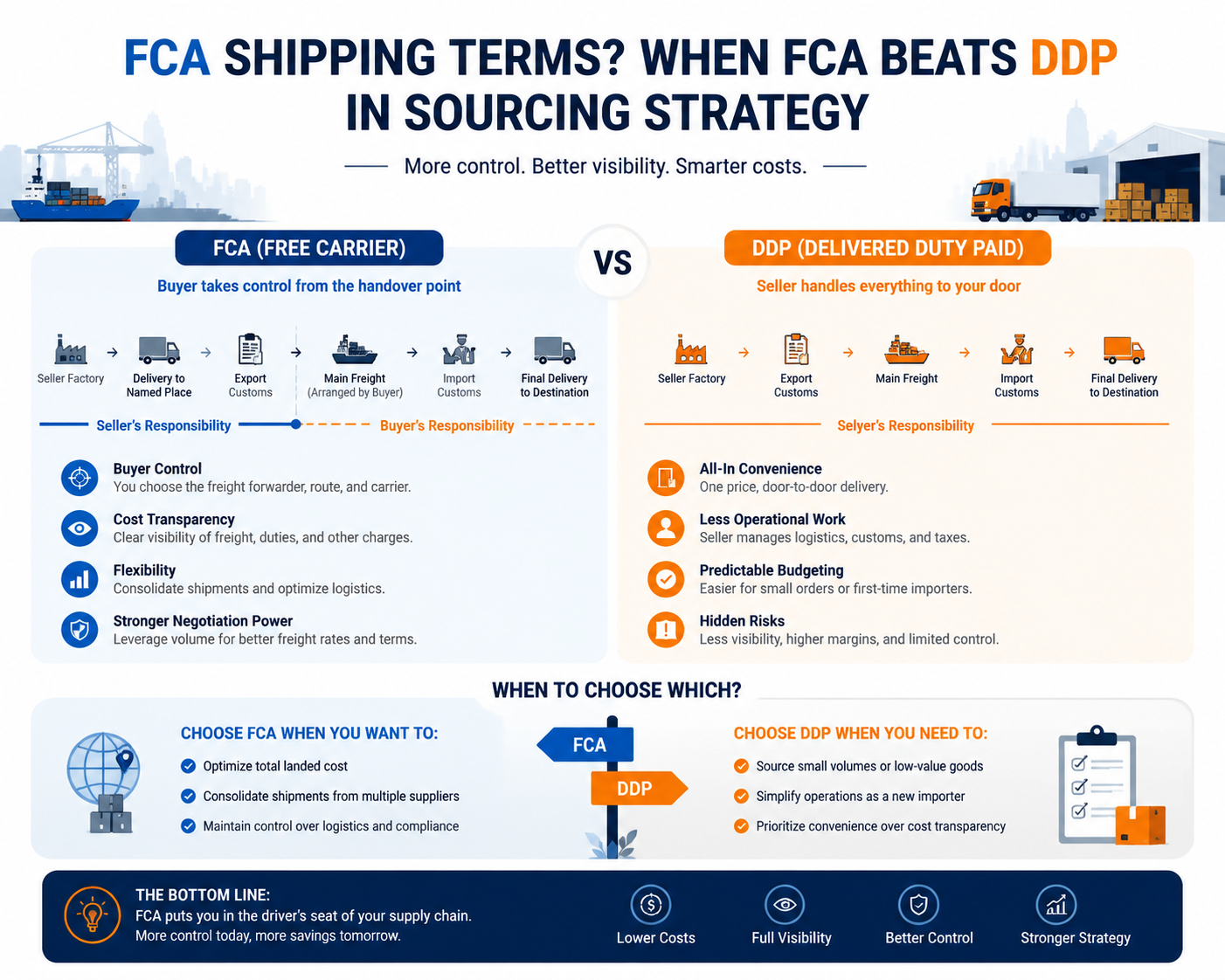
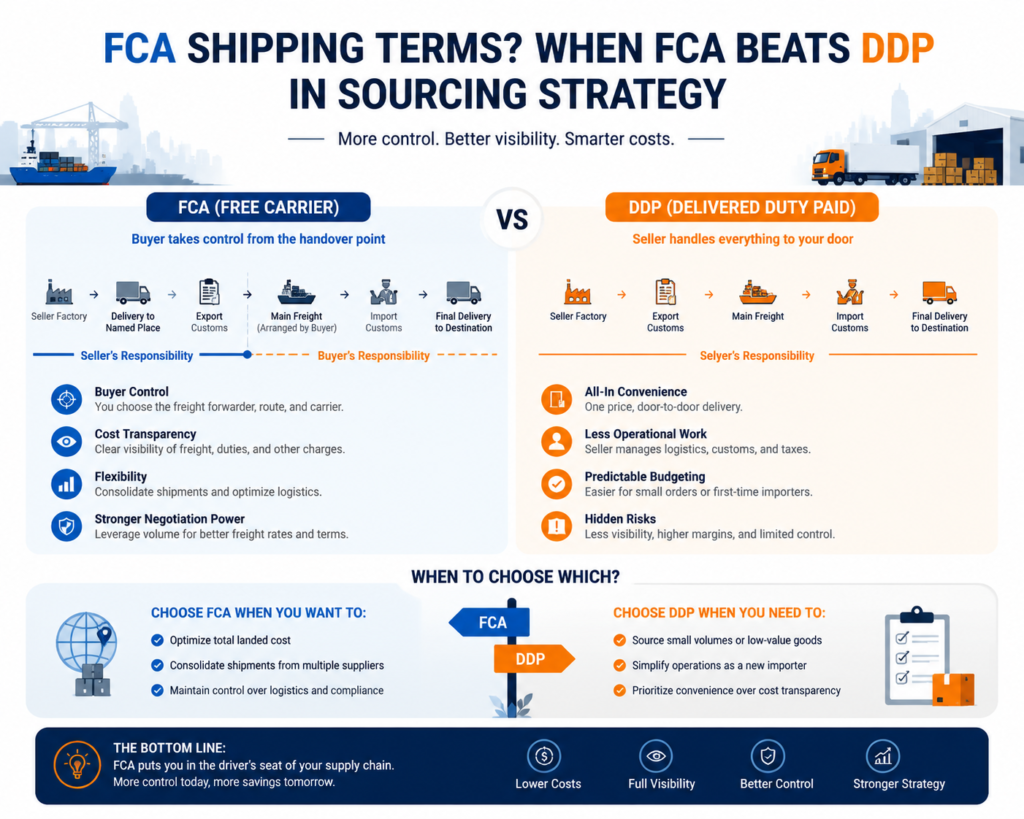
FCA (Free Carrier) sits within the Incoterms 2020 structure as a delivery term where the seller fulfills its obligation once goods are handed over to a carrier or another party nominated by the buyer at a specified location. In practical procurement language, it is essentially a “handover at gate” arrangement where ownership of logistics execution shifts earlier than many assume. This term is widely used in cross-border sourcing because it creates a clean separation between production responsibility and international freight management.
Seller and buyer responsibility split
Under FCA, the seller is responsible for export packaging, internal transport to the agreed delivery point, and export customs clearance, while the buyer takes control once the goods are handed to the nominated carrier. This division creates a sharp operational boundary that procurement teams often prefer because it eliminates ambiguity in freight cost allocation. However, it also means the buyer must be ready to manage freight booking, insurance, and downstream logistics without relying on the supplier’s coordination.
Common FCA delivery points in China exports
In China export operations, FCA delivery points are often defined as factory gate, bonded warehouse, or port terminal depending on the agreed structure. Factory FCA is particularly common when working with manufacturers that do not want to engage in freight coordination beyond export clearance. Port FCA, on the other hand, is frequently used by experienced procurement teams that already have established freight forwarder networks in major hubs like Shenzhen, Ningbo, or Shanghai.
2. What FCA Means for Brand Procurement Teams
Control over main freight arrangement
For procurement engineers, FCA fundamentally shifts control of international freight into their own hands, allowing direct negotiation with carriers and forwarders. This enables better benchmarking of freight rates, transit time optimization, and carrier performance comparison. In real sourcing environments, this often translates into more leverage over landed cost engineering, especially when shipping volumes are significant.
Impact on sourcing flexibility
FCA introduces a higher degree of flexibility because buyers are no longer locked into supplier-selected logistics channels. Procurement teams can consolidate shipments across multiple suppliers into one optimized freight route, which reduces fragmentation and improves economies of scale. This flexibility also supports multi-origin sourcing strategies, a common tactic among global brands seeking resilience in supply chains.
Supplier responsibility limitations
At the same time, FCA deliberately limits supplier responsibility once goods are handed over, which can reduce coordination friction but also reduce supplier accountability. If delays or freight inefficiencies occur after handover, suppliers are typically shielded from responsibility. This is where procurement teams must be sharp, because the “last mile out of factory control” becomes their operational burden.
3. Overview of DDP Shipping Terms for Comparison
Full cost responsibility structure
DDP (Delivered Duty Paid) represents the opposite end of the spectrum, where the seller assumes full responsibility for delivering goods to the buyer’s door, including duties and taxes. On paper, this appears to be a “fully managed” solution that simplifies procurement decisions. In reality, it often embeds all logistics risks and cost buffers into a single quoted price.
Door-to-door delivery expectations
Under DDP, suppliers are expected to handle every step from origin pickup to final delivery, including international freight, customs clearance, and last-mile logistics. For procurement teams, this creates a seemingly frictionless purchasing experience, especially for non-logistics-heavy organizations. However, the lack of transparency in intermediate cost components can make it difficult to validate efficiency.
Customs and tax handling under DDP
One of the defining features of DDP is that import duties, VAT, and customs compliance are managed by the seller or their agent. While this reduces administrative workload for the buyer, it also introduces dependency on the supplier’s compliance capability in destination countries. Any misclassification or under-declaration risk ultimately sits within the supplier-controlled logistics chain, which can become a hidden liability.
4. Key Structural Differences Between FCA and DDP
Risk transfer timing differences
The most critical distinction lies in when risk transfers from seller to buyer. FCA transfers risk at the moment goods are handed to the carrier, while DDP delays this transfer until final delivery. This difference alone reshapes how procurement teams evaluate exposure across the supply chain. In FCA, risk is front-loaded; in DDP, it is absorbed upstream.
Cost ownership breakdown
FCA separates manufacturing cost from logistics cost in a transparent way, allowing procurement teams to independently benchmark freight and duty expenses. DDP bundles all costs into a single figure, which may simplify quoting but obscures cost structure visibility. This bundled model can lead to inefficiencies that are difficult to detect without deep audit capabilities.
Operational control comparison
FCA empowers buyers to control logistics execution, whereas DDP centralizes control with the supplier or their agent. From a procurement engineering perspective, FCA is like “plugging into the global logistics grid,” while DDP is more like outsourcing the entire pipeline. The trade-off is clear: control versus convenience.
5. Why Procurement Strategy Depends on Incoterms Choice
Supply chain visibility priorities
Procurement strategy today is heavily driven by visibility requirements across global supply chains. FCA enables granular tracking of freight costs, carrier performance, and routing decisions. This level of transparency is critical for brands optimizing landed cost models across multiple SKUs and regions.
Cost predictability requirements
Some procurement organizations prioritize predictable all-in pricing, especially for low-margin retail products. In such cases, DDP can appear attractive because it stabilizes budgeting at the purchase order level. However, FCA allows more dynamic cost optimization through competitive freight sourcing, which can reduce long-term average landed costs.
Compliance and import control needs
Large brands often require strict compliance control at the import level, particularly in regulated markets. FCA allows internal compliance teams or appointed brokers to manage customs processes directly. This reduces dependency on supplier-side compliance maturity, which can vary significantly across factories.
6. Cost Transparency: FCA vs DDP Breakdown
Hidden cost risks in DDP quotes
DDP pricing often contains embedded buffers for risk, currency fluctuation, and customs uncertainty. These buffers are not always visible to procurement teams, which can result in inflated landed costs over time. In many sourcing audits, these hidden margins only become apparent when FCA comparisons are introduced.
Freight rate visibility under FCA
FCA provides clear separation of freight costs, enabling procurement teams to benchmark shipping rates independently. This transparency allows direct negotiation with freight forwarders and carriers. Over time, this leads to more competitive logistics pricing and improved cost discipline.
Customs duty and tax allocation clarity
Under FCA, customs duties and taxes are explicitly managed by the buyer, which enhances visibility and control. Procurement teams can optimize HS codes, duty recovery strategies, and import structuring. DDP, by contrast, hides these components inside a bundled price, limiting optimization opportunities.
7. Control Over Freight Forwarders and Logistics Partners
Buyer-selected forwarder advantages under FCA
FCA allows procurement teams to select freight forwarders based on performance, pricing, and service reliability. This creates a competitive ecosystem where logistics providers must continuously improve. In high-volume sourcing environments, this control becomes a strategic advantage rather than a tactical detail.
Supplier-controlled logistics under DDP
With DDP, suppliers typically choose their own logistics partners, which may prioritize cost minimization over service quality. This can lead to inconsistent carrier performance or longer transit times. Procurement teams often lose visibility into routing decisions and service-level optimization.
Negotiation leverage differences
FCA significantly strengthens buyer negotiation leverage because freight becomes a separable procurement category. In contrast, DDP consolidates negotiation power with the supplier, reducing the buyer’s ability to influence logistics efficiency. This difference often determines whether logistics becomes a cost center or a controllable variable.
8. Customs Clearance Responsibility Comparison
Import clearance under DDP structure
In DDP, customs clearance is handled by the seller or their appointed broker, which simplifies buyer operations. However, this also means the buyer has limited visibility into declaration accuracy and compliance strategy. Any regulatory issue can still indirectly affect the buyer’s supply chain continuity.
Buyer-managed customs under FCA
FCA places import clearance responsibility on the buyer, allowing direct control over customs procedures. Procurement teams can select experienced brokers and implement standardized import compliance processes. This is especially valuable in industries with strict regulatory oversight or complex product classifications.
Risk of documentation errors
When customs processes are split between parties, documentation consistency becomes critical. FCA reduces dependency on supplier documentation quality for import clearance, while DDP increases reliance on supplier accuracy. In practice, many customs disputes originate from misaligned documentation ownership.
9. Risk Management in International Procurement
Shipment delay responsibility allocation
Under FCA, delays after handover are typically outside supplier responsibility, placing operational risk on the buyer. This requires procurement teams to actively manage logistics timelines and buffer planning. DDP, in contrast, keeps delay accountability with the supplier until final delivery.
Damage and loss liability differences
Risk transfer under FCA occurs early, meaning damage after carrier handover is generally the buyer’s responsibility. Insurance strategy becomes critical in this model to protect shipment value. DDP shifts this liability to the supplier, but recovery may be slower and less transparent.
Insurance control strategies
FCA enables buyers to directly select cargo insurance providers and coverage levels. This allows more tailored risk management aligned with product value and shipping routes. In DDP, insurance is often embedded and may not fully align with procurement risk appetite.
10. When FCA Improves Supply Chain Efficiency
Multi-supplier consolidation scenarios
FCA is highly effective when procurement teams source from multiple suppliers in the same region. Shipments can be consolidated at origin, reducing per-unit freight costs. This is particularly relevant for brands optimizing global SKU distribution.
Regional distribution strategies
For companies operating regional distribution hubs, FCA allows centralized inbound logistics planning. This improves inventory allocation efficiency and reduces redundant shipping routes. The result is a more streamlined global distribution architecture.
Flexible routing optimization
FCA enables procurement teams to dynamically select shipping routes based on cost and speed. This flexibility supports seasonal demand fluctuations and capacity constraints. It also reduces dependency on supplier-defined logistics pathways.
11. Situations Where DDP Becomes a Better Option
Small-volume e-commerce sourcing
For low-volume shipments, DDP can simplify operations by removing logistics complexity. Small procurement teams may not have the scale to optimize freight independently. In such cases, convenience outweighs cost transparency.
New importers without compliance teams
Companies new to international sourcing often lack customs expertise. DDP provides an entry-level solution where suppliers manage regulatory processes. This reduces operational learning curves during early-stage sourcing.
Low-value standardized goods
For commoditized products with low unit value, logistics optimization may not justify operational overhead. DDP can streamline procurement cycles and reduce administrative workload. The trade-off is reduced cost visibility.
12. FCA Advantages for Large Brand Procurement Teams
Centralized logistics governance
Large procurement organizations benefit from FCA because it centralizes logistics governance internally. This supports standardized policies across regions and suppliers. It also improves auditability of logistics performance.
Global freight rate negotiation power
With FCA, brands can aggregate volume across suppliers to negotiate better freight rates. This creates economies of scale that are not possible under fragmented DDP arrangements. Over time, this significantly reduces total landed cost.
Standardized shipping procedures
FCA allows procurement teams to implement standardized shipping SOPs across global suppliers. This reduces operational variance and improves predictability. Standardization is a key driver of supply chain maturity.
13. Hidden Risks of Overusing DDP in Sourcing
Inflated logistics margins from suppliers
DDP pricing often includes embedded margins that are difficult to audit. Over time, this can lead to structurally higher procurement costs. These inefficiencies are often hidden within “all-in” pricing models.
Lack of shipment visibility
DDP reduces transparency into routing, carrier selection, and transit performance. Procurement teams may struggle to diagnose delays or inefficiencies. This limits continuous improvement in logistics operations.
Limited carrier accountability
Because suppliers control logistics decisions, carrier accountability becomes indirect. Procurement teams cannot easily enforce performance standards. This weakens supply chain governance.
14. How FCA Supports Cost Optimization Strategy
Direct freight rate benchmarking
FCA enables procurement teams to benchmark freight rates across multiple forwarders. This competitive pressure drives cost efficiency. It also prevents supplier-controlled markups.
Competitive forwarder bidding process
Buyers can run structured bidding processes for logistics services. This introduces procurement discipline into freight management. Over time, this leads to more optimized carrier selection.
Route optimization opportunities
FCA allows dynamic route planning based on market conditions. Procurement teams can shift between sea, rail, and air depending on cost and urgency. This flexibility is essential in volatile global logistics markets.
15. Supplier Negotiation Strategy Under FCA Terms
Defining clear delivery points
Clear definition of FCA delivery points is essential to avoid disputes. Whether factory gate or port terminal must be explicitly stated in contracts. Ambiguity in this area often leads to hidden cost disputes.
Avoiding ambiguous handover terms
Procurement contracts must clearly define when risk transfers occur. This ensures both parties understand liability boundaries. Clear documentation reduces operational friction.
Aligning Incoterms in contracts
Standardizing Incoterms across suppliers ensures consistency in procurement execution. FCA must be consistently applied to avoid mixed logistics models. This improves overall supply chain governance.
16. Real-World Case Comparison: FCA vs DDP
Cost structure example in China exports
In typical China export scenarios, FCA pricing often reveals lower base manufacturing costs compared to DDP bundled quotes. Once freight and duties are separated, procurement teams can identify hidden logistics margins. This clarity often leads to significant cost optimization opportunities.
Lead time performance differences
FCA can improve lead time control when buyers actively manage freight execution. DDP may appear simpler but can introduce delays due to supplier-controlled logistics bottlenecks. In practice, FCA often delivers more predictable transit performance when properly managed.
Procurement decision outcomes analysis
Large brand procurement teams increasingly favor FCA when scaling operations due to its transparency and control advantages. DDP remains useful in specific low-complexity scenarios but is less optimal for strategic sourcing. The overall trend reflects a shift toward more procurement-driven logistics governance models.