
mark
Why Are Your Shipping Prices Higher Than Others? Boost Your Machine Efficiency Today
1. Introduction to Shipping Costs
1.1 Understanding the Basics of Shipping Pricing
Shipping costs are rarely calculated from a single variable. In industrial manufacturing, particularly in sectors involving gears, heavy machinery, fabricated assemblies, and precision mechanical components, freight pricing is an intricate amalgamation of transportation mode, dimensional metrics, handling complexity, delivery urgency, and geopolitical fluctuations. Many procurement managers initially assume shipping is merely about moving cargo from Point A to Point B, but seasoned logistics engineers know the devil is in the details.
Carriers evaluate shipments using dimensional weight formulas, fuel indexes, route density, pallet stability, freight classification, and even loading compatibility. A compact carton containing hardened steel gears may weigh substantially more than its external volume suggests, instantly pushing transportation charges upward. On the flip side, oversized but lightweight components consume valuable trailer or container space, creating another pricing dilemma.
In the industrial world, logistics is not a side operation. It becomes a mission-critical function intertwined with production efficiency, inventory turnover, and customer satisfaction. When shipping expenses spiral out of control, the ripple effect can erode profit margins faster than a worn-out gearbox under overload conditions.
1.2 Why Shipping Costs Vary Across Providers
One freight forwarder quotes $2,000 while another demands $3,500 for seemingly identical transportation services. Sound familiar? That kind of price disparity leaves many purchasing engineers scratching their heads.
The variance typically stems from operational infrastructure, carrier contracts, warehouse locations, customs capabilities, and shipment consolidation capacity. Some logistics providers operate lean digital systems with automated route optimization, while others rely on fragmented manual coordination processes that inflate overhead costs.
Furthermore, carriers differ dramatically in network density. A company with established distribution corridors between China and Europe may offer exceptionally competitive rates because they already move high cargo volumes along those routes. Another provider lacking shipment density must compensate by charging higher rates to maintain profitability.
In practical terms, logistics pricing behaves much like machining tolerances. Two suppliers may manufacture the same shaft, but the one with advanced CNC systems, optimized tooling paths, and lower scrap rates can deliver better pricing without sacrificing quality.
1.3 The Impact of Shipping on Overall Business Efficiency
Shipping inefficiencies quietly drain operational performance. Excessive freight costs elevate product pricing, reduce competitiveness, delay inventory replenishment, and create tension between procurement departments and end customers.
For manufacturing enterprises operating under Just-In-Time methodologies, delayed shipments can halt production lines entirely. One missing bearing assembly or gearbox component can leave expensive machinery idle, causing cascading operational disruptions.
Mechanical engineers often focus intensely on machine efficiency while overlooking logistics inefficiency. Yet the two are deeply interconnected. Poor packaging design, inefficient warehouse handling, or unreliable freight scheduling creates systemic waste throughout the production ecosystem.
As the old shop-floor saying goes, “A machine standing still makes no money.” The same principle applies to cargo trapped in inefficient supply chains.
2. Factors Affecting Shipping Prices
2.1 Distance and Route Considerations
Transportation distance remains one of the most obvious cost determinants, but route complexity matters even more. Freight moving through congested ports, politically unstable regions, or infrastructure-deficient corridors accumulates additional operational risk.
A shipment from Shenzhen to Hamburg may travel smoothly due to mature trade infrastructure, while cargo destined for inland industrial zones may require multimodal transitions involving rail, trucking, and customs transfers. Every transition introduces handling costs and scheduling vulnerabilities.
Moreover, route imbalances affect pricing considerably. Certain trade lanes experience container shortages because exports heavily outweigh imports. Carriers compensate by increasing freight rates to reposition equipment.
From an engineering perspective, logistics routes resemble power transmission systems. The straighter and more balanced the energy flow, the greater the operational efficiency.
2.2 Weight and Dimensions of Shipments
Heavy industrial products are notorious for generating elevated shipping costs. Steel gears, reducers, hydraulic assemblies, and industrial couplings possess high mass density, making transportation economically demanding.
Carriers commonly use whichever value is greater: actual weight or dimensional weight. This calculation methodology catches many manufacturers off guard. Large wooden crates containing lightweight fabricated parts may incur enormous charges simply because they occupy excessive cargo volume.
Overpacking also contributes to inflated transportation expenses. Excessive timber reinforcement, unnecessary pallet height, or inefficient crate geometry increases dead space. In containerized shipping, wasted cubic capacity translates directly into wasted money.
Savvy engineers collaborate with packaging teams to optimize crate architecture while maintaining mechanical protection standards. It is a balancing act between structural integrity and logistical efficiency.
2.3 Handling and Special Requirements
Fragile machinery, hazardous lubricants, oversized industrial modules, and high-value precision components all require specialized handling procedures.
Forklift accessibility, crane loading, shock-proof packaging, humidity protection, and anti-corrosion preservation treatments add labor and material costs. In many cases, special permits are required for oversized cargo transportation.
Some shipments demand temperature-controlled environments or vibration mitigation measures, especially for precision-engineered equipment with tight tolerance requirements. One careless impact during transit can destroy months of meticulous machining work.
As warehouse veterans often say, “Freight gets treated rougher than a rental truck.” Designing shipments for survivability becomes essential.
3. Carrier Selection and Its Influence on Pricing
3.1 Comparing Major Shipping Carriers
Not all carriers operate under the same economic structure. Some specialize in premium express services, while others focus on cost-efficient freight consolidation.
Global logistics giants possess broader infrastructure networks, advanced tracking systems, and higher reliability levels, but smaller regional providers occasionally outperform them in niche markets. Procurement engineers must evaluate service quality, transit stability, claims handling, and responsiveness—not merely quoted rates.
A cheap carrier becomes extraordinarily expensive when late deliveries disrupt manufacturing schedules.
3.2 Service Levels: Standard vs Express
Express transportation offers speed at a premium. Standard shipping prioritizes cost efficiency over transit time.
The challenge lies in distinguishing between genuinely urgent shipments and poor inventory planning. Many factories burn enormous logistics budgets because operational departments rely excessively on expedited freight to compensate for forecasting inaccuracies.
Repeated emergency air shipments are often symptoms of deeper supply chain dysfunction.
3.3 Negotiating Rates With Carriers
Freight pricing is more negotiable than many buyers realize. Long-term shipping commitments, stable cargo volumes, and predictable schedules strengthen bargaining leverage considerably.
Suppliers that consistently provide accurate shipment forecasts and minimize operational disruptions become preferred customers. Carriers reward reliability because it improves asset utilization and route planning efficiency.
Negotiation success often depends on data transparency. Procurement teams armed with shipping analytics can challenge inflated surcharges with factual precision.
4. Fuel Costs and Surcharges
4.1 How Fuel Prices Affect Shipping Rates
Fuel represents one of the largest operational expenses in logistics. Ocean vessels, cargo aircraft, rail systems, and trucking fleets all consume enormous quantities of energy.
When oil prices rise sharply, carriers implement fuel surcharges to offset escalating operational costs. These fluctuations can dramatically impact shipping budgets within weeks.
4.2 Understanding Fuel Surcharges
Fuel surcharges are variable fees tied to energy market indexes. Unfortunately, some providers apply opaque surcharge formulas that lack transparency.
Procurement departments should carefully analyze surcharge mechanisms before signing transportation agreements. Hidden escalation clauses frequently become unpleasant surprises during volatile fuel markets.
4.3 Strategies to Minimize Fuel-Related Costs
Shipment consolidation, optimized routing, and accurate load planning reduce fuel consumption significantly.
Factories that coordinate production schedules with transportation schedules avoid partially filled containers and inefficient emergency dispatches. Even small improvements in loading efficiency produce meaningful long-term savings.
5. Packaging and Material Costs
5.1 The Role of Packaging in Shipping Pricing
Packaging is more than protective wrapping. It directly influences freight classification, stacking efficiency, handling speed, and cargo survivability.
Poor packaging increases damage risk, claims costs, and operational inefficiency.
5.2 Material Choices and Their Cost Implications
Wood, steel frames, corrugated composites, vapor barrier films, and foam cushioning all contribute differently to overall costs.
Excessively robust packaging may provide excellent protection but create unnecessary weight penalties.
5.3 Packaging Optimization for Cost Reduction
Engineered packaging optimization combines structural analysis with logistics practicality. Finite element simulations are increasingly used to minimize packaging material while maintaining durability standards.
Good packaging design behaves like a well-designed gearbox—maximum performance with minimal waste.
6. Warehouse and Fulfillment Factors
6.1 Storage Costs and Their Impact
Warehouse expenses accumulate rapidly through rent, utilities, insurance, and inventory carrying costs.
Slow-moving inventory consumes valuable storage capacity and increases operational inefficiency.
6.2 Labor Costs in Warehousing
Manual handling remains expensive. Inefficient warehouse layouts force unnecessary forklift travel and labor-intensive material movement.
High employee turnover further inflates operational costs through repeated training requirements.
6.3 Streamlining Fulfillment to Reduce Expenses
Barcode systems, warehouse automation, and optimized picking strategies dramatically improve throughput efficiency.
Lean fulfillment operations reduce delays and improve shipment accuracy simultaneously.
7. Logistics Technology and Automation
7.1 Using Software to Optimize Shipping Routes
Advanced logistics software analyzes traffic patterns, fuel consumption, and route efficiency in real time.
Data-driven transportation planning minimizes empty mileage and delivery delays.
7.2 Automation in Sorting and Handling
Automated conveyors, robotic palletizers, and intelligent sorting systems accelerate warehouse operations while reducing labor dependency.
Automation also improves consistency, particularly during high-volume periods.
7.3 Reducing Errors and Costs Through Technology
Human error remains one of the most expensive operational liabilities in logistics.
Digital tracking systems, automated documentation platforms, and AI-assisted forecasting reduce mistakes significantly.
8. Supply Chain Inefficiencies
8.1 Identifying Bottlenecks in Your Process
Supply chain bottlenecks often hide in plain sight. Delayed supplier responses, poor communication, and inefficient customs documentation quietly undermine operational performance.
8.2 How Delays Increase Overall Costs
Every delay compounds expenses through storage fees, production interruptions, expedited freight requirements, and dissatisfied customers.
Time truly is money in industrial logistics.
8.3 Improving Coordination Between Suppliers
Collaborative planning between suppliers, manufacturers, and logistics providers improves visibility and operational synchronization.
Strong coordination reduces chaos substantially.
9. International Shipping Considerations
9.1 Import and Export Fees
Cross-border logistics introduces customs duties, inspection fees, and regulatory compliance costs.
Many companies underestimate these expenses during procurement planning.
9.2 Customs and Tariffs
Tariff structures fluctuate according to trade policies, geopolitical tensions, and bilateral agreements.
Incorrect HS code classification can trigger penalties or shipment delays.
9.3 Currency Fluctuations Affecting Prices
Foreign exchange volatility affects freight contracts significantly, particularly for long-term international agreements.
Currency hedging strategies may help stabilize budgeting accuracy.
10. Machine Efficiency in Logistics
10.1 The Role of Machinery in Shipping Operations
Forklifts, conveyors, cranes, automated storage systems, and packaging equipment form the mechanical backbone of logistics operations.
Poorly maintained equipment reduces throughput efficiency dramatically.
10.2 Maintenance and Its Cost Implications
Reactive maintenance is expensive. Preventive maintenance improves reliability and minimizes operational downtime.
A neglected forklift can disrupt an entire warehouse shift.
10.3 Upgrading Equipment for Faster Turnaround
Modern automated systems enhance handling speed, improve safety, and reduce labor costs.
Although capital-intensive initially, equipment upgrades often deliver substantial long-term ROI.
11. Volume Discounts and Shipping Consolidation
11.1 Benefits of Bulk Shipping
High shipment volumes improve negotiating leverage and reduce per-unit transportation costs.
Economies of scale remain one of the most effective logistics cost reduction strategies.
11.2 Partnering with Freight Forwarders
Experienced freight forwarders streamline customs handling, route planning, and shipment coordination.
The right logistics partner acts like an extension of the procurement department.
11.3 Consolidation Techniques to Lower Costs
Combining multiple shipments into consolidated loads reduces transportation frequency and container underutilization.
Smart consolidation significantly improves cost efficiency.
12. Seasonal Demand and Price Fluctuations
12.1 High-Demand Periods and Their Effect on Rates
Peak seasons create equipment shortages, port congestion, and elevated freight rates.
Holiday demand spikes can send transportation costs through the roof.
12.2 Planning Ahead to Avoid Peak Pricing
Early forecasting and strategic inventory positioning reduce dependence on expensive peak-season transportation.
Preparation separates efficient operators from perpetual firefighting teams.
12.3 Balancing Inventory to Manage Costs
Excess inventory increases storage costs, while insufficient inventory creates emergency freight situations.
Finding equilibrium is essential.
13. Hidden Costs in Shipping
13.1 Understanding Fees Beyond the Base Rate
Documentation charges, detention fees, chassis fees, terminal handling costs, and customs examination charges frequently inflate logistics budgets unexpectedly.
13.2 Late Delivery Penalties
Missed deadlines can trigger contractual penalties, production stoppages, and damaged customer relationships.
13.3 Insurance and Liability Considerations
Freight insurance protects against damage, theft, and loss during transit.
Without proper coverage, one catastrophic incident can become financially devastating.
14. Customer Expectations vs Operational Costs
14.1 How Competitive Pricing Shapes Expectations
Customers increasingly expect faster delivery at lower costs.
Balancing affordability and operational sustainability becomes increasingly challenging.
14.2 Communicating Value to Customers
Transparent communication regarding shipping reliability, quality assurance, and handling expertise builds trust.
Sometimes customers willingly pay more for predictability.
14.3 Aligning Service Levels with Costs
Not every order requires premium express service.
Segmenting service options according to customer priorities improves profitability.
15. Benchmarking Against Competitors
15.1 How to Compare Your Rates Objectively
Benchmarking requires evaluating transit reliability, damage rates, service responsiveness, and total landed costs—not merely freight quotations.
15.2 Identifying Areas for Cost Improvement
Data analytics often reveal hidden inefficiencies in packaging, routing, warehouse operations, or carrier selection.
Continuous improvement remains essential.
15.3 Adapting to Market Trends Without Sacrificing Quality
Competitive pressure should never compromise shipment integrity or operational reliability.
Cheap logistics frequently becomes expensive logistics later.
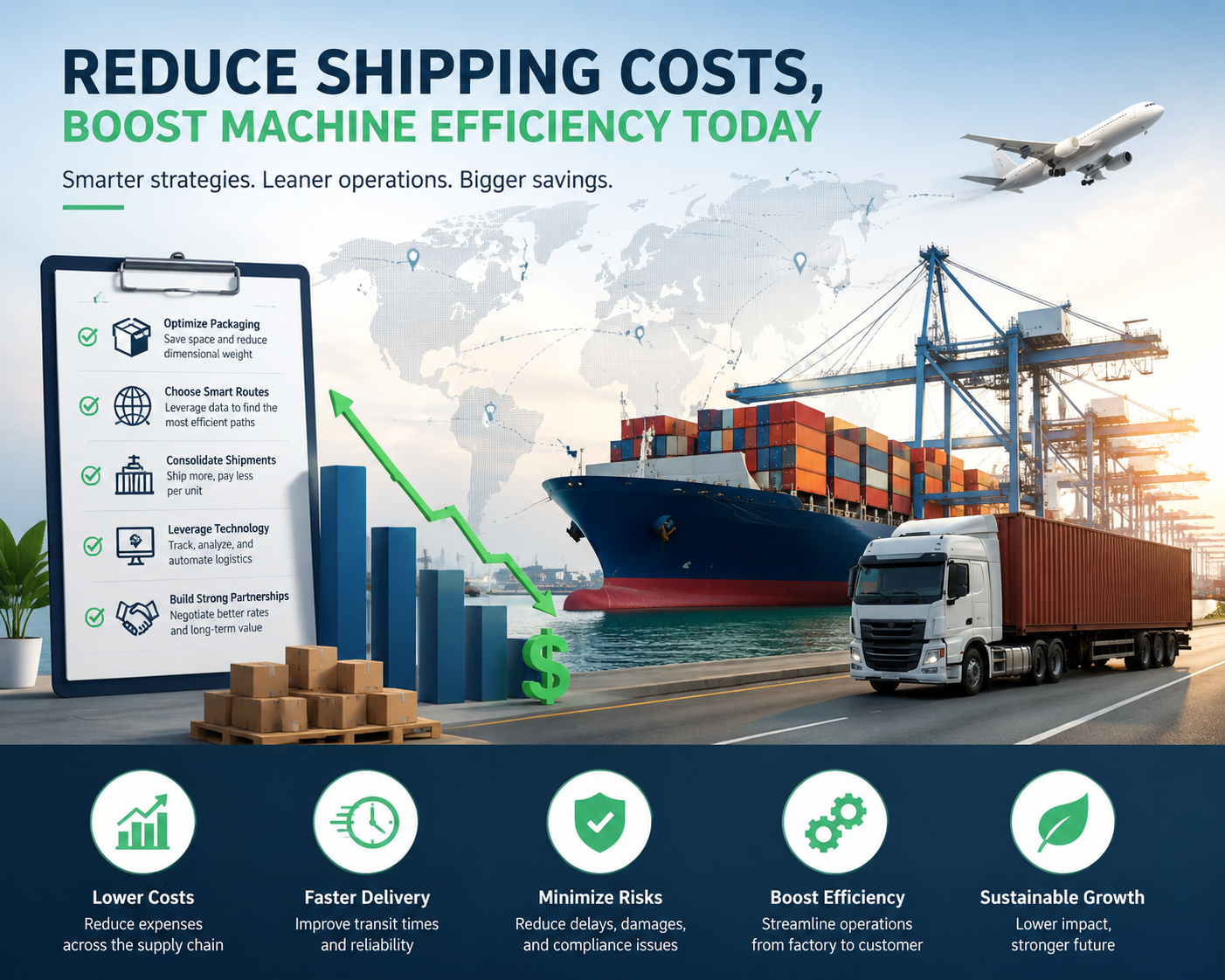
16. Strategies to Reduce Your Shipping Costs
16.1 Optimizing Routes and Delivery Schedules
Efficient route planning minimizes fuel consumption, idle time, and unnecessary mileage.
Smart scheduling improves vehicle utilization dramatically.
16.2 Leveraging Technology for Cost Efficiency
AI forecasting, IoT tracking systems, and digital freight platforms improve operational transparency and reduce waste.
Technology is rapidly becoming indispensable.
16.3 Training Staff to Improve Operational Performance
Well-trained warehouse teams reduce errors, improve loading efficiency, and enhance shipment accuracy.
Operational discipline matters enormously.
17. Conclusion and Next Steps
17.1 Recap of Key Factors Affecting Shipping Prices
Shipping costs are influenced by distance, packaging, fuel, labor, customs regulations, carrier selection, and operational efficiency.
Every component within the logistics chain contributes to the final landed cost.
17.2 Actionable Steps to Boost Machine Efficiency
Manufacturers should optimize packaging design, automate warehouse operations, maintain equipment proactively, and improve supply chain coordination.
Incremental improvements accumulate into substantial competitive advantages.
17.3 Long-Term Planning for Sustainable Cost Reduction
Sustainable logistics efficiency requires continuous analysis, technological investment, supplier collaboration, and operational discipline.
In modern manufacturing, efficient logistics is no longer optional. It is a strategic weapon.
Recommended External Resources
```