Table of Contents
China to Netherlands Logistics: Gain Better Freight Visibility
1. Introduction to China to Netherlands Logistics Visibility
What freight visibility means in global shipping
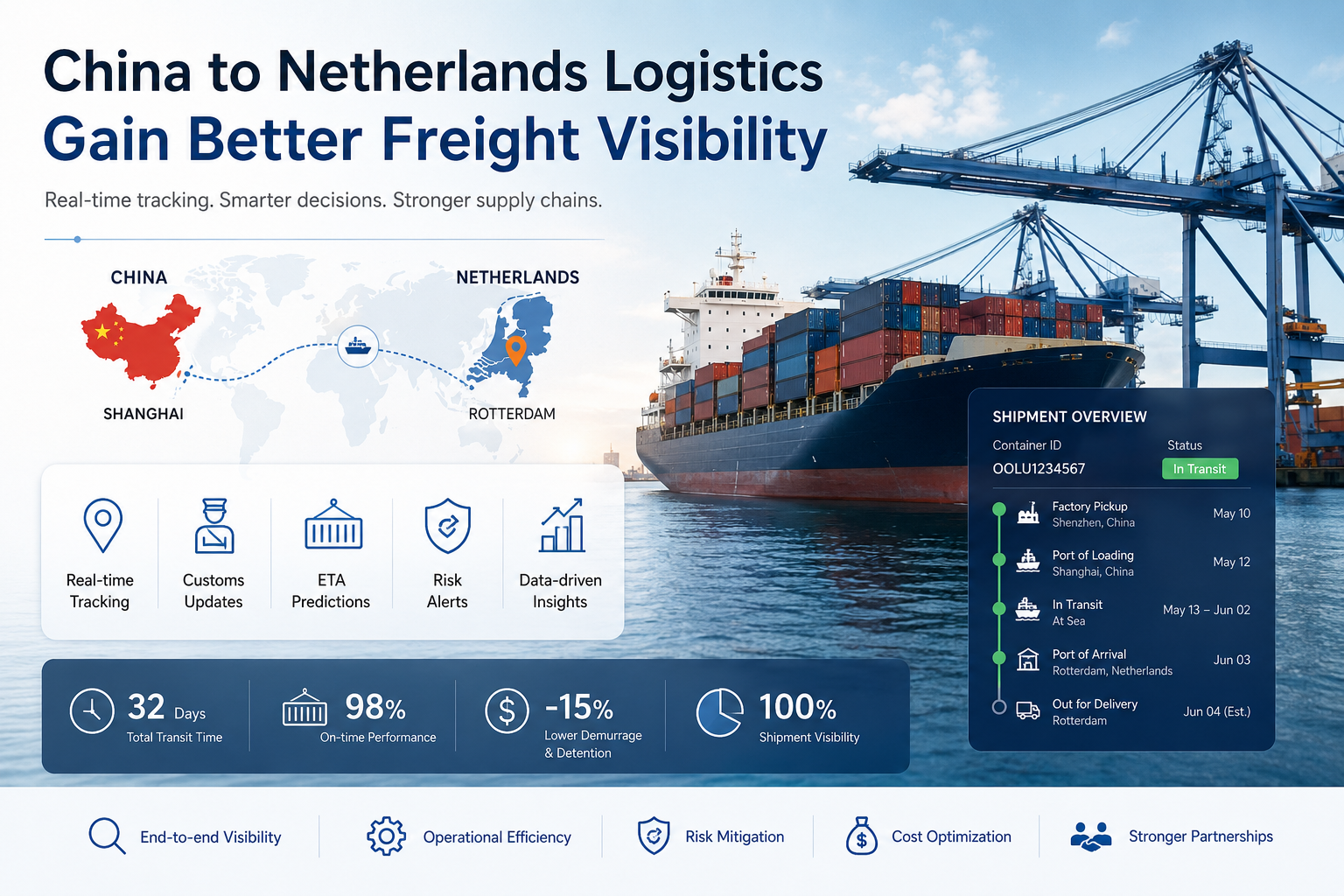
Freight visibility in global shipping is essentially the operational ability to track, interpret, and anticipate the movement of cargo across multi-jurisdictional corridors with near-real-time granularity. From a purchase engineering standpoint, it is not just “where is my container,” but rather a layered intelligence system that exposes every micro-stage of transit, from factory gate release in Guangdong to last-mile handover in Rotterdam’s hinterlands. In modern procurement ecosystems, visibility has evolved into a quasi-control tower function—an indispensable lens for synchronizing demand planning with supply execution. Learn more about logistics concepts at Logistics (Wikipedia).
Key challenges in China–Netherlands trade lanes
The China–Netherlands corridor is notoriously complex, not least because it fuses high-volume export dynamics with extended ocean transit, multiple transshipment nodes, and highly regulated EU customs frameworks. Data discontinuity remains a recurring pain point; updates often arrive like scattered breadcrumbs rather than a continuous feed, leaving procurement teams to stitch together fragmented narratives. Add to that vessel schedule volatility, port congestion swings, and documentation lag, and the whole system sometimes feels like trying to read a book with half the pages missing.
Why visibility has become a procurement priority
For procurement professionals, especially those managing global sourcing portfolios, visibility has shifted from a “nice-to-have” dashboard feature to a hard KPI driver. Cost overruns, stockouts, and production stoppages are now tightly correlated with information latency. In today’s high-stakes sourcing environment, if you cannot see it, you cannot control it—and if you cannot control it, margins start leaking faster than anyone wants to admit.
2. Overview of the China–Netherlands Trade Corridor
Major export categories from China
The cargo profile moving from China into the Netherlands is strikingly diverse, spanning industrial machinery, consumer electronics, automotive components, textiles, and high-value retail goods. From a procurement engineer’s lens, this diversity creates a heterogeneous logistics requirement set, where one shipment might demand temperature control while another prioritizes anti-vibration packaging and strict lead-time adherence.
Key entry points in the Netherlands
The Port of Rotterdam stands as the undisputed gateway, functioning as Europe’s maritime supernode where global supply chains converge before radiating inland. Supplementary entry points include Amsterdam logistics hubs and regional inland terminals connected via rail and barge networks. Each node introduces its own visibility layer, and each layer can either strengthen or dilute shipment traceability depending on data integration maturity. More details about the port can be found at Port of Rotterdam (Wikipedia).
Typical transit routes and multimodal options
Standard routing often involves ocean freight via the Suez Canal corridor, though alternative pathways occasionally surface through transshipment hubs like Singapore or Algeciras. Once in Europe, multimodal distribution kicks in—rail to inland terminals, barge distribution through the Rhine corridor, and trucking for final delivery. It’s a choreography of movement that only works smoothly when every actor shares synchronized visibility data.
3. Core Components of Freight Visibility
Shipment tracking systems and data points
Modern shipment tracking systems compile a mosaic of data points including container ID scans, vessel AIS signals, port gate timestamps, and customs clearance triggers. For procurement specialists, these data points are not just technical markers—they are operational decision inputs that influence inventory buffers and production scheduling.
Carrier and forwarder integration layers
Visibility collapses quickly when carriers, freight forwarders, and third-party logistics providers operate in siloed digital environments. Integration layers—often API-driven—serve as the connective tissue that fuses disparate systems into a coherent informational ecosystem. Without this integration, procurement teams are essentially flying blind with fragmented telemetry.
Real-time vs milestone-based updates
Milestone-based updates tell you when a container leaves Shanghai or arrives in Rotterdam; real-time tracking, however, reveals the journey in motion. The difference is akin to watching a slideshow versus streaming live footage. For high-value or time-sensitive cargo, this distinction is not academic—it directly influences risk exposure.
4. Importance of Visibility for Procurement Teams
Cost control and budget forecasting accuracy
Visibility acts as a financial stabilizer. When transit timelines are predictable, procurement engineers can fine-tune landed cost calculations with surgical precision, avoiding the classic budget drift that occurs when shipments arrive earlier, later, or via unexpected routes. It’s the difference between controlled expenditure and reactive firefighting.
Supplier performance evaluation
With robust visibility systems, supplier assessment becomes data-driven rather than anecdotal. On-time dispatch rates, inland transit delays, and documentation accuracy can all be quantified, allowing procurement teams to separate strategic suppliers from operational liabilities with far greater confidence.
Risk mitigation in supply continuity
Supply continuity is the holy grail of procurement. Visibility tools allow early detection of disruptions, enabling rerouting, expediting, or inventory rebalancing before downstream production lines feel the impact. In practical terms, it’s the difference between a minor delay and a full-blown production stoppage.
5. Main Visibility Gaps in Traditional Freight Systems
Fragmented carrier data sources
Traditional logistics systems often resemble a patchwork quilt of disconnected carrier portals, each speaking its own data language. This fragmentation forces procurement teams into manual reconciliation exercises that are both time-consuming and error-prone.
Lack of standardized reporting formats
Even when data is available, inconsistency in formatting—timestamps, status codes, location naming conventions—creates interpretive ambiguity. One system’s “departed port” may be another’s “vessel loaded,” leading to analytical misalignment.
Delayed status updates across transit stages
Latency in status updates remains a structural weakness. By the time information reaches procurement dashboards, the actual shipment condition may have already evolved, rendering reactive decisions less effective than they should be.
6. Digital Transformation in Logistics Visibility
Role of Transport Management Systems (TMS)
Transport Management Systems act as centralized orchestration engines, consolidating freight data across carriers, routes, and modes into a unified operational interface. For procurement engineers, this translates into a single pane of truth rather than a fragmented mosaic of partial truths.
Cloud-based logistics platforms
Cloud infrastructure has revolutionized logistics visibility by enabling scalable, always-on data access across geographies. No more siloed desktop systems or delayed batch updates—just continuous, globally synchronized information streams.
Automation in shipment tracking
Automation removes the cognitive burden of manual tracking. Exception alerts, predictive ETA recalculations, and automated reporting workflows ensure that procurement teams spend less time chasing data and more time acting on it. Explore transport system efficiency insights via World Bank Transport Data.
7. China Export Side Visibility Challenges
Factory dispatch confirmation delays
At the origin point, delays often begin with something as mundane as late dispatch confirmations from manufacturing facilities. These delays cascade downstream, distorting ETA projections before the shipment even leaves Chinese soil.
Inland transport tracking limitations
Inland trucking visibility within China can be uneven, especially for secondary routes where telematics adoption is inconsistent. This creates early-stage blind spots that propagate through the entire logistics chain.
Export documentation transparency issues
Documentation workflows—commercial invoices, packing lists, export declarations—can suffer from asynchronous updates, leading to customs clearance friction that feels entirely avoidable yet persistently recurring.
8. Ocean Freight Visibility Across Long Haul Routes
Container tracking via shipping lines
Shipping lines provide vessel-level tracking, but container-level granularity can vary significantly. Procurement engineers often find themselves reconciling macro vessel movement with micro container behavior, a task that demands both patience and precision.
Port congestion monitoring
Port congestion is a variable that behaves almost like a living organism—unpredictable, cyclical, and highly sensitive to external shocks. Without real-time congestion intelligence, ETA reliability becomes a moving target.
Vessel schedule reliability issues
Schedule reliability remains one of the most persistent challenges in ocean freight. Weather disruptions, port labor constraints, and cascading delays contribute to a volatility profile that demands constant recalibration. Additional policy-level context can be explored via OECD Transport Research.
9. European Entry Point Visibility in Netherlands
Port of Rotterdam tracking systems
Rotterdam operates one of the most advanced port visibility ecosystems in the world, offering granular tracking across terminal operations, yard movements, and hinterland distribution. Yet even this sophistication requires proper integration to unlock full value for procurement stakeholders.
Customs clearance process updates
EU customs processes introduce another visibility layer where delays can occur due to inspection triggers, tariff classifications, or compliance checks. Real-time clearance visibility is essential for avoiding downstream bottlenecks.
Inland distribution visibility after arrival
Once cargo leaves the port, visibility often fragments again across trucking and rail operators. Maintaining continuity through inland logistics is critical for preserving end-to-end transparency.
10. Role of IoT and Smart Sensors in Tracking
Container GPS and telematics devices
IoT-enabled GPS trackers transform passive containers into active data generators, transmitting location and movement data with unprecedented precision. For procurement engineers, this feels like turning on headlights in a previously dark corridor.
Temperature and condition monitoring
For sensitive goods, environmental monitoring ensures that temperature, humidity, and shock exposure remain within acceptable thresholds. This is especially critical for electronics, pharmaceuticals, and precision components.
Exception alerts and predictive warnings
Smart systems no longer just report what happened—they forecast what might go wrong. Predictive alerts enable proactive intervention before disruptions escalate into operational failures.
11. Data Integration Between Stakeholders
Forwarder and carrier data synchronization
Without synchronization, each stakeholder operates on a different version of the truth. Integration ensures that forwarders, carriers, and clients align on a single operational narrative.
ERP system connectivity for buyers
ERP integration allows procurement teams to embed logistics visibility directly into enterprise planning systems, bridging the gap between operational execution and financial planning.
API-based logistics data sharing
APIs function as the digital arteries of modern logistics ecosystems, enabling continuous, automated data exchange across platforms without manual intervention.
12. Real-Time Tracking vs Event-Based Updates
Differences in data granularity
Real-time tracking provides continuous telemetry, whereas event-based updates deliver discrete checkpoints. The former is fluid, the latter is episodic.
Advantages of real-time monitoring
Real-time monitoring enables dynamic decision-making, allowing procurement teams to react to disruptions as they unfold rather than after the fact.
Limitations of milestone tracking systems
Milestone systems, while simpler, often fail to capture interim deviations, creating blind spots that can mask emerging risks.
13. Customs Clearance Transparency in Netherlands
Digital customs declaration systems
The Netherlands leverages advanced digital customs platforms that streamline declaration submissions, reducing manual intervention and accelerating clearance cycles.
Duty and tax calculation visibility
Transparent duty calculations help procurement engineers accurately model landed costs and avoid post-shipment financial surprises.
Common clearance bottlenecks
Despite digitalization, bottlenecks still occur due to documentation mismatches, inspection triggers, and classification disputes.
14. Risk Management Through Visibility Tools
Early detection of shipment delays
Advanced visibility systems act like early-warning radars, flagging deviations long before they become critical disruptions.
Alternative routing strategies
When delays are detected, procurement teams can pivot to alternative ports, carriers, or multimodal routes to mitigate impact.
Supplier disruption response planning
Visibility data feeds directly into contingency planning, enabling structured response frameworks rather than ad-hoc reactions.
15. Cost Optimization Enabled by Better Visibility
Reducing demurrage and detention fees
Accurate ETA tracking helps avoid container overstays, significantly reducing avoidable port-related penalties.
Improving container utilization rates
Better visibility allows for optimized load planning, ensuring that container space is utilized efficiently rather than suboptimally.
Enhancing freight negotiation leverage
Data-rich visibility strengthens procurement leverage in carrier negotiations, enabling fact-based rate discussions rather than speculative pricing.
16. Future Trends in China to Netherlands Logistics Visibility
AI-driven predictive logistics analytics
Artificial intelligence is increasingly being used to model transit behavior, predict disruptions, and optimize routing decisions with uncanny accuracy.
Blockchain-based shipment verification
Blockchain introduces immutable tracking records, enhancing trust and reducing disputes across multi-party logistics networks.
End-to-end autonomous supply chain tracking
The future points toward fully autonomous visibility ecosystems where shipments self-report status, predict delays, and trigger corrective actions with minimal human intervention.