Table of Contents
Sea Ports in China: Choosing the Right Export Hub
1. Introduction to Sea Ports in China
1.1 Why China Dominates Global Maritime Trade
China occupies a commanding position in global maritime commerce due to its unparalleled manufacturing ecosystem, extensive coastal infrastructure, and strategic integration into international supply chains. From consumer electronics and automotive components to industrial machinery and renewable energy equipment, an immense volume of goods originates from Chinese factories every day.
As a purchase engineer or procurement professional, understanding China's port system is not merely a logistics concern. It directly influences landed costs, inventory turnover, supplier performance, and customer satisfaction. China has spent decades developing sophisticated deep-water ports, automated terminals, intermodal transportation networks, and customs modernization initiatives that enable millions of containers to move efficiently across continents.
The country's maritime strength is not simply a result of scale. It is supported by a highly coordinated ecosystem involving manufacturers, freight forwarders, shipping lines, customs authorities, trucking companies, rail operators, and distribution centers. This interconnected framework allows products to move from factory floors to overseas markets with remarkable efficiency.
For additional information on maritime trade and global shipping infrastructure, readers may refer to Maritime Transport and the World Bank, which regularly publishes research on international trade and logistics performance.
1.2 The Role of Sea Ports in International Supply Chains
Sea ports function as critical junctions within international supply chains. They serve as transfer points where cargo moves between inland transportation systems and global shipping networks.
For procurement teams managing global sourcing programs, ports represent much more than loading facilities. They influence shipment visibility, lead time predictability, transportation expenses, and inventory planning.
A well-selected port can streamline logistics operations, minimize cargo handling, reduce dwell times, and improve delivery reliability. Conversely, a poorly selected export hub can create bottlenecks that ripple throughout the entire supply chain.
Think of a port as the heartbeat of an export operation. If that heartbeat becomes irregular, every downstream activity—from warehouse scheduling to retail replenishment—can be affected.
1.3 Why Export Hub Selection Matters for Buyers
Many buyers focus heavily on supplier pricing while overlooking export hub selection. In reality, two factories producing identical products at identical costs can generate significantly different total landed costs depending on the chosen port.
Export hub selection affects:
- Inland transportation expenses
- Ocean freight rates
- Customs processing efficiency
- Shipping frequency
- Transit times
- Cargo security
- Port congestion exposure
A common saying in logistics is that "cheap freight can become expensive freight." A lower ocean rate means little if delays cause stockouts, missed promotions, or production shutdowns.
For procurement professionals, selecting the appropriate Chinese export hub should be viewed as a strategic sourcing decision rather than a purely logistical one.
2. Overview of China's Port Network
2.1 Major Coastal Port Regions
China's coastline stretches over 18,000 kilometers and hosts numerous world-class ports. These ports are concentrated within several major economic regions:
- Bohai Rim Region
- Yangtze River Delta
- Pearl River Delta
- Southeast Coastal Region
Each region supports distinct industrial clusters and manufacturing specializations.
The Yangtze River Delta serves as a powerhouse for advanced manufacturing and exports. The Pearl River Delta remains a global center for electronics and consumer goods production. Northern ports support heavy industries, petrochemicals, and industrial equipment exports.
Understanding these regional distinctions helps buyers align logistics strategies with supplier locations.
For a broader overview of China's economic geography, visit Economy of China.
2.2 North, Central, and South China Port Clusters
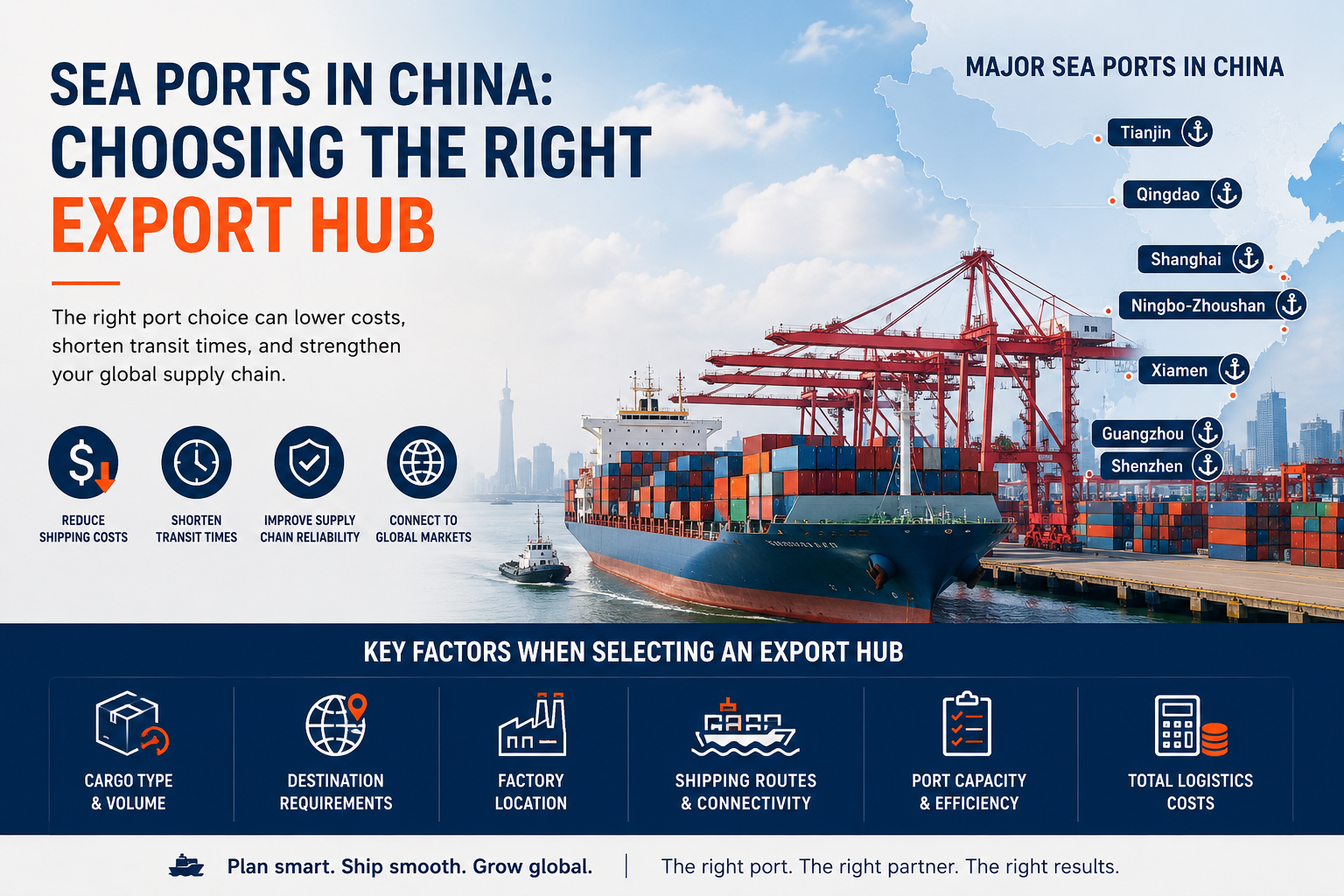
Northern China primarily relies on ports such as Qingdao and Tianjin.
Central China exports frequently move through Shanghai and Ningbo-Zhoushan.
Southern China heavily utilizes Shenzhen and Guangzhou.
Each cluster possesses unique advantages regarding shipping routes, inland transportation infrastructure, and manufacturing proximity.
Procurement professionals sourcing from multiple provinces often develop multi-port strategies to optimize costs and reduce dependency risks.
2.3 Port Connectivity to Global Markets
One of China's greatest advantages lies in global connectivity. Major ports maintain extensive vessel schedules linking North America, Europe, Latin America, Africa, Oceania, and the Middle East.
High-frequency sailings create flexibility for exporters and buyers. Missed departures can often be replaced with alternative sailings within days rather than weeks.
This connectivity enhances supply chain resilience and provides buyers with greater routing options during disruptions.
3. Why Choosing the Right Export Hub Is Critical
3.1 Impact on Shipping Costs
Shipping expenses extend far beyond ocean freight.
Costs include:
- Factory-to-port trucking
- Container drayage
- Port handling charges
- Storage fees
- Documentation costs
- Customs processing fees
A supplier located near Ningbo may incur substantially lower inland transportation costs than exporting through Shanghai, even if Shanghai offers slightly lower ocean freight rates.
The total logistics equation always matters more than any single cost component.
3.2 Impact on Transit Times
Transit time affects inventory carrying costs and customer service performance.
A port offering direct vessel services can reduce transportation lead times by several days compared with routes requiring transshipment.
In highly competitive industries, even a two-day improvement can create meaningful advantages in inventory availability and working capital efficiency.
3.3 Impact on Supply Chain Reliability
Reliability frequently outweighs speed.
Consistent delivery performance enables procurement teams to forecast inventory requirements accurately and reduce safety stock levels.
Ports with strong operational stability often generate greater long-term value than ports offering marginally lower rates but frequent disruptions.
4. Key Factors to Evaluate Before Selecting a Port
4.1 Cargo Type and Volume
Different cargo categories require different infrastructure.
Examples include:
- Containerized cargo
- Bulk commodities
- Refrigerated products
- Oversized machinery
- Hazardous materials
Ports vary considerably in their specialized handling capabilities.
High-volume exporters may benefit from ports offering superior carrier competition and more frequent departures.
4.2 Destination Market Requirements
The final destination significantly influences port selection.
For shipments to the U.S. West Coast, certain ports may offer more direct sailings and shorter transit times.
European destinations may benefit from alternative routing strategies that prioritize schedule reliability over raw speed.
Destination-specific optimization can generate measurable savings.
4.3 Supplier and Factory Locations
Factory proximity remains one of the most important variables.
A lower ocean freight rate rarely compensates for excessive inland transportation costs.
The optimal port is often the one that balances factory accessibility with global shipping connectivity.
5. Shanghai Port: China's Largest Export Gateway
5.1 Main Advantages of Shanghai Port
Shanghai stands as the world's busiest container port.
Advantages include:
- Massive capacity
- Extensive carrier coverage
- Frequent departures
- Advanced terminal technology
- Strong customs efficiency
Its global connectivity makes it a preferred gateway for multinational procurement operations.
Additional details about the port can be found at Port of Shanghai.
5.2 Suitable Industries and Products
Shanghai serves numerous sectors:
- Electronics
- Automotive components
- Industrial equipment
- Medical devices
- Consumer goods
- Renewable energy products
Its diverse industrial base supports virtually every major export category.
5.3 Potential Challenges and Considerations
Despite its strengths, Shanghai can experience:
- Peak-season congestion
- Higher local costs
- Intense competition for capacity
Buyers should evaluate seasonal shipping patterns carefully when planning exports through Shanghai.
6. Ningbo-Zhoushan Port: A Fast-Growing Export Hub
6.1 Strategic Location and Infrastructure
Located near Shanghai, Ningbo-Zhoushan has evolved into one of the world's most important maritime gateways.
The port features:
- Deep-water berths
- Extensive container facilities
- Efficient automation systems
- Strong multimodal connections
6.2 Cost and Efficiency Benefits
Many exporters appreciate Ningbo's competitive cost structure.
Benefits include:
- Lower congestion risks
- Competitive terminal charges
- Strong schedule reliability
For many procurement teams, Ningbo represents an excellent balance between efficiency and cost control.
6.3 Best Cargo Types for Ningbo
Common exports include:
- Industrial machinery
- Consumer products
- Home goods
- Textile products
- Automotive components
Large-volume container shipments often perform particularly well through Ningbo.
7. Shenzhen Port: Gateway to Southern China Manufacturing
7.1 Access to Guangdong Supply Chains
Shenzhen serves the heart of China's manufacturing powerhouse.
Factories throughout Guangdong benefit from proximity to Shenzhen's export infrastructure.
This geographic advantage reduces inland transportation costs and simplifies logistics coordination.
7.2 International Shipping Network
Shenzhen maintains extensive direct services to:
- North America
- Europe
- Southeast Asia
- Australia
- Middle East markets
The breadth of these services supports diverse sourcing programs.
7.3 Industries Commonly Exporting Through Shenzhen
Major sectors include:
- Consumer electronics
- Telecommunications equipment
- Smart devices
- Electrical products
- Consumer goods
Many globally recognized brands rely on Shenzhen as a primary export gateway.
Learn more about the region through the Port of Shenzhen.
8. Guangzhou Port: A Versatile Trade Center
8.1 Geographic Advantages
Guangzhou occupies a strategic position within the Pearl River Delta.
Its accessibility supports exporters throughout southern China.
8.2 Export Opportunities for Various Industries
Key export categories include:
- Apparel
- Furniture
- Household products
- Electronics
- Machinery
The port accommodates both large and mid-sized exporters.
8.3 Logistics and Transportation Links
Strong road, rail, and inland waterway connections enhance operational flexibility and support efficient cargo movement.
9. Qingdao Port: Leading Hub for Northern China
9.1 Key Export Industries
Qingdao supports:
- Industrial machinery
- Chemicals
- Agricultural products
- Metal products
- Automotive components
9.2 Connections to International Markets
The port maintains strong connectivity to Asia, Europe, and North America.
Its strategic location supports exporters across northern provinces.
9.3 Advantages for Bulk and Industrial Cargo
Qingdao's infrastructure is particularly suitable for heavy industrial shipments and bulk commodities requiring specialized handling.
10. Tianjin Port: Serving Beijing and North China
10.1 Strategic Importance
Tianjin serves as the primary maritime gateway for Beijing and surrounding industrial zones.
10.2 Manufacturing Regions Served
Key regions include:
- Beijing
- Hebei
- Inner Mongolia
- Shanxi
10.3 Export Benefits and Challenges
Advantages include strong inland connectivity and proximity to northern manufacturing centers.
Challenges may include seasonal weather disruptions and fluctuating demand patterns.
11. Xiamen Port: An Efficient Gateway for Southeast China
11.1 Regional Trade Advantages
Xiamen supports exporters throughout Fujian Province and neighboring manufacturing regions.
11.2 Key Export Commodities
Common exports include:
- Electronics
- Footwear
- Textiles
- Consumer products
- Industrial components
11.3 Shipping Routes and Connectivity
Xiamen offers reliable access to Southeast Asia, Europe, and North America through a growing network of shipping services.
12. Comparing Major Sea Ports in China
12.1 Port Capacity Comparison
Shanghai leads in container throughput, followed closely by Ningbo-Zhoushan and Shenzhen.
Capacity influences vessel availability, schedule frequency, and operational flexibility.
12.2 Transit Time Comparison
Direct service availability often determines transit performance more than geographic location alone.
Buyers should compare actual carrier schedules rather than relying solely on theoretical transit times.
12.3 Cost Comparison
True logistics costs require evaluating:
- Inland transportation
- Port charges
- Ocean freight
- Customs fees
- Inventory carrying costs
The lowest freight quote is not always the lowest total cost.
13. How Factory Location Influences Port Selection
13.1 Inland Transportation Costs
Transportation from factory to port can represent a substantial portion of logistics expenses.
Long-distance trucking can quickly erode apparent freight savings.
13.2 Trucking and Rail Accessibility
Efficient access to highways and rail networks improves shipment predictability and lowers transportation risk.
13.3 Balancing Freight and Production Costs
Procurement teams should evaluate total landed cost rather than focusing narrowly on manufacturing or freight expenses independently.
14. Port Congestion and Seasonal Considerations
14.1 Peak Shipping Seasons
Common peak periods include:
- Pre-holiday retail demand
- Back-to-school seasons
- Year-end inventory replenishment
14.2 Holiday-Related Disruptions
Chinese New Year often creates substantial operational disruptions throughout supply chains.
Advance planning remains essential.
14.3 Strategies to Avoid Delays
Successful strategies include:
- Early booking
- Flexible routing
- Multi-port sourcing
- Buffer inventory planning
A little foresight goes a long way when the market gets choppy.
15. Export Documentation and Customs Procedures
15.1 Required Export Documents
Typical documentation includes:
- Commercial invoice
- Packing list
- Bill of lading
- Export declaration
- Certificates of origin
Additional guidance on international trade documentation can be found through the U.S. International Trade Administration.
15.2 Customs Clearance Processes
Proper documentation accuracy minimizes customs delays and inspection risks.
15.3 Compliance Best Practices
Regular audits, supplier verification, and documentation reviews help maintain compliance and reduce operational risk.
16. Sea Freight Options Available at Chinese Ports
16.1 Full Container Load Services
FCL shipments provide:
- Better cargo security
- Faster transit handling
- Lower damage risk
Ideal for large-volume shipments.
16.2 Less Than Container Load Services
LCL services enable smaller buyers to consolidate cargo economically.
16.3 Special Cargo and Project Shipments
Chinese ports also support:
- Heavy machinery
- Oversized equipment
- Breakbulk cargo
- Project logistics
17. Choosing the Best Port Based on Destination Market
17.1 Exporting to North America
Direct sailings and schedule reliability should remain primary considerations.
North American importers often prioritize predictable lead times, strong vessel frequency, and efficient customs processing. Ports such as Shanghai, Ningbo-Zhoushan, and Shenzhen typically provide extensive service coverage to major destinations on both the U.S. West Coast and East Coast.
Procurement professionals should evaluate not only transit duration but also carrier reliability, equipment availability, and potential congestion at destination ports. A routing that appears slightly more expensive on paper may ultimately deliver superior value through improved inventory flow and reduced disruption risk.
17.2 Exporting to Europe
Carrier network diversity and congestion management often become critical factors.
European importers frequently source products from multiple Chinese regions, making port selection a key element of supply chain optimization. Shanghai, Ningbo-Zhoushan, Qingdao, and Shenzhen all maintain strong connections to major European ports.
When evaluating European export routes, buyers should consider vessel frequency, transshipment requirements, customs procedures, and seasonal demand fluctuations. Stable schedules can often provide greater value than marginal freight savings.
17.3 Exporting to Latin America, Middle East, and Africa
Route availability and transshipment efficiency frequently influence performance.
These regions may have fewer direct sailing options compared with North America and Europe. Consequently, procurement teams should assess total transit reliability, carrier partnerships, and network coverage before selecting an export hub.
Careful planning can significantly reduce delays and improve delivery performance in emerging markets where logistics infrastructure may vary considerably.
18. How Freight Forwarders Help Optimize Port Selection
18.1 Route Planning and Cost Analysis
Experienced forwarders evaluate multiple routing scenarios to identify optimal solutions.
They analyze transportation costs, sailing schedules, port handling fees, inland transportation requirements, and destination market considerations. This comprehensive approach allows procurement teams to make decisions based on total landed cost rather than isolated freight quotations.
In many cases, alternative routing strategies can uncover substantial savings while maintaining service quality.
18.2 Carrier Selection and Space Management
Carrier relationships often provide access to better capacity and schedule options.
Freight forwarders maintain close relationships with shipping lines and can frequently secure space during peak seasons when capacity becomes constrained. This capability can prove invaluable when market conditions become volatile.
As many logistics professionals like to say, "having options in your back pocket" can make all the difference when supply chains encounter turbulence.
18.3 Risk Reduction and Supply Chain Support
Forwarders help mitigate disruptions through proactive monitoring and contingency planning.
Their expertise enables buyers to navigate changing market conditions, customs requirements, weather events, labor disruptions, and carrier schedule changes more effectively.
Strong logistics partnerships contribute significantly to supply chain resilience and operational continuity.
19. Common Mistakes Buyers Make When Selecting an Export Hub
19.1 Focusing Only on Ocean Freight Rates
Lowest freight rates can conceal higher overall logistics costs.
Many procurement teams initially focus on securing the cheapest ocean transportation option. However, transportation economics extend far beyond freight rates alone.
Factors such as inland trucking, inventory carrying costs, cargo delays, storage charges, and schedule reliability must also be incorporated into decision-making processes.
An apparently inexpensive shipping solution can quickly become costly if it generates supply chain inefficiencies.
19.2 Ignoring Inland Logistics Costs
Factory-to-port transportation must always be included in cost analysis.
A supplier located hundreds of kilometers from a selected port may require significant trucking expenses that outweigh any perceived savings on ocean freight.
Evaluating the complete transportation journey provides a far more accurate representation of actual logistics costs.
19.3 Overlooking Port-Specific Risks
Congestion, labor issues, weather disruptions, and capacity constraints should be evaluated carefully.
Every port possesses unique operational characteristics and risk profiles. Procurement professionals should regularly review market conditions and maintain alternative routing strategies when possible.
Risk management should be treated as an integral component of export planning rather than an afterthought.
20. Step-by-Step Process for Choosing the Right Export Hub
20.1 Assess Product and Supply Chain Requirements
Understand cargo characteristics, shipment frequency, customer expectations, and sourcing strategies.
This assessment should include cargo dimensions, handling requirements, seasonal demand patterns, inventory policies, and destination market expectations.
A clear understanding of these variables establishes the foundation for effective port selection.
20.2 Compare Port Performance and Costs
Analyze comprehensive logistics metrics rather than isolated pricing data.
Important evaluation criteria include:
- Transit times
- Port handling efficiency
- Carrier availability
- Inland transportation costs
- Congestion levels
- Schedule reliability
Objective comparison enables procurement teams to identify the most suitable export gateway.
20.3 Develop a Long-Term Shipping Strategy
The most successful procurement organizations view logistics as a strategic capability rather than a transactional expense.
Long-term planning enables businesses to build resilient supply chains, improve forecasting accuracy, reduce risk exposure, and strengthen supplier relationships.
Strategic alignment between sourcing and logistics functions often generates sustainable competitive advantages.
21. Frequently Asked Questions About Sea Ports in China
21.1 Which Is the Largest Sea Port in China?
Shanghai Port is currently the largest container port in China and the world by throughput.
Its enormous capacity, extensive shipping network, and advanced infrastructure make it one of the most important logistics gateways globally.
More information can be found through the Port of Shanghai resource.
21.2 How Do I Choose Between Shanghai and Shenzhen?
The decision depends largely on supplier location, destination market, cargo characteristics, and total logistics costs.
Shanghai generally offers exceptional connectivity for eastern and central China manufacturing regions, while Shenzhen provides strategic advantages for suppliers located within Guangdong and surrounding southern provinces.
Evaluating total landed cost and service performance is usually more important than comparing freight rates alone.
21.3 What Is the Most Cost-Effective Port for Exporting?
There is no universal answer. The most cost-effective port is the one that minimizes total landed cost while maintaining required service levels.
Factors such as factory location, shipment volume, cargo type, destination market, and transportation infrastructure all influence the final outcome.
Procurement teams should conduct comprehensive logistics analyses rather than relying on generalized assumptions.
22. Conclusion
22.1 Key Takeaways for Procurement Professionals
Port selection is a strategic procurement decision that directly affects cost, lead time, inventory performance, and customer satisfaction.
The most effective sourcing organizations recognize that logistics and procurement functions are deeply interconnected. Decisions made during supplier selection often have lasting consequences throughout the supply chain.
A disciplined approach to port evaluation can unlock measurable improvements in operational performance.
22.2 Building a Resilient Export Strategy
Diversified routing, strong supplier coordination, and proactive logistics planning create resilience in an increasingly dynamic global trade environment.
Organizations that invest in contingency planning, transportation visibility, and collaborative supplier relationships are generally better positioned to manage disruptions successfully.
Resilience is no longer a luxury; it has become a fundamental requirement for sustained competitiveness.
22.3 Selecting the Right Chinese Port for Sustainable Growth
The right export hub is not necessarily the largest or the cheapest. It is the port that best aligns with sourcing locations, customer requirements, transportation economics, and long-term business objectives.
When procurement teams evaluate ports through a total-cost and risk-management lens, they position their organizations for sustained competitive advantage in global markets.
Whether utilizing Shanghai, Ningbo-Zhoushan, Shenzhen, Guangzhou, Qingdao, Tianjin, or Xiamen, successful export strategies depend upon balancing cost efficiency, operational reliability, and long-term supply chain resilience.
For additional industry insights and global shipping trends, readers may reference the United Nations Conference on Trade and Development (UNCTAD), which publishes extensive research on maritime transport, port performance, and international trade.