Table of Contents
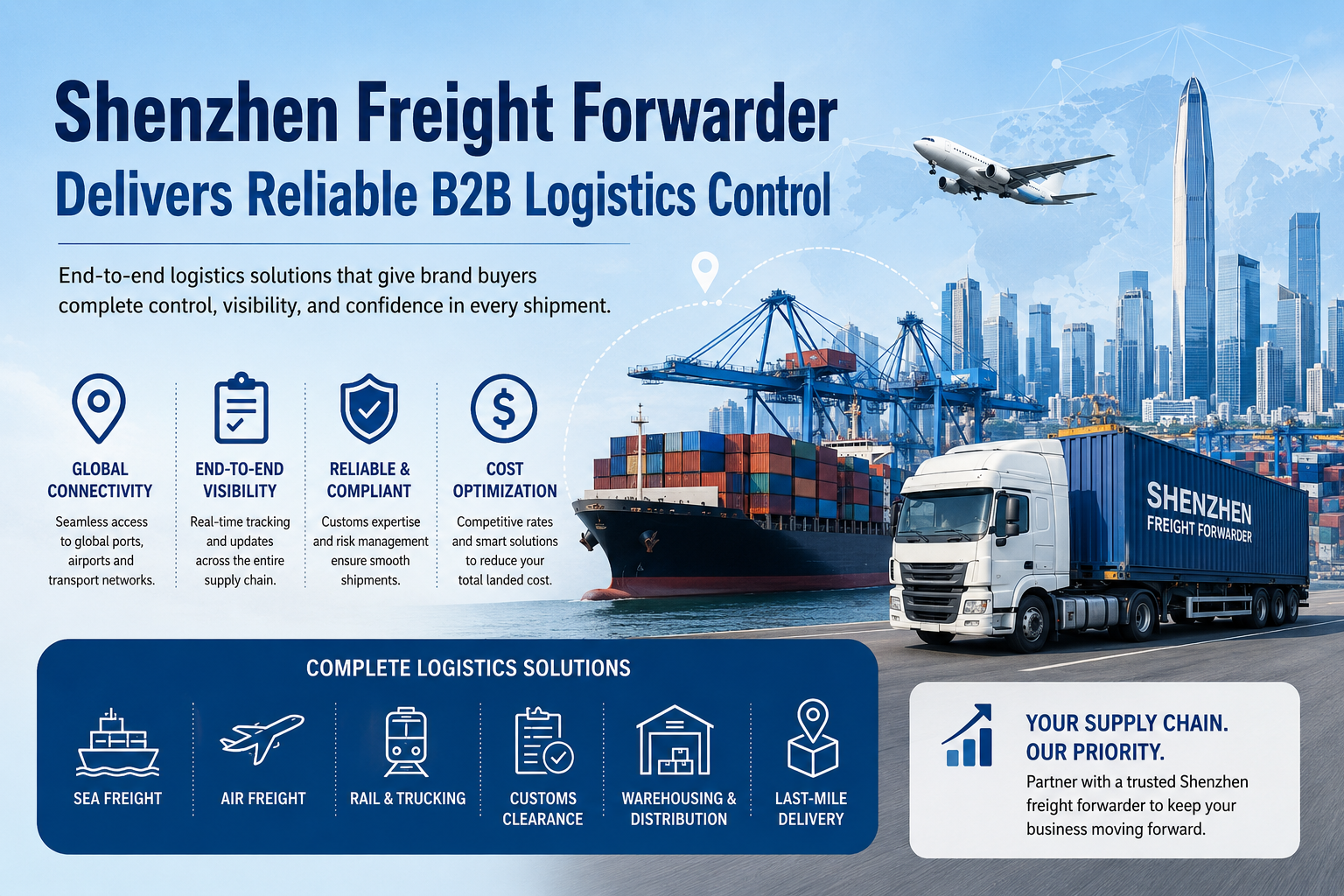
Freight Forwarder Shenzhen Delivers Reliable B2B Logistics Control
1. Introduction: B2B Logistics Control via Shenzhen Freight Forwarding
What logistics control means for B2B procurement
In modern procurement operations, logistics control is no longer just about moving cartons from Point A to Point B—it has evolved into a finely tuned orchestration of timing, compliance, cost engineering, and risk hedging. For a purchase engineer juggling supplier variability, volatile freight markets, and aggressive delivery schedules, “control” essentially means having a grip on every moving variable before it turns into a supply chain headache.
Why Shenzhen is a global logistics hub
The logistics ecosystem around Shenzhen has become a gravitational center for global commerce due to its dense manufacturing base, hyper-efficient port infrastructure, and proximity to Hong Kong’s international gateways. It is one of those rare places where you can literally source, consolidate, clear customs, and ship—all within a tightly compressed radius.
Key expectations from brand buyers in international shipping
Brand buyers today are not just chasing the lowest freight rate; they are hunting for consistency, transparency, and accountability. The expectation set is brutally clear: stable lead times, real-time visibility, compliant documentation, and a freight partner who does not vanish when turbulence hits.
2. Strategic Role of Shenzhen in Global Trade
Integration with major export manufacturing clusters
The region is deeply embedded with electronics, consumer goods, and precision manufacturing clusters, enabling just-in-time export rhythms that support lean procurement strategies.
Access to world-class ports and airports
With advanced infrastructure, cargo movement is supported by dual-mode international connectivity through ports and airports, enabling flexible logistics planning.
Position in global supply chain networks
Shenzhen sits at a critical node in global trade networks, aligning Asian manufacturing with Western demand cycles.
3. Core Advantages of a Shenzhen Freight Forwarder
Consolidated shipping channels and carrier access
Freight forwarders aggregate cargo volumes to secure preferential carrier rates and capacity access.
Competitive freight rate structures
Dense competition allows optimized pricing structures and flexible negotiation opportunities.
Strong supplier coordination capabilities
Forwarders synchronize multiple suppliers into unified logistics flows, ensuring operational alignment.
4. End-to-End Supply Chain Visibility
Real-time shipment tracking systems
Advanced tracking systems provide continuous updates from pickup to final delivery.
Data integration across transport stages
Unified dashboards integrate fragmented logistics data into a single operational view.
Exception alert and delay management
Proactive alert systems detect disruptions before they escalate into major delays.
5. Export Customs Clearance Efficiency in China
Documentation accuracy and compliance handling
Precise documentation is essential for avoiding regulatory delays and penalties.
Export declaration optimization
Strategic classification and declaration ensure smooth customs processing.
Reducing customs inspection delays
Pre-clearance preparation reduces unnecessary inspection frequency.
6. Multimodal Transport Solutions from Shenzhen
Sea freight consolidation strategies
Ocean freight consolidation improves cost efficiency through shared container usage.
Air freight express solutions
Air transport provides high-speed delivery for urgent or high-value cargo.
Rail and cross-border trucking options
Alternative transport modes offer flexible cost and speed balancing options.
7. Cost Optimization in International Freight Operations
Container utilization improvements
Optimized loading strategies reduce wasted space and improve cost per unit.
Route and carrier selection strategy
Carrier selection is based on performance data rather than nominal pricing alone.
Hidden cost reduction techniques
Reducing detention, demurrage, and handling fees is critical for cost control.
8. Risk Management in Cross-Border Logistics
Cargo insurance and liability coverage
Insurance frameworks protect against financial loss due to unforeseen disruptions.
Delay and disruption contingency planning
Backup routing ensures continuity when primary logistics plans fail.
Supply chain risk forecasting
Predictive tools identify potential disruptions before they occur.
9. Digital Transformation in Freight Forwarding Systems
AI-based shipment planning tools
Artificial intelligence optimizes routing and logistics planning decisions.
Digital booking and documentation platforms
Paperless systems accelerate transaction and documentation workflows.
Predictive analytics for logistics performance
Analytics tools forecast delays and cost fluctuations.
10. Warehouse and Inventory Control in Shenzhen Logistics
Bonded warehouse advantages
Bonded storage improves cash flow by deferring customs duties.
Inventory synchronization with overseas demand
Inventory is aligned dynamically with global consumption patterns.
Cross-docking efficiency improvements
Cross-docking reduces storage time and accelerates throughput.
11. Global Last-Mile Delivery Coordination
Integration with destination-country carriers
Local carrier integration ensures seamless delivery transitions.
Delivery time optimization strategies
Optimized routing improves final delivery performance.
Final-mile tracking transparency
End-to-end visibility continues through final delivery stages.
12. Industry-Specific Logistics Solutions for Brand Buyers
Retail and e-commerce supply chain needs
High SKU turnover requires agile logistics structures.
Electronics and high-value cargo handling
Specialized handling ensures safety of sensitive products.
Industrial and machinery shipment requirements
Heavy cargo requires specialized transport planning.
13. Procurement Decision Factors for Brand Teams
Evaluating freight forwarder reliability
Performance consistency is a key evaluation metric.
Service-level agreement (SLA) structures
SLAs define accountability in logistics performance.
Total landed cost assessment
True cost includes freight, duties, delays, and risk exposure.
14. Compliance and Regulatory Management
International trade documentation standards
Standardized documentation ensures cross-border efficiency.
Product classification and tariff accuracy
Correct classification prevents penalties and delays.
Export-import regulatory updates
Continuous monitoring ensures compliance with evolving rules.
15. Real-World Logistics Scenarios and Use Cases
High-volume seasonal shipment management
Peak season logistics require early capacity planning.
Emergency replenishment logistics flow
Expedited logistics ensures production continuity.
Multi-supplier consolidation projects
Consolidation improves efficiency across fragmented supply chains.
16. Future Trends in Shenzhen Freight Forwarding Industry
Automation in global freight coordination
Automation reduces manual intervention in logistics operations.
Green logistics and carbon reduction initiatives
Sustainability is reshaping logistics decision-making.
Expansion of digital supply chain ecosystems
Digital integration is transforming freight forwarding into a connected ecosystem.
External References