Table of Contents
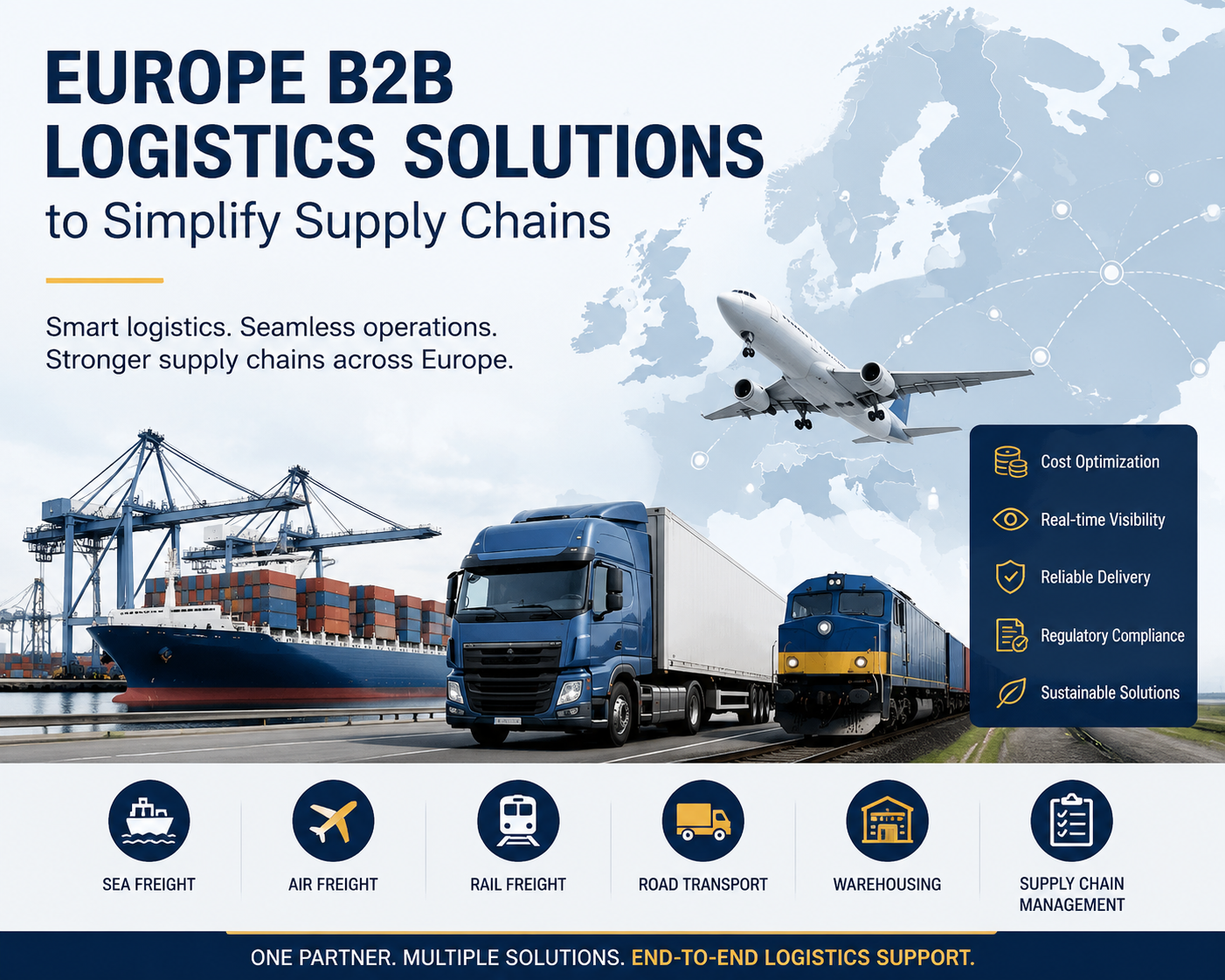
Europe B2B Logistics Solutions to Simplify Supply Chains
1. Introduction to Europe B2B Logistics Solutions
1.1 Overview of B2B Logistics in Europe
Europe remains one of the most sophisticated and interconnected commercial markets in the world. For procurement engineers and sourcing professionals, Europe B2B logistics encompasses a highly integrated network of ports, airports, rail systems, distribution centers, customs authorities, and transportation providers working together to move goods across dozens of countries efficiently.
Unlike single-country logistics operations, European supply chains involve multiple jurisdictions, languages, regulations, and transportation modes. Products sourced from Asia may enter through major ports in Northern Europe, undergo customs clearance, move via rail or truck to regional warehouses, and finally reach retailers, manufacturers, or end customers throughout the continent.
Modern B2B logistics is no longer simply about moving cargo from Point A to Point B. It is about orchestrating a synchronized ecosystem that balances cost, speed, inventory availability, compliance, and customer satisfaction. In today's competitive environment, procurement teams cannot afford supply chain bottlenecks because every delayed shipment creates a domino effect across the business.
1.2 Importance of Streamlined Supply Chains
A streamlined supply chain enables organizations to maintain inventory continuity, reduce operational expenses, and improve responsiveness to market demand. When procurement teams have confidence in transportation schedules and inventory visibility, purchasing decisions become more strategic rather than reactive.
Efficient logistics solutions help companies:
- Reduce inventory carrying costs
- Improve order fulfillment rates
- Shorten lead times
- Minimize stockouts
- Enhance supplier performance
- Improve customer satisfaction
In highly competitive sectors such as electronics, automotive, fashion, and industrial equipment, even minor logistics inefficiencies can translate into significant revenue losses. A streamlined supply chain acts as a competitive differentiator, enabling organizations to respond rapidly to market fluctuations while maintaining profitability.
1.3 Challenges Faced by Brand Procurement Professionals
Procurement professionals face a multitude of challenges when managing European supply chains. Rising transportation costs, labor shortages, customs complexity, geopolitical uncertainties, and fluctuating demand patterns create a continuously evolving environment.
One of the most common frustrations is visibility. Buyers often hear phrases such as "the shipment is on the way" without receiving meaningful tracking information. This lack of transparency can complicate production planning and inventory forecasting.
Additional challenges include:
- Managing multiple suppliers
- Maintaining compliance across markets
- Reducing logistics expenses
- Handling customs documentation
- Mitigating transportation disruptions
- Balancing inventory levels
Successful procurement teams develop resilient logistics frameworks that anticipate disruptions rather than merely reacting to them.
2. Key Components of B2B Logistics in Europe
2.1 Transportation and Freight Management
Transportation forms the backbone of every supply chain. Effective freight management requires selecting appropriate transportation modes based on cargo characteristics, urgency, destination, and budget constraints.
Procurement teams must evaluate:
- Transit times
- Freight rates
- Carrier reliability
- Route stability
- Capacity availability
An optimized freight strategy often combines multiple transportation modes to achieve both cost efficiency and operational flexibility.
2.2 Warehousing and Inventory Control
Warehouses serve as strategic nodes within the supply chain. Modern facilities are no longer passive storage locations but dynamic fulfillment centers equipped with sophisticated inventory management systems.
Effective inventory control allows businesses to maintain optimal stock levels while minimizing capital tied up in excess inventory.
Best practices include:
- Safety stock optimization
- Demand forecasting
- Cycle counting
- Automated replenishment
- SKU rationalization
2.3 Order Fulfillment and Distribution
Order fulfillment directly impacts customer experience and operational performance. Efficient fulfillment processes ensure products move quickly from warehouses to end destinations.
Distribution strategies should focus on:
- Order accuracy
- Delivery speed
- Geographic coverage
- Cost efficiency
- Service reliability
Organizations that excel in fulfillment often enjoy stronger customer loyalty and improved supply chain performance.
3. Understanding the European Supply Chain Landscape
3.1 Major Logistics Hubs and Ports in Europe
Europe's logistics network is supported by several world-class transportation hubs.
Key gateways include:
These hubs serve as entry points for international trade and connect seamlessly to inland transportation networks.
3.2 Cross-Border Trade Regulations
The European market benefits from extensive economic integration, yet cross-border trade still requires careful compliance management.
Important considerations include:
- Product classifications
- Import documentation
- VAT regulations
- Product certifications
- Country-specific requirements
Understanding regulatory obligations helps avoid unnecessary delays and penalties.
3.3 Impact of EU Customs Policies on Supply Chains
European customs policies influence transit times, landed costs, and inventory planning. Procurement teams must remain informed about evolving customs frameworks, tariff structures, and trade agreements.
Failure to anticipate regulatory changes can result in shipment holds, increased costs, and customer dissatisfaction.
4. Choosing the Right Freight Forwarder
4.1 Criteria for Selecting a Reliable Partner
A freight forwarder should be viewed as a strategic supply chain partner rather than merely a transportation vendor.
Evaluation criteria should include:
- Industry experience
- Geographic coverage
- Customs expertise
- Technology capabilities
- Financial stability
- Customer service responsiveness
4.2 Advantages of Working with Experienced European Forwarders
Experienced forwarders possess extensive market knowledge and established carrier relationships. They understand local regulations, infrastructure constraints, and seasonal market fluctuations.
Their expertise often translates into:
- Faster problem resolution
- Better freight rates
- Reduced compliance risks
- Improved transit reliability
4.3 Cost vs Quality Considerations
The lowest freight quote is not always the most economical option. Poor service quality frequently results in hidden costs such as delays, stock shortages, production disruptions, and customer complaints.
Smart procurement teams evaluate total logistics value rather than focusing solely on transportation rates.
5. Air Freight Solutions for B2B Supply Chains
5.1 When to Choose Air Freight for Europe Shipments
Air freight is ideal for:
- High-value products
- Time-sensitive inventory
- Product launches
- Emergency replenishments
- Critical spare parts
Although more expensive than other transportation modes, air freight can prevent costly production stoppages.
5.2 Air Freight Cost-Saving Strategies
Companies can reduce air freight expenses by:
- Consolidating shipments
- Optimizing packaging dimensions
- Forecasting demand accurately
- Using deferred air services
- Negotiating volume agreements
Every kilogram matters in air logistics, making packaging optimization particularly important.
5.3 Managing Transit Times and Delays
Successful air freight management requires proactive monitoring.
Key practices include:
- Booking capacity early
- Monitoring airport congestion
- Maintaining documentation accuracy
- Establishing contingency plans
A little preparation goes a long way when managing critical shipments.
6. Sea Freight Options for Europe
6.1 FCL vs LCL Shipping for Brands
Full Container Load (FCL) provides greater control, faster transit, and lower risk of cargo handling.
Less than Container Load (LCL) offers flexibility for smaller shipments but may involve additional consolidation and deconsolidation activities.
Choosing between FCL and LCL depends on shipment volume, urgency, and cost objectives.
6.2 Optimizing Sea Freight Schedules
Procurement teams should align purchase planning with vessel schedules and seasonal demand patterns.
Benefits include:
- Reduced detention costs
- Improved inventory flow
- Better capacity availability
6.3 Reducing Port Congestion and Waiting Times
Strategies include:
- Diversifying port options
- Monitoring congestion trends
- Booking early
- Utilizing inland logistics hubs
Proactive planning helps avoid costly bottlenecks.
7. Rail Freight Solutions Across Europe
7.1 Benefits of Rail for B2B Logistics
Rail transportation offers a compelling balance between speed and cost.
Advantages include:
- Lower emissions
- Predictable transit schedules
- Competitive pricing
- Reduced highway congestion exposure
7.2 Key European Rail Corridors
Major rail corridors connect industrial centers throughout Europe, supporting efficient freight movement between ports, manufacturing regions, and distribution centers.
These corridors play an increasingly important role in multimodal supply chains.
7.3 Integrating Rail with Multimodal Logistics
Combining rail with sea and road transportation allows businesses to optimize transit performance while controlling costs.
Multimodal strategies often provide superior resilience compared to reliance on a single transportation mode.
8. Road Transport and Last-Mile Delivery
8.1 Selecting Reliable Trucking Partners
Reliable trucking providers contribute significantly to supply chain stability.
Evaluation factors include:
- Fleet capacity
- Safety performance
- Geographic coverage
- Service consistency
8.2 Managing Delivery Routes and Schedules
Advanced route planning technologies improve delivery performance by minimizing transit variability and maximizing asset utilization.
Efficient scheduling reduces fuel consumption and transportation expenses.
8.3 Reducing Last-Mile Delivery Risks
Common risks include:
- Traffic congestion
- Delivery failures
- Driver shortages
- Security concerns
Risk mitigation requires proactive planning and real-time visibility.
9. Warehousing and Inventory Management
9.1 Strategic Warehouse Locations in Europe
Warehouse placement directly affects delivery speed and transportation costs.
Popular locations include:
- Netherlands
- Germany
- Belgium
- Poland
These regions provide strong infrastructure and excellent market access.
9.2 Inventory Optimization Techniques
Modern inventory strategies focus on balancing service levels with working capital efficiency.
Techniques include:
- ABC analysis
- Safety stock modeling
- Demand forecasting
- Reorder point optimization
9.3 Technology Tools for Warehouse Efficiency
Technology solutions improve operational performance through:
- Automated picking
- Barcode scanning
- RFID tracking
- Warehouse management systems
These tools reduce human error and enhance productivity.
10. Supply Chain Visibility and Tracking
10.1 Importance of Real-Time Shipment Tracking
Visibility has become a cornerstone of modern procurement operations.
Real-time tracking enables:
- Better planning
- Faster issue resolution
- Improved customer communication
10.2 Digital Platforms for Supply Chain Monitoring
Integrated logistics platforms consolidate data from carriers, warehouses, suppliers, and customs authorities into centralized dashboards.
This provides a single source of operational truth.
10.3 Reporting and Analytics for Informed Decisions
Advanced analytics help identify inefficiencies and uncover opportunities for continuous improvement.
Data-driven decision making consistently outperforms intuition alone.
11. Customs Clearance and Regulatory Compliance
11.1 Understanding European Customs Requirements
Accurate customs management requires a thorough understanding of:
- HS codes
- Import duties
- VAT obligations
- Product certifications
11.2 Avoiding Delays with Proper Documentation
Documentation errors remain one of the leading causes of customs delays.
Critical documents include:
- Commercial invoices
- Packing lists
- Certificates of origin
- Shipping documents
11.3 Compliance Best Practices for Procurement Teams
Strong compliance frameworks reduce regulatory exposure and improve operational efficiency.
Regular audits and staff training are essential components.
12. Risk Management in Europe B2B Logistics
12.1 Identifying Potential Supply Chain Disruptions
Risks can originate from:
- Weather events
- Labor strikes
- Geopolitical tensions
- Infrastructure failures
12.2 Mitigating Transport and Operational Risks
Effective mitigation strategies include:
- Supplier diversification
- Transportation alternatives
- Safety stock programs
- Contingency planning
12.3 Insurance Solutions for High-Value Shipments
Cargo insurance provides financial protection against unexpected losses and transportation incidents.
Coverage should align with shipment value and risk exposure.
13. Cost Optimization Strategies
13.1 Reducing Freight and Logistics Expenses
Cost reduction initiatives may include:
- Freight consolidation
- Packaging optimization
- Route redesign
- Carrier benchmarking
13.2 Negotiating Favorable Contracts with Providers
Long-term partnerships often deliver greater value than transactional relationships.
Negotiation priorities should include:
- Service levels
- Pricing mechanisms
- Capacity guarantees
13.3 Leveraging Economies of Scale for Bulk Shipments
Larger shipment volumes typically generate lower unit transportation costs and stronger negotiating leverage.
Strategic volume planning enhances profitability.
14. Technology and Automation in Logistics
14.1 Implementing Warehouse Management Systems
Warehouse Management Systems improve inventory accuracy, labor productivity, and operational visibility.
Implementation requires careful planning and change management.
Modern WMS platforms support:
- Inventory tracking
- Order processing automation
- Labor management
- Performance reporting
- Warehouse optimization
14.2 Using AI and Predictive Analytics for Planning
Artificial intelligence is transforming logistics by enabling businesses to anticipate demand fluctuations, optimize inventory levels, and identify potential disruptions before they occur.
AI enhances:
- Demand forecasting
- Route optimization
- Inventory planning
- Risk prediction
- Capacity management
Organizations leveraging AI often achieve significant operational improvements through data-driven planning and predictive decision-making.
14.3 Digital Integration with Suppliers and Carriers
Integrated systems facilitate seamless information exchange and accelerate decision making across the supply chain ecosystem.
Benefits of digital integration include:
- Improved data accuracy
- Faster communication
- Enhanced shipment visibility
- Reduced manual processes
- Better collaboration among stakeholders
As supply chains become increasingly complex, digital connectivity serves as a crucial enabler of operational efficiency.
15. Sustainability and Green Logistics
15.1 Reducing Carbon Footprint in Supply Chains
Sustainability has evolved from a corporate aspiration into a procurement requirement. Customers, investors, and regulators increasingly expect businesses to reduce environmental impact throughout their supply chains.
Key initiatives include:
- Modal shifts from air to rail or sea freight
- Route optimization
- Energy-efficient warehousing
- Alternative fuel adoption
- Load consolidation
Reducing emissions not only supports environmental objectives but can also generate long-term cost savings.
15.2 Eco-Friendly Packaging and Transportation Solutions
Sustainable packaging reduces waste while improving transportation efficiency. Lightweight materials, recyclable packaging, and optimized carton dimensions help minimize environmental impact.
Eco-friendly logistics solutions include:
- Reusable packaging systems
- Recyclable materials
- Electric delivery vehicles
- Carbon-neutral shipping programs
- Green warehouse operations
Environmentally conscious logistics practices increasingly influence supplier selection decisions and procurement strategies.
15.3 Compliance with EU Environmental Regulations
European environmental regulations continue to evolve as governments pursue ambitious sustainability objectives.
Procurement and logistics teams must remain informed about:
- Carbon reporting requirements
- Packaging waste regulations
- Extended Producer Responsibility programs
- Emission reduction targets
- Environmental compliance standards
Organizations that proactively adapt to regulatory developments are better positioned to maintain compliance and competitive advantage.
16. Case Studies of Successful B2B Logistics
16.1 Brands That Optimized European Supply Chains
Leading brands across various industries have improved logistics performance through strategic investments in technology, transportation networks, and supply chain partnerships.
Successful initiatives often include:
- Distribution network redesign
- Warehouse automation
- Advanced forecasting systems
- Multimodal transportation strategies
- Supplier collaboration programs
Their success demonstrates the value of proactive logistics management and continuous improvement.
16.2 Lessons Learned from Logistics Challenges
Supply chain disruptions over recent years have highlighted the importance of resilience and adaptability.
Common lessons include:
- Visibility matters
- Diversification reduces risk
- Technology improves responsiveness
- Collaboration strengthens performance
- Planning beats firefighting
Organizations that prepare thoroughly are better equipped to navigate disruptions and maintain operational continuity.
16.3 Key Takeaways for Procurement Professionals
The most successful procurement teams focus on creating resilient and efficient supply chains capable of supporting long-term business growth.
Core priorities include:
- Resilience
- Visibility
- Cost efficiency
- Strategic collaboration
- Continuous improvement
These pillars create sustainable competitive advantages and stronger supplier relationships.
17. Future Trends in Europe B2B Logistics
17.1 Emerging Technologies Shaping Supply Chains
Technology innovation continues to reshape logistics operations throughout Europe and globally.
Future innovations include:
- AI-powered logistics platforms
- Autonomous vehicles
- Blockchain-enabled visibility
- Advanced robotics
- Digital twins for supply chain simulation
These technologies will continue transforming supply chain operations by increasing efficiency, accuracy, and transparency.
17.2 Shifts in European Trade Policies
Trade policies influence sourcing decisions, transportation routes, customs procedures, and market access strategies.
Procurement teams should monitor developments related to:
- Trade agreements
- Customs modernization initiatives
- Environmental regulations
- Supply chain security requirements
- Regional economic policies
Remaining agile and informed allows organizations to adapt quickly to regulatory changes.
17.3 Preparing Procurement Teams for Future Logistics Demands
Future-ready organizations invest in workforce development and technological capabilities that support evolving supply chain requirements.
Key investment areas include:
- Digital skills training
- Data analytics expertise
- Supplier collaboration programs
- Strategic planning capabilities
- Risk management frameworks
Adaptability will become increasingly important as logistics networks grow more interconnected and dynamic.
18. Conclusion and Actionable Insights
18.1 Summary of Logistics Solutions for Supply Chain Simplification
Europe B2B logistics success depends on creating an integrated network that combines transportation efficiency, inventory optimization, regulatory compliance, technology-driven visibility, and collaborative partnerships.
Organizations that align these elements can achieve:
- Lower logistics costs
- Faster deliveries
- Improved customer satisfaction
- Greater supply chain resilience
- Enhanced operational performance
18.2 Recommendations for Brand Procurement Teams
Procurement professionals should prioritize strategic initiatives that improve visibility, efficiency, and resilience throughout the supply chain.
Recommended focus areas include:
- End-to-end visibility
- Reliable logistics partnerships
- Data-driven decision making
- Risk diversification
- Continuous process improvement
A well-designed logistics strategy transforms supply chains from cost centers into strategic business assets.
18.3 Next Steps for Improving European B2B Logistics Efficiency
Organizations seeking to improve logistics performance should begin with a comprehensive assessment of current operations, identifying bottlenecks and opportunities for optimization.
Key actions include:
- Evaluating transportation networks
- Improving inventory management
- Strengthening supplier collaboration
- Investing in logistics technology
- Establishing performance metrics
In an increasingly competitive European marketplace, the organizations that master logistics execution are the ones that stay ahead of the curve, keep inventory flowing smoothly, and maintain a decisive advantage over competitors.
Recommended External Resources