Table of Contents
1. Introduction to China to Spain Logistics
1.1 Overview of China-Spain Trade
China and Spain, though separated by thousands of kilometers of land and sea, have cultivated a robust trade relationship over the past decades, underpinned by the global appetite for consumer goods, electronics, and industrial components. The trade flow is substantial, with China acting as a manufacturing powerhouse, exporting everything from machinery to textiles, while Spain provides a gateway to the broader European market, leveraging its strategic location, maritime infrastructure, and well-established distribution networks. Understanding this trade dynamic is essential for procurement engineers who are always seeking ways to streamline costs, maximize efficiency, and ensure the timely arrival of critical shipments, because in this game, even a day’s delay can translate to thousands in lost opportunity. Learn more about China-Spain trade.
1.2 Importance of Efficient Logistics
Efficient logistics isn’t just about moving goods from point A to point B—it’s the lifeblood of a company’s supply chain strategy. For brand procurement professionals, a finely tuned logistics chain ensures that inventory levels are optimized, cash flow is predictable, and customer satisfaction is consistently high. Missteps in planning or execution can snowball into delayed product launches, overstocking, or penalties for missed delivery windows. In short, efficiency isn’t a luxury—it’s the difference between thriving in a hyper-competitive market and being left in the dust.
1.3 Key Challenges in International Shipping
International shipping is a labyrinth of challenges, ranging from unpredictable weather and port congestion to fluctuating freight rates and shifting geopolitical landscapes. Beyond the obvious hurdles, nuances like port labor strikes, local customs practices, or even seasonal surges can wreak havoc on an otherwise well-laid plan. For procurement engineers, navigating these waters requires foresight, flexibility, and contingency planning, because no amount of wishful thinking can substitute for operational readiness. US Customs overview
2. Understanding Supply Chain Dynamics
2.1 Role of Freight Forwarders
Freight forwarders act as the unsung orchestrators of the supply chain, coordinating between carriers, customs authorities, and warehouses. They provide the logistical muscle that allows procurement teams to focus on strategic sourcing rather than getting mired in paperwork or tracking headaches. Skilled forwarders can offer route optimization, consolidate shipments to reduce costs, and even advise on regulatory compliance—a real ace up the sleeve for any brand looking to punch above its weight.
2.2 Procurement Perspective on Logistics
From a procurement standpoint, logistics isn’t an afterthought—it’s a key lever for cost management, supplier performance evaluation, and risk mitigation. Decisions made at the negotiation table ripple through the supply chain, influencing lead times, transportation costs, and ultimately, customer satisfaction. For procurement engineers, it’s crucial to marry technical knowledge of products with operational insights into shipping methods, carrier reliability, and international regulations.
2.3 Coordination Between Suppliers and Carriers
Smooth coordination between suppliers and carriers is akin to an intricate dance; one misstep can throw the entire supply chain off balance. Timely communication, transparent documentation, and mutual understanding of delivery priorities are essential. For instance, aligning production schedules with carrier availability can reduce storage costs and minimize idle time—a small tweak that can yield outsized benefits.
3. Key Factors Affecting Route Efficiency
3.1 Transit Time Considerations
Transit time is more than a number on a shipping quote—it dictates inventory cycles, working capital, and service levels. A slight delay in sea freight can ripple through a just-in-time system, forcing costly emergency shipments or production pauses. Evaluating transit times across multiple modes—air, sea, rail, and road—allows procurement engineers to balance speed with cost and reliability, ensuring that operations run like clockwork.
3.2 Cost vs Speed Trade-Off
In logistics, you rarely get something for nothing. Faster shipping often comes with a premium, while slower routes may save costs but risk stockouts. Procurement engineers must navigate this tightrope, leveraging historical data, seasonal trends, and supplier reliability to make informed choices. Sometimes, the cheapest option isn’t the most economical when factoring in inventory carrying costs and potential lost sales.
3.3 Customs and Regulatory Constraints
Every shipment crossing borders must contend with customs protocols, tariffs, and regulatory compliance. Failure to account for these requirements can result in delayed clearance, fines, or even seizure of goods. Understanding HS codes, import duties, and local regulations isn’t optional—it’s fundamental to preventing bottlenecks and safeguarding the supply chain.
4. Sea Freight Routes from China to Spain
4.1 Main Chinese Ports for Export
China’s export machinery is concentrated in mega-ports such as Shanghai, Ningbo-Zhoushan, and Shenzhen. These ports are well-equipped for container handling, offer multiple weekly sailings, and serve as hubs for both FCL and LCL shipments. Selecting the right port can impact transit time, freight rates, and even the risk of congestion-related delays. Port of Shanghai
4.2 Popular Spanish Ports for Import
Spain’s major ports, including Valencia, Barcelona, and Algeciras, provide gateways to inland distribution networks across Europe. Their infrastructure supports high-volume container operations, cold chain logistics, and intermodal connectivity. For procurement engineers, choosing the optimal port is a strategic decision that affects not only shipping costs but also downstream warehousing and last-mile delivery efficiency.
4.3 Typical Transit Times by Sea
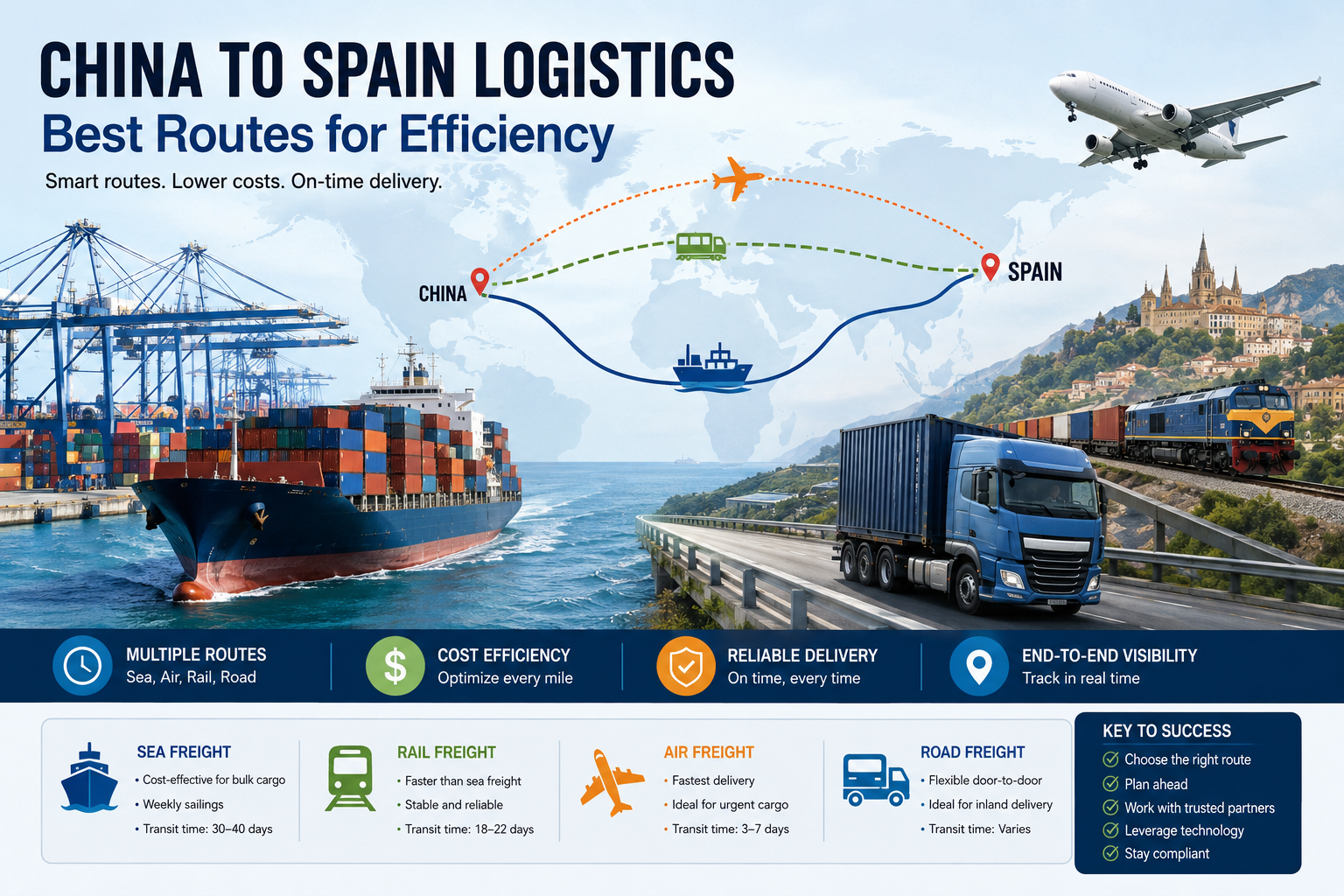
Typical sea transit from China to Spain ranges from 28 to 40 days, depending on the port of departure, route, and shipping line. Delays due to seasonal congestion, weather disruptions, or port strikes are par for the course, so building buffer times into delivery schedules is essential. Efficient planning ensures that supply chains remain resilient, even when the unexpected hits.
5. Air Freight Options
5.1 Major Air Cargo Hubs in China
Air cargo hubs such as Shanghai Pudong, Beijing Capital, and Guangzhou Baiyun offer high-frequency flights and reliable handling services. Air freight is particularly advantageous for high-value, time-sensitive goods, where a few days can make a significant difference in market responsiveness.
5.2 Spanish Airport Gateways
Madrid Barajas and Barcelona El Prat airports are the main conduits for air imports from China. Their customs facilities, cargo handling capabilities, and connectivity to European road networks make them ideal for urgent shipments. Coordinating with local ground transport ensures that air freight doesn’t lose its speed advantage upon arrival.
5.3 Air Freight Cost Analysis
Air freight is undeniably faster but also significantly more expensive than sea freight. Cost-benefit analysis must factor in inventory carrying costs, potential lost sales due to delays, and the value of goods being shipped. Often, a hybrid approach—air for critical items, sea for bulk—strikes the perfect balance.
6. Rail Freight Solutions
6.1 China-Europe Rail Corridors
China-Europe rail corridors have emerged as a viable alternative to sea and air, offering transit times of 18-25 days. These rail lines traverse Central Asia and Eastern Europe before reaching Spain, providing a predictable schedule with lower carbon emissions compared to air transport. China-Europe Rail Network
6.2 Key Transit Hubs for Spain
Key rail hubs such as Madrid and Zaragoza serve as entry points into the Spanish distribution network. Efficient customs processing at these nodes is critical, as delays can negate the speed advantage that rail offers over maritime shipping.
6.3 Pros and Cons of Rail Freight
Rail freight combines moderate speed with lower cost compared to air but is constrained by limited capacity and route inflexibility. Procurement engineers must weigh these factors, considering the nature of the cargo and its delivery criticality before committing to rail solutions.
7. Road Freight Considerations
7.1 Cross-Border Trucking Routes
Road transport complements sea and rail shipping by enabling door-to-door delivery. Efficient route planning, considering traffic patterns, tolls, and border checkpoints, ensures timely arrival without unnecessary detours or delays.
7.2 Legal and Regulatory Requirements
Cross-border
Cross-border trucking is governed by a web of regulations, including cabotage restrictions, driver hours, vehicle standards, and insurance requirements. Staying compliant is non-negotiable to prevent fines and shipment delays.
7.3 Cost and Time Efficiency
While road transport is flexible, its efficiency is influenced by fuel costs, tolls, and driver availability. Combining road freight with sea or rail can optimize both cost and delivery time, creating a seamless supply chain from factory to warehouse.
8. Multimodal Shipping Strategies
8.1 Combining Sea, Rail, and Road
Multimodal shipping leverages the strengths of each transportation mode. For example, sea transport handles bulk shipping cost-effectively, rail reduces transit times across continents, and road delivers to the final destination efficiently. Such combinations require precise coordination but yield substantial operational advantages.
8.2 How to Optimize Transit Time
Optimizing transit involves careful scheduling, buffer planning, and selecting carriers with synchronized operations. Leveraging predictive analytics can anticipate bottlenecks, while staggered shipments can maintain supply continuity without tying up capital unnecessarily.
8.3 Cost-Benefit Analysis
A rigorous cost-benefit analysis evaluates not just transport costs but inventory carrying, risk exposure, and opportunity costs. Sometimes spending a little more on faster transit prevents losses far greater than the premium, making the extra expense a no-brainer.
9. Customs Clearance in Spain
9.1 Required Documentation
Accurate customs documentation is the linchpin of smooth clearance. Bills of lading, commercial invoices, packing lists, certificates of origin, and HS codes must be prepared meticulously to avoid unnecessary scrutiny or delays.
9.2 Common Delays and How to Avoid Them
Delays often arise from incomplete paperwork, tariff misclassifications, or inspections. Proactive engagement with customs brokers and pre-clearance procedures can shave days off the clearance process and prevent costly downtime.
9.3 Role of Customs Brokers
Customs brokers act as navigators through the regulatory maze, ensuring compliance, calculating duties accurately, and expediting shipments through complex procedures. Their expertise is indispensable for procurement teams dealing with high-volume or high-value imports.
10. Cargo Tracking and Visibility
10.1 Real-Time Tracking Technologies
Modern IoT devices, GPS trackers, and RFID tags provide real-time visibility into cargo location and condition. This level of transparency is a game-changer, enabling proactive interventions when delays or deviations occur.
10.2 Integration with Supply Chain Systems
Tracking data integrated into enterprise resource planning (ERP) systems allows procurement engineers to synchronize inventory, anticipate shortages, and adjust orders dynamically. This connectivity reduces the blind spots that historically plagued international logistics.
10.3 Benefits for Brand Procurement Teams
End-to-end visibility empowers procurement teams to make data-driven decisions, optimize routes, and respond rapidly to disruptions. With real-time insights, they can fine-tune supply chain performance and maintain customer satisfaction.
11. Packaging and Handling
11.1 Choosing the Right Packaging
Proper packaging isn’t just about protection—it also influences handling efficiency, stacking optimization, and transport costs. Selecting durable, lightweight materials can reduce freight charges while safeguarding goods.
11.2 Minimizing Damage During Transit
Damage prevention hinges on cushioning, moisture control, and securing loads against vibration or shifting. Strategic packaging reduces claims and maintains the brand’s reputation for quality.
11.3 Special Considerations for High-Value Goods
High-value shipments demand extra vigilance—tamper-proof seals, GPS tracking, and insurance coverage are essential. Sometimes, even minor oversights can result in substantial losses.
12. Risk Management in Logistics
12.1 Common Risks in China-Spain Shipping
Risks include port congestion, weather disruptions, geopolitical tensions, and supplier insolvency. Awareness of these threats allows procurement teams to develop preemptive strategies rather than react after the fact.
12.2 Insurance Options for Freight
Marine insurance, all-risk coverage, and specialized policies safeguard investments, ensuring that financial losses are mitigated in case of accidents, theft, or natural disasters.
12.3 Contingency Planning
A robust contingency plan involves alternative routes, backup carriers, and pre-positioned inventory. Being prepared for the unexpected separates agile supply chains from those constantly firefighting.
13. Cost Optimization Strategies
13.1 Negotiating with Carriers
Effective negotiation leverages volume, long-term contracts, and seasonal patterns to secure favorable rates. Procurement engineers often deploy benchmarking against market indices to ensure competitiveness.
13.2 Volume Consolidation Techniques
Consolidating shipments reduces per-unit freight costs, optimizes container usage, and improves operational efficiency. Pooling cargo with other brands or suppliers is a tactic increasingly used in high-volume routes.
13.3 Seasonal Shipping Considerations
Seasonal spikes, such as Chinese New Year or European holidays, demand foresight. Early booking and flexible planning mitigate rate hikes and port congestion.
14. Sustainability in Logistics
14.1 Reducing Carbon Footprint
Eco-conscious logistics prioritizes low-emission transport modes, route optimization, and fuel-efficient vehicles. A greener supply chain aligns with global sustainability mandates and brand responsibility.
14.2 Eco-Friendly Transport Modes
Rail and sea freight are inherently more environmentally friendly than air, while electric and hybrid trucks reduce local emissions. Integrating these modes contributes to long-term sustainability goals.
14.3 Corporate Sustainability Goals
Many companies now tie procurement decisions to corporate ESG objectives, incentivizing the selection of suppliers and carriers who demonstrate commitment to sustainability.
15. Technology and Automation
15.1 Freight Management Software
Sophisticated freight management platforms streamline shipment planning, carrier selection, and cost tracking. For procurement engineers, these tools enhance transparency and operational control.
15.2 AI and Predictive Analytics in Routing
AI-powered predictive models analyze historical data, forecast demand, and recommend optimal routes, reducing delays and improving efficiency. These insights empower data-driven decision-making at every stage.
15.3 Automation in Warehousing and Handling
Automated warehouses, robotics, and smart sorting systems expedite cargo handling, reduce errors, and lower labor costs, creating a competitive edge in international logistics.
16. Case Studies and Best Practices
16.1 Successful China to Spain Shipments
Examining successful shipments highlights the importance of meticulous planning, trusted carrier partnerships, and adaptive strategies, providing a blueprint for repeatable success.
16.2 Lessons Learned from Delays
Analyzing delayed shipments uncovers common pitfalls, from underestimated transit times to customs mismanagement, offering invaluable lessons for proactive risk mitigation.
16.3 Recommendations for Efficient Routing
Best practices include multimodal integration, proactive carrier engagement, and predictive planning—an approach that balances speed, cost, and reliability.
17. Future Trends in China-Spain Logistics
17.1 Emerging Transport Technologies
Autonomous vehicles, drones, and AI-driven logistics platforms are set to revolutionize how goods move between China and Spain, promising faster, safer, and more efficient delivery options.
17.2 Geopolitical and Trade Policy Impacts
Trade agreements, tariffs, and international sanctions continue to shape the logistics landscape, requiring constant vigilance and adaptive procurement strategies.
17.3 Opportunities for Brand Procurement Teams
Proactive adoption of emerging technologies and route innovations positions procurement teams to gain competitive advantage, reduce costs, and improve service levels.
18. Conclusion
18.1 Summary of Key Routes and Strategies
Efficient China to Spain logistics relies on a blend of sea, air, rail, and road transport, supported by robust planning, risk mitigation, and data-driven decision-making.
18.2 Final Recommendations for Efficiency
Optimizing routes, consolidating shipments, leveraging technology, and maintaining strong supplier relationships are essential to achieving operational excellence.
18.3 Preparing for Future Supply Chain Challenges
Anticipating market trends, adopting sustainable practices, and embedding agility into the supply chain ensures resilience against disruptions and positions brands for long-term success.
Additional industry resources: