Table of Contents
China to Poland Logistics Risk Management Made Simple
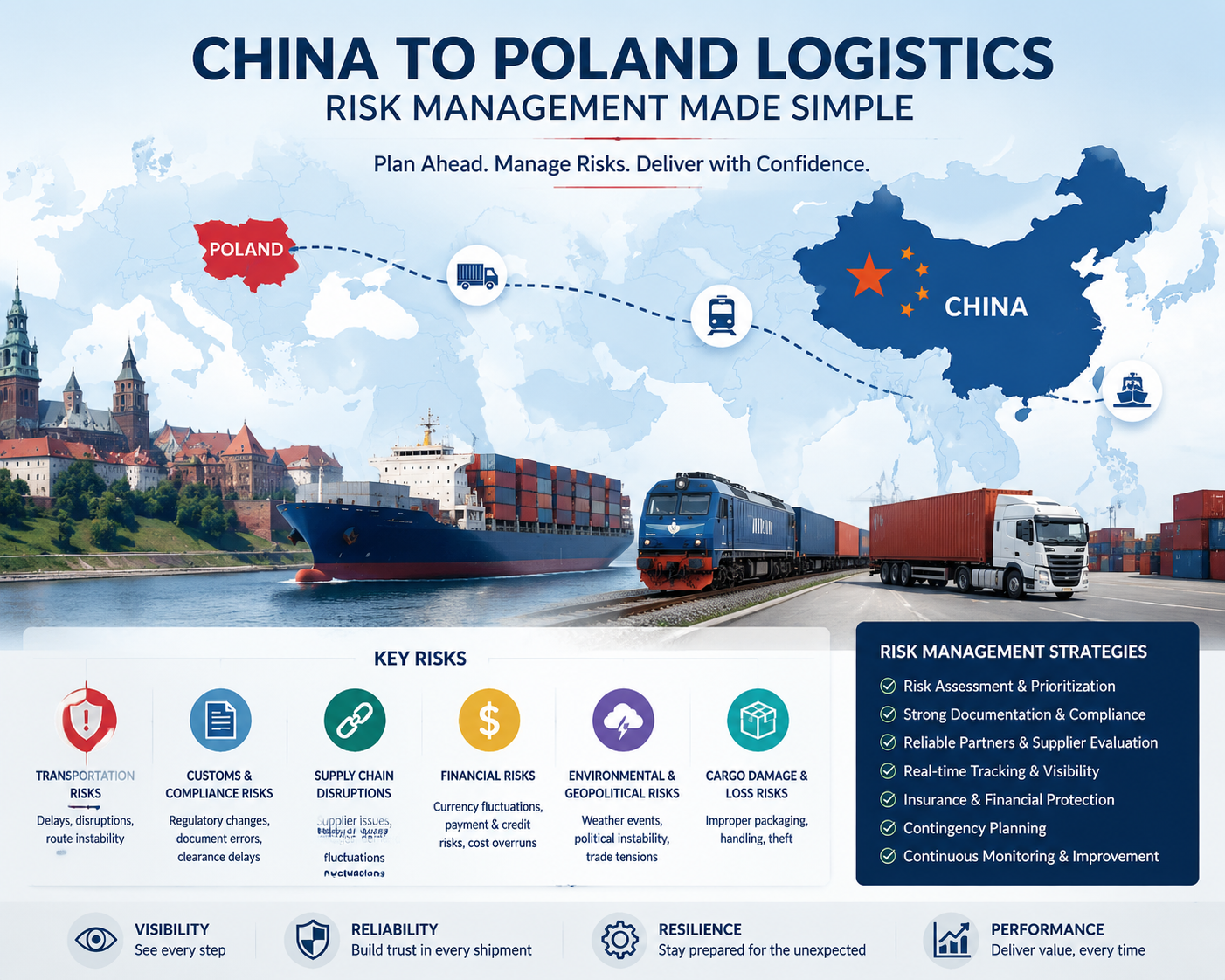
China to Poland logistics has become a backbone corridor for EU-bound procurement flows, especially for electronics, machinery components, consumer goods, and industrial assemblies. The dominant lanes typically combine sea freight via major Chinese ports like Shanghai and Ningbo, rail corridors through Central Asia under the China–Europe Railway Express, and increasingly agile air freight solutions for time-sensitive SKUs. From a purchase engineering perspective, this route is less about “shipping cargo” and more about orchestrating multi-node synchronization across customs regimes, transshipment hubs, and inland distribution centers in Poland such as Łódź and Warsaw.
Reference concepts: Logistics, Supply Chain, China–Europe Railway Express, Customs
1. Introduction to China to Poland Logistics
1.1 Overview of China to Poland trade routes
China to Poland logistics has become a backbone corridor for EU-bound procurement flows, especially for electronics, machinery components, consumer goods, and industrial assemblies. The dominant lanes typically combine sea freight via major Chinese ports like Shanghai and Ningbo, rail corridors through Central Asia under the China–Europe Railway Express, and increasingly agile air freight solutions for time-sensitive SKUs.
1.2 Importance of risk management in logistics
Risk management in this corridor is not optional overhead—it is structural engineering for supply continuity. Without a disciplined framework, even minor deviations can snowball into production stoppages and contractual penalties downstream.
1.3 Key challenges for global procurement professionals
Procurement engineers juggle volatile freight rates, geopolitical friction, port congestion, and compliance fragmentation across jurisdictions while maintaining cost discipline and delivery reliability.
2. Understanding Logistics Risks
2.1 Definition of logistics risk
Logistics risk refers to any uncertain event affecting the flow, timing, cost, or integrity of goods moving through the supply chain.
2.2 Types of risks in international shipping
Transport risk, regulatory risk, financial exposure, operational breakdowns, and force majeure events collectively shape the risk landscape.
2.3 Impact of unmanaged risks on business operations
Unmanaged risks lead to production downtime, inventory depletion, and cascading disruptions across procurement and distribution systems.
3. Common Risks in China to Poland Logistics
3.1 Transportation and transit risks
Delays, container rollovers, rail schedule instability, and port congestion frequently disrupt delivery timelines.
3.2 Customs and regulatory compliance risks
Incorrect HS codes, incomplete declarations, or regulatory misalignment can trigger inspections and clearance delays.
3.3 Supply chain disruption risks
Raw material shortages, supplier shutdowns, and demand spikes amplify upstream disruptions across long-distance supply chains.
4. Risk Assessment Strategies
4.1 Identifying potential risk factors
Mapping the entire logistics chain helps identify weak points such as transit variability and supplier instability.
4.2 Analyzing probability and impact
Risk scoring methods evaluate severity, likelihood, and detectability of disruptions.
4.3 Prioritizing risks for mitigation
Resources are allocated to high-impact risks to maximize supply chain resilience.
5. Shipping Documentation Risks
5.1 Importance of accurate paperwork
Documentation serves as the legal foundation of international trade compliance.
5.2 Common documentation errors
Mismatched HS codes, incorrect descriptions, and inconsistent weights frequently cause customs delays.
5.3 Strategies to avoid paperwork delays
Standardized templates and automated validation systems significantly reduce documentation errors.
6. Customs and Regulatory Compliance
6.1 Overview of Poland import regulations
Poland follows EU customs regulations requiring strict classification, VAT compliance, and product certification adherence.
6.2 China export compliance requirements
Export declarations and inspection certificates must be properly completed before shipment release.
6.3 Tools for ensuring regulatory adherence
Digital compliance platforms and ERP-integrated customs tools reduce manual errors and improve accuracy.
7. Transportation and Freight Risks
7.1 Choosing the right shipping mode
Sea freight is cost-efficient, rail balances speed and cost, and air freight prioritizes urgency.
7.2 Risk factors for sea, air, and rail freight
Each transport mode carries unique vulnerabilities such as congestion, capacity limits, or schedule rigidity.
7.3 Tips for securing cargo in transit
Proper packaging, real-time tracking, and carrier vetting reduce transit-related risks.
8. Supply Chain Disruption Risks
8.1 Causes of supply chain interruptions
Geopolitical tensions, labor shortages, and cyber disruptions contribute to instability.
8.2 Strategies for maintaining continuity
Dual sourcing and buffer inventory strategies enhance resilience.
8.3 Contingency planning for unexpected events
Predefined alternative routing and emergency response plans ensure continuity.
9. Partner and Vendor Risk Management
9.1 Evaluating freight forwarders and carriers
Performance history, reliability, and network coverage are key evaluation metrics.
9.2 Assessing supplier reliability
Audits and production history analysis help evaluate supplier stability.
9.3 Building strong logistics partnerships
Long-term collaboration improves communication and operational predictability.
10. Technology in Risk Mitigation
10.1 Role of tracking and monitoring tools
Real-time tracking systems improve visibility across supply chain nodes.
10.2 Data-driven risk analysis
Predictive analytics identify delay patterns and optimize planning.
10.3 Automation for reducing human error
Automation reduces manual input errors in documentation and routing.
11. Insurance Strategies for Logistics
11.1 Types of logistics insurance
Marine cargo insurance and all-risk coverage provide financial protection.
11.2 Determining coverage for China to Poland shipments
Coverage depends on cargo value and transport risk exposure.
11.3 Claims management and risk transfer
Insurance transfers financial risk from shipper to insurer under defined conditions.
12. Financial Risk Management
12.1 Managing currency fluctuations
Exchange rate volatility impacts landed cost predictability.
12.2 Payment and credit risks
Letters of credit and credit insurance reduce default exposure.
12.3 Cost control and budgeting strategies
Total landed cost modeling ensures financial accuracy.
13. Environmental and Geopolitical Risks
13.1 Impact of global events on logistics
Trade disputes and global crises significantly alter shipping flows.
13.2 Weather-related transportation risks
Storms and seasonal disruptions impact sea and air freight reliability.
13.3 Strategies for mitigating geopolitical uncertainties
Route diversification and supplier diversification reduce dependency risks.
14. Packaging and Cargo Protection
14.1 Importance of secure packaging
Packaging integrity directly impacts cargo safety during transit.
14.2 Methods to prevent damage during transit
Shock absorption and humidity control materials reduce damage risk.
14.3 Specialized packaging for high-value goods
Electronics and precision components require anti-static and vibration-resistant packaging.
15. Monitoring and Reporting Risks
15.1 Implementing KPI tracking
Key metrics include delivery performance and damage rates.
15.2 Real-time monitoring of shipments
Live dashboards enable immediate corrective actions.
15.3 Reporting and analyzing risk trends
Trend analysis identifies systemic inefficiencies across logistics flows.
16. Continuous Improvement in Risk Management
16.1 Reviewing past logistics performance
Post-shipment reviews highlight recurring operational issues.
16.2 Updating risk management protocols
Frameworks must evolve with changing global conditions.
16.3 Training staff for proactive risk mitigation
Skilled teams reduce operational mistakes and improve responsiveness.
17. Case Studies and Real-World Examples
17.1 Successful risk management in China to Poland shipments
Companies using multi-route logistics achieve higher delivery stability.
17.2 Lessons from logistics failures
Over-reliance on single carriers often leads to severe disruptions.
17.3 Actionable insights for procurement professionals
Diversification and visibility systems are essential for resilience.
18. Conclusion and Key Takeaways
18.1 Summary of risk management strategies
Risk management integrates compliance, visibility, and operational redundancy.
18.2 Future trends in China to Poland logistics
AI forecasting and digital logistics ecosystems will reshape the industry.
18.3 Final recommendations for brand procurement professionals
Logistics should be treated as strategic engineering rather than a cost center.
China to Poland Logistics Risk Management Made Simple
China to Poland logistics has become a backbone corridor for EU-bound procurement flows, especially for electronics, machinery components, consumer goods, and industrial assemblies. The dominant lanes typically combine sea freight via major Chinese ports like Shanghai and Ningbo, rail corridors through Central Asia under the China–Europe Railway Express, and increasingly agile air freight solutions for time-sensitive SKUs. From a purchase engineering perspective, this route is less about “shipping cargo” and more about orchestrating multi-node synchronization across customs regimes, transshipment hubs, and inland distribution centers in Poland such as Łódź and Warsaw.
Reference concepts: Logistics, Supply Chain, China–Europe Railway Express, Customs
1. Introduction to China to Poland Logistics
1.1 Overview of China to Poland trade routes
China to Poland logistics has become a backbone corridor for EU-bound procurement flows, especially for electronics, machinery components, consumer goods, and industrial assemblies. The dominant lanes typically combine sea freight via major Chinese ports like Shanghai and Ningbo, rail corridors through Central Asia under the China–Europe Railway Express, and increasingly agile air freight solutions for time-sensitive SKUs.
1.2 Importance of risk management in logistics
Risk management in this corridor is not optional overhead—it is structural engineering for supply continuity. Without a disciplined framework, even minor deviations can snowball into production stoppages and contractual penalties downstream.
1.3 Key challenges for global procurement professionals
Procurement engineers juggle volatile freight rates, geopolitical friction, port congestion, and compliance fragmentation across jurisdictions while maintaining cost discipline and delivery reliability.
2. Understanding Logistics Risks
2.1 Definition of logistics risk
Logistics risk refers to any uncertain event affecting the flow, timing, cost, or integrity of goods moving through the supply chain.
2.2 Types of risks in international shipping
Transport risk, regulatory risk, financial exposure, operational breakdowns, and force majeure events collectively shape the risk landscape.
2.3 Impact of unmanaged risks on business operations
Unmanaged risks lead to production downtime, inventory depletion, and cascading disruptions across procurement and distribution systems.
3. Common Risks in China to Poland Logistics
3.1 Transportation and transit risks
Delays, container rollovers, rail schedule instability, and port congestion frequently disrupt delivery timelines.
3.2 Customs and regulatory compliance risks
Incorrect HS codes, incomplete declarations, or regulatory misalignment can trigger inspections and clearance delays.
3.3 Supply chain disruption risks
Raw material shortages, supplier shutdowns, and demand spikes amplify upstream disruptions across long-distance supply chains.
4. Risk Assessment Strategies
4.1 Identifying potential risk factors
Mapping the entire logistics chain helps identify weak points such as transit variability and supplier instability.
4.2 Analyzing probability and impact
Risk scoring methods evaluate severity, likelihood, and detectability of disruptions.
4.3 Prioritizing risks for mitigation
Resources are allocated to high-impact risks to maximize supply chain resilience.
5. Shipping Documentation Risks
5.1 Importance of accurate paperwork
Documentation serves as the legal foundation of international trade compliance.
5.2 Common documentation errors
Mismatched HS codes, incorrect descriptions, and inconsistent weights frequently cause customs delays.
5.3 Strategies to avoid paperwork delays
Standardized templates and automated validation systems significantly reduce documentation errors.
6. Customs and Regulatory Compliance
6.1 Overview of Poland import regulations
Poland follows EU customs regulations requiring strict classification, VAT compliance, and product certification adherence.
6.2 China export compliance requirements
Export declarations and inspection certificates must be properly completed before shipment release.
6.3 Tools for ensuring regulatory adherence
Digital compliance platforms and ERP-integrated customs tools reduce manual errors and improve accuracy.
7. Transportation and Freight Risks
7.1 Choosing the right shipping mode
Sea freight is cost-efficient, rail balances speed and cost, and air freight prioritizes urgency.
7.2 Risk factors for sea, air, and rail freight
Each transport mode carries unique vulnerabilities such as congestion, capacity limits, or schedule rigidity.
7.3 Tips for securing cargo in transit
Proper packaging, real-time tracking, and carrier vetting reduce transit-related risks.
8. Supply Chain Disruption Risks
8.1 Causes of supply chain interruptions
Geopolitical tensions, labor shortages, and cyber disruptions contribute to instability.
8.2 Strategies for maintaining continuity
Dual sourcing and buffer inventory strategies enhance resilience.
8.3 Contingency planning for unexpected events
Predefined alternative routing and emergency response plans ensure continuity.
9. Partner and Vendor Risk Management
9.1 Evaluating freight forwarders and carriers
Performance history, reliability, and network coverage are key evaluation metrics.
9.2 Assessing supplier reliability
Audits and production history analysis help evaluate supplier stability.
9.3 Building strong logistics partnerships
Long-term collaboration improves communication and operational predictability.
10. Technology in Risk Mitigation
10.1 Role of tracking and monitoring tools
Real-time tracking systems improve visibility across supply chain nodes.
10.2 Data-driven risk analysis
Predictive analytics identify delay patterns and optimize planning.
10.3 Automation for reducing human error
Automation reduces manual input errors in documentation and routing.
11. Insurance Strategies for Logistics
11.1 Types of logistics insurance
Marine cargo insurance and all-risk coverage provide financial protection.
11.2 Determining coverage for China to Poland shipments
Coverage depends on cargo value and transport risk exposure.
11.3 Claims management and risk transfer
Insurance transfers financial risk from shipper to insurer under defined conditions.
12. Financial Risk Management
12.1 Managing currency fluctuations
Exchange rate volatility impacts landed cost predictability.
12.2 Payment and credit risks
Letters of credit and credit insurance reduce default exposure.
12.3 Cost control and budgeting strategies
Total landed cost modeling ensures financial accuracy.
13. Environmental and Geopolitical Risks
13.1 Impact of global events on logistics
Trade disputes and global crises significantly alter shipping flows.
13.2 Weather-related transportation risks
Storms and seasonal disruptions impact sea and air freight reliability.
13.3 Strategies for mitigating geopolitical uncertainties
Route diversification and supplier diversification reduce dependency risks.
14. Packaging and Cargo Protection
14.1 Importance of secure packaging
Packaging integrity directly impacts cargo safety during transit.
14.2 Methods to prevent damage during transit
Shock absorption and humidity control materials reduce damage risk.
14.3 Specialized packaging for high-value goods
Electronics and precision components require anti-static and vibration-resistant packaging.
15. Monitoring and Reporting Risks
15.1 Implementing KPI tracking
Key metrics include delivery performance and damage rates.
15.2 Real-time monitoring of shipments
Live dashboards enable immediate corrective actions.
15.3 Reporting and analyzing risk trends
Trend analysis identifies systemic inefficiencies across logistics flows.
16. Continuous Improvement in Risk Management
16.1 Reviewing past logistics performance
Post-shipment reviews highlight recurring operational issues.
16.2 Updating risk management protocols
Frameworks must evolve with changing global conditions.
16.3 Training staff for proactive risk mitigation
Skilled teams reduce operational mistakes and improve responsiveness.
17. Case Studies and Real-World Examples
17.1 Successful risk management in China to Poland shipments
Companies using multi-route logistics achieve higher delivery stability.
17.2 Lessons from logistics failures
Over-reliance on single carriers often leads to severe disruptions.
17.3 Actionable insights for procurement professionals
Diversification and visibility systems are essential for resilience.
18. Conclusion and Key Takeaways
18.1 Summary of risk management strategies
Risk management integrates compliance, visibility, and operational redundancy.
18.2 Future trends in China to Poland logistics
AI forecasting and digital logistics ecosystems will reshape the industry.
18.3 Final recommendations for brand procurement professionals
Logistics should be treated as strategic engineering rather than a cost center.