Table of Contents
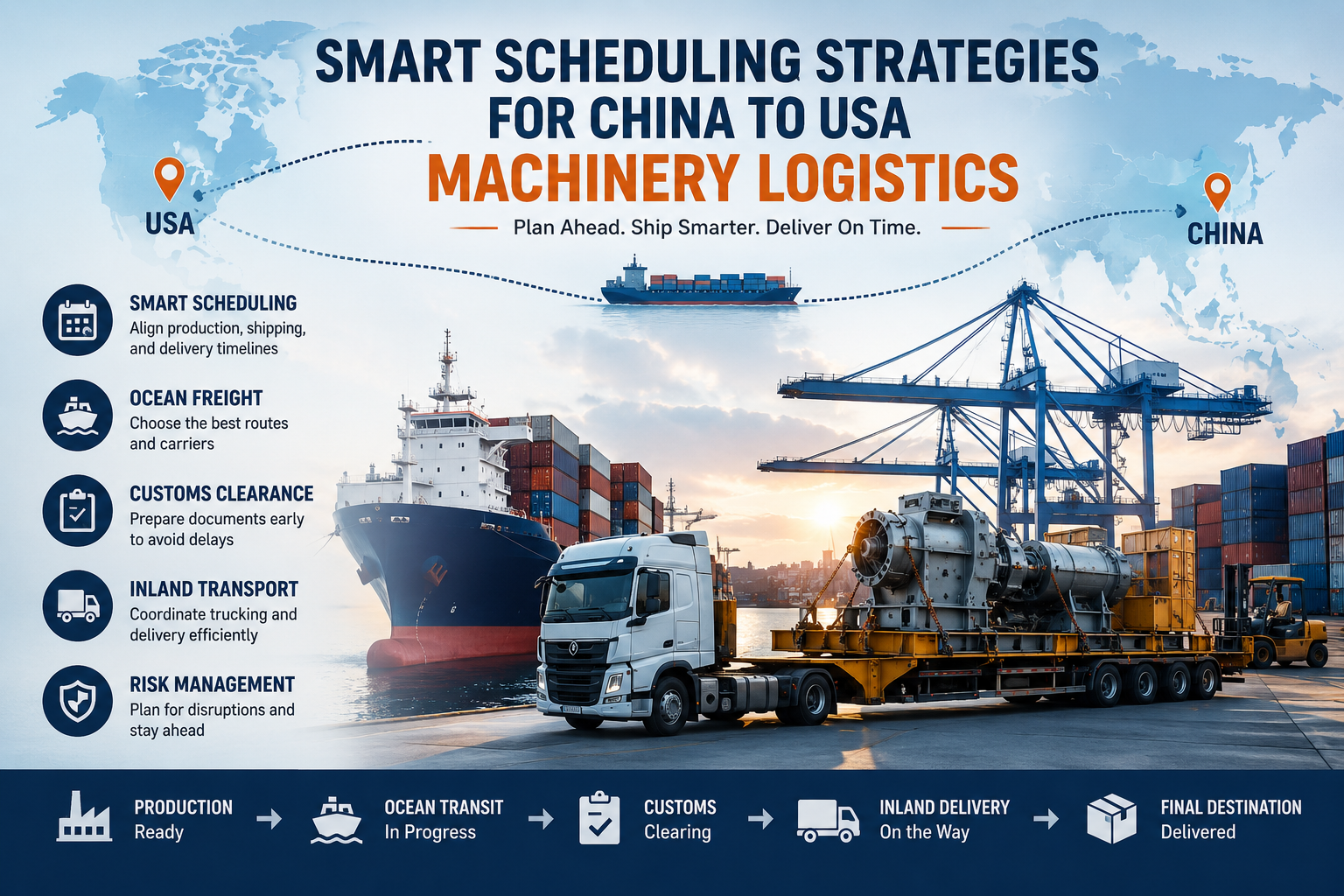
China to USA Machinery Logistics Smart Scheduling Strategies
1. Overview of China to USA Machinery Logistics Scheduling
1.1 Why scheduling matters in cross-border machinery transport
In machinery procurement, timing is not just a KPI—it is the backbone of project feasibility. A single missed vessel can ripple through installation windows, commissioning schedules, and downstream production launches like a domino chain collapsing in slow motion. From a purchase engineer’s desk, it’s not just about moving steel from point A to B; it’s about orchestrating a synchronized industrial ballet where every gear turns in rhythm with global supply chains.
1.2 Key stakeholders involved in the scheduling process
The scheduling ecosystem is a multi-headed beast: suppliers, freight forwarders, trucking vendors, port operators, customs brokers, carriers, and end-client project teams all tug on the same timeline. Each party runs on its own clock, its own priorities, and sometimes its own version of “urgent.” Keeping these players aligned is like herding cats across continents, except the cats are 40-ton CNC machines.
1.3 Common timing challenges in international shipments
Delays rarely come announced. They creep in through production slippage, vessel rollovers, port congestion, and documentation hiccups. One weak link—say, a late inspection certificate—can snowball into missed cutoffs. In practice, schedules are less “set in stone” and more “etched in wet sand near high tide.”
2. Understanding Machinery Shipping Requirements
2.1 Heavy equipment classification and handling needs
Machinery is not homogeneous cargo; it spans precision CNC systems, hydraulic presses, and oversized industrial assemblies that demand bespoke handling protocols. Weight distribution, center of gravity, and shock sensitivity dictate whether a shipment behaves like a gentleman or a ticking time bomb in transit. Learn more about heavy equipment handling.
2.2 Packaging and crating lead time considerations
Crating is often underestimated until it becomes the bottleneck. Custom steel frames, anti-rust coatings, vacuum sealing, and moisture barrier systems require meticulous lead time planning. Rushing this stage is like trying to weld under pressure—technically possible, but nobody sleeps well afterward.
2.3 Special handling for oversized or precision machinery
Oversized cargo triggers a different logistical universe altogether: route surveys, lifting plans, escort vehicles, and sometimes even temporary infrastructure adjustments. Precision machinery, on the other hand, demands vibration damping and micro-movement protection—because even a slight jolt can turn calibrated perfection into expensive scrap.
3. Production Planning Alignment with Shipping
3.1 Synchronizing manufacturing and freight readiness
Production and shipping must dance in lockstep. If production finishes early but freight isn’t ready, capital sits idle. If freight arrives too soon, chaos ensues at the factory gate. The sweet spot lies in aligning production milestones with vessel cutoffs like a well-tuned gearbox engaging at just the right RPM.
3.2 Buffer time for quality inspection and testing
Quality inspection is not a box-ticking ritual—it is the last line of defense before global embarrassment. Factoring in inspection buffers ensures that minor defects don’t metastasize into international disputes. In real terms, this is where “better safe than sorry” becomes operational doctrine.
3.3 Avoiding production bottlenecks before dispatch
Bottlenecks often emerge at finishing stages: calibration delays, missing components, or last-minute design tweaks. These small cracks widen under shipping pressure. Smart scheduling anticipates these choke points and builds slack into the system before the pressure cooker reaches full boil.
4. Booking Ocean Freight Space in Advance
4.1 Peak season capacity constraints on China–USA routes
The transpacific corridor behaves like rush hour on steroids. Peak seasons—pre-holiday surges and fiscal year-end rushes—tighten capacity to the point where booking becomes a competitive sport. If you’re late, you’re basically left scrolling for miracles.
4.2 Carrier booking windows and cutoff timelines
Every carrier operates on rigid cutoff timelines that feel unforgiving but are absolutely non-negotiable. Missing a gate-in deadline doesn’t just delay cargo; it resets the entire schedule narrative. Think of it as missing your flight while still standing in line at security.
4.3 Risk management for space shortages
Experienced planners don’t gamble on a single vessel. They hedge with backup sailings, alternative carriers, and even flexible routing strategies. It’s not paranoia—it’s just seasoned realism in a market where space evaporates faster than morning coffee on a cold dock.
5. Choosing Between FCL and LCL Timing Strategies
5.1 Full container load scheduling advantages
FCL offers control, predictability, and fewer handovers. For machinery, it’s the equivalent of having your own private lane on a congested highway. Less touching, less risk, and tighter schedule integrity.
5.2 Less than container load consolidation delays
LCL introduces dependency on consolidation cycles, which can feel like waiting for everyone else to finish packing before your trip begins. While cost-effective, it introduces variability that purchase engineers often find… spiritually exhausting.
5.3 Hybrid scheduling approaches for mixed shipments
In real-world operations, hybrid strategies often win. Critical components go FCL, ancillary parts ride LCL. It’s a pragmatic split—balancing cost discipline with schedule certainty, like having both a sports car and a utility truck in the same fleet.
6. Port Selection Strategy in China
6.1 Major export ports and their sailing frequency
Ports like Shanghai, Ningbo, and Shenzhen offer high-frequency sailings to the USA, creating a dense web of scheduling options. Frequency equals flexibility, and flexibility is currency in logistics. Port of Shanghai official site
6.2 Port congestion and seasonal fluctuations
Congestion is the silent schedule killer. When ports jam up, even perfectly planned shipments get sucked into the vortex of yard delays and berth waiting games. It’s not uncommon for cargo to spend more time waiting than sailing.
6.3 Matching port choice with factory location
The smartest move is geographic alignment—minimizing inland haul distance while maximizing sailing options. A well-chosen port reduces cost, risk, and stress levels across the entire chain.
7. USA Port of Entry Scheduling Considerations
7.1 West Coast vs East Coast transit planning
West Coast ports offer speed; East Coast ports offer distribution reach. The choice depends on whether urgency or inland coverage dominates the procurement strategy. It’s a classic trade-off between sprint and marathon.
7.2 Customs processing time variations by port
Not all ports process cargo at the same velocity. Some are optimized for high throughput; others are notorious for procedural drag. Understanding these nuances can shave days off lead time.
7.3 Inland transportation coordination after arrival
Arrival is not the finish line—it’s halftime. Coordinating drayage, rail, or heavy haul trucking is where schedules either stay intact or unravel into operational chaos. US Customs and Border Protection trade guidelines
8. Transit Time Optimization Across Shipping Routes
8.1 Direct vs transshipment route planning
Direct routes minimize handling and risk. Transshipment routes may offer flexibility or cost savings but introduce additional nodes of uncertainty. Every transfer is another opportunity for delay.
8.2 Impact of weather and maritime conditions
The ocean is not a static conveyor belt. Typhoons, seasonal storms, and port weather disruptions inject volatility into even the most optimized schedules. It’s the uncontrollable variable everyone respects but nobody fully tames.
8.3 Carrier schedule reliability comparisons
Not all carriers are created equal. Historical on-time performance becomes a critical decision factor, especially when downstream production depends on precision delivery windows.
9. Customs Clearance Timing Strategy
9.1 Pre-clearance documentation preparation
Prepping documents before vessel arrival is a non-negotiable discipline. It transforms customs clearance from a reactive scramble into a controlled process.
9.2 Common causes of customs delays
Errors in HS codes, missing certificates, or inconsistent descriptions can stall clearance like a red light at peak traffic. Small mistakes, big consequences.
9.3 Coordination with customs brokers
A skilled customs broker is less a vendor and more a tactical ally. Their expertise can mean the difference between smooth release and prolonged detention. National Customs Brokers & Forwarders Association of America
10. Documentation Preparation Timeline
10.1 Commercial invoice and packing list readiness
These documents are the DNA of shipment identity. Any mismatch between them and physical cargo triggers scrutiny and delays.
10.2 Certificates and compliance documents scheduling
Machinery often requires safety, origin, or compliance certifications that must be obtained well ahead of shipment. Late certification is a schedule killer.
10.3 Avoiding last-minute documentation errors
Rushed paperwork invites chaos. A structured checklist approach prevents errors that could derail entire vessel bookings.
11. Factory Pickup and Inland Transport Scheduling
11.1 Coordination between factory and trucking providers
Factory readiness must align precisely with truck arrival. Misalignment leads to idle trucks or congested factory yards.
11.2 Lead time for heavy haul trucking arrangements
Heavy haul is not Uber. Permits, escorts, and route surveys require advance planning that can’t be compressed at the last minute.
11.3 Managing road permits for oversized cargo
Oversized transport permits often dictate timing windows for movement. Missing these windows can push schedules back by days or weeks.
12. Multi-Stage Logistics Coordination
12.1 Synchronizing trucking, port, and ocean schedules
Each stage is interdependent. One delay cascades forward unless buffer strategies are in place.
12.2 Avoiding idle time at transfer points
Idle time is invisible cost accumulation. Smart scheduling eliminates dwell time wherever possible.
12.3 Digital tracking for real-time coordination
Visibility platforms reduce guesswork. Real-time tracking transforms logistics from reactive to predictive.
13. Risk Buffer Planning in Shipping Timelines
13.1 Building contingency time into schedules
Buffer time is not inefficiency—it’s insurance against systemic unpredictability.
13.2 Managing unexpected delays in transit
Delays are inevitable; unmanaged delays are catastrophic. Proactive adjustment keeps projects on track.
13.3 Emergency rerouting strategies
When disruptions occur, rerouting through alternative ports or carriers becomes the tactical escape valve.
14. Seasonal Impact on Scheduling Efficiency
14.1 Chinese New Year production disruptions
Factories slow or shut down, creating upstream compression that impacts global timelines.
14.2 Peak shipping seasons to the USA
Pre-holiday demand surges tighten capacity and inflate costs, requiring early booking discipline.
14.3 Weather-related delays in different months
Seasonal storms in both Pacific and North American regions introduce cyclical uncertainty into transit planning.
15. Carrier Selection and Schedule Reliability
15.1 Comparing major ocean carriers servicing USA routes
Carrier selection impacts everything from transit speed to schedule stability. Differences are not marginal—they are operationally significant.
15.2 On-time performance metrics for logistics planning
Historical punctuality data is a key procurement input, not just a nice-to-have metric.
15.3 Long-term carrier contract advantages
Strategic contracts secure space, stabilize rates, and reduce exposure to market volatility.
16. Technology Tools for Logistics Scheduling
16.1 Shipment tracking and visibility platforms
End-to-end visibility reduces uncertainty and improves decision speed across stakeholders.
16.2 AI-based predictive delay systems
Predictive analytics help anticipate disruptions before they materialize, allowing proactive adjustments.
16.3 Integration with ERP and supply chain systems
Seamless integration ensures logistics data flows into procurement systems, enabling smarter, faster, and more synchronized decision-making across global operations.