If you have ever stared at a quotation that says “FOB Shenzhen” or “DDP Los Angeles” and wondered what you are actually agreeing to, you are not alone. Incoterms 2020 are the three-letter rules that decide who pays for freight, who carries the risk if cargo is damaged, and who deals with customs. Get them wrong and a “cheap” quote can turn into a very expensive surprise.
This guide explains all eleven Incoterms 2020 rules in plain English, with a comparison chart, real examples from China shipping, and a simple process for choosing the right term. No legal jargon — just what matters when your goods are on the water.
The short answer: Incoterms 2020 are eleven standardised international trade terms published by the International Chamber of Commerce (ICC). Seven work for any transport mode (EXW, FCA, CPT, CIP, DAP, DPU, DDP) and four are for sea and inland waterway only (FAS, FOB, CFR, CIF). Each rule defines exactly where the seller’s costs end and where the buyer’s risks begin.
What are Incoterms, really?
Incoterms — short for International Commercial Terms — were first published by the ICC in 1936 and updated roughly every decade. The current version, Incoterms 2020, took effect on 1 January 2020.
They are not laws. They are a set of definitions that buyers and sellers agree to include in a contract. When both sides write “FOB Shanghai, Incoterms 2020” into a purchase order, they are agreeing to one shared meaning for a handful of practical questions:
- Who pays for loading, main carriage, insurance, import duties and delivery?
- Where does risk transfer — the exact point at which damage becomes the buyer’s problem?
- Who handles customs on export and on import?
That is the whole point. One three-letter term replaces pages of negotiation about who does what. (ICC official Incoterms 2020 page)
What Incoterms do not cover
This is where a lot of confusion starts. Incoterms do not set the price of the goods, define payment terms, transfer ownership, or tell you what happens if the cargo arrives late. Those belong in the sales contract. An Incoterm only covers the delivery obligations between buyer and seller — cost, risk and clearance. If your contract is silent on payment or title, adding “CIF” will not fix it.
All 11 Incoterms 2020 at a glance
The ICC splits the rules into two groups by transport mode. This is a cleaner way to think about them than the old E/F/C/D letters, but both groupings appear in daily use.
| Rule | Full name | Mode | Seller pays up to | Risk transfers at | Use when |
|---|---|---|---|---|---|
| EXW | Ex Works | Any | Goods made available at their premises | Buyer takes over at seller’s door | Buyer controls the whole supply chain |
| FCA | Free Carrier | Any | Goods handed to buyer’s carrier | Handover to carrier | Containerised / air cargo, better than FOB |
| FAS | Free Alongside Ship | Sea only | Goods placed alongside the vessel | Alongside the ship | Bulk or project cargo |
| FOB | Free On Board | Sea only | Goods loaded on board the vessel | On board the ship | Traditional bulk sea shipments |
| CFR | Cost and Freight | Sea only | Main freight to destination port | On board at origin (not destination) | Buyer arranges insurance |
| CIF | Cost, Insurance and Freight | Sea only | Freight + minimum insurance to destination port | On board at origin | Buyer wants insurance included |
| CPT | Carriage Paid To | Any | Main carriage to named destination | Handover to first carrier | Multimodal, buyer insures |
| CIP | Carriage and Insurance Paid To | Any | Carriage + full insurance to destination | Handover to first carrier | Multimodal, insurance included |
| DAP | Delivered at Place | Any | Delivery to named place, duty unpaid | Goods ready for unloading at destination | Buyer handles import duty & clearance |
| DPU | Delivered at Place Unloaded | Any | Delivery and unloading at named place | After unloading at destination | Buyer wants seller to unload |
| DDP | Delivered Duty Paid | Any | Everything, including import duty & clearance | Goods placed at buyer’s disposal | True door-to-door, buyer wants zero hassle |
The critical idea: for the C-terms (CFR, CIF, CPT, CIP), the seller pays the freight to the destination, but risk still transfers at origin. This mismatch is the single most misunderstood part of Incoterms. If the ship sinks mid-voyage under CIF, it is the buyer’s loss — the buyer then claims against the insurance the seller was obliged to arrange.
Group 1: The seven rules that work for any transport mode
EXW — Ex Works (named place)
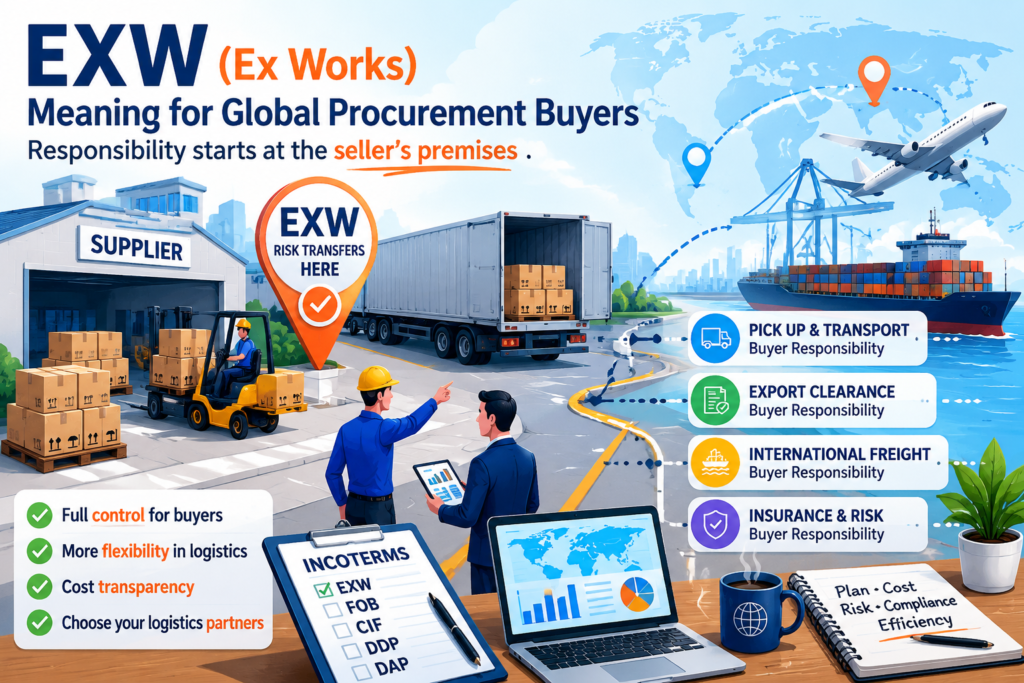
The seller’s job is the smallest it can be: make the goods available at their factory, warehouse or office. From that moment, every cost and every risk is the buyer’s — loading, trucking, export clearance, ocean freight, insurance, import duty, the lot.
Where it goes wrong: EXW is often quoted by Chinese factories because it looks cheap, but if the buyer has no entity in China, they cannot handle Chinese export customs clearance themselves. In practice the forwarder ends up doing it anyway, with extra documentation and liability gaps. For most China-origin shipments, FCA is the safer replacement. See our full EXW breakdown for the practical pitfalls.
FCA — Free Carrier (named place)
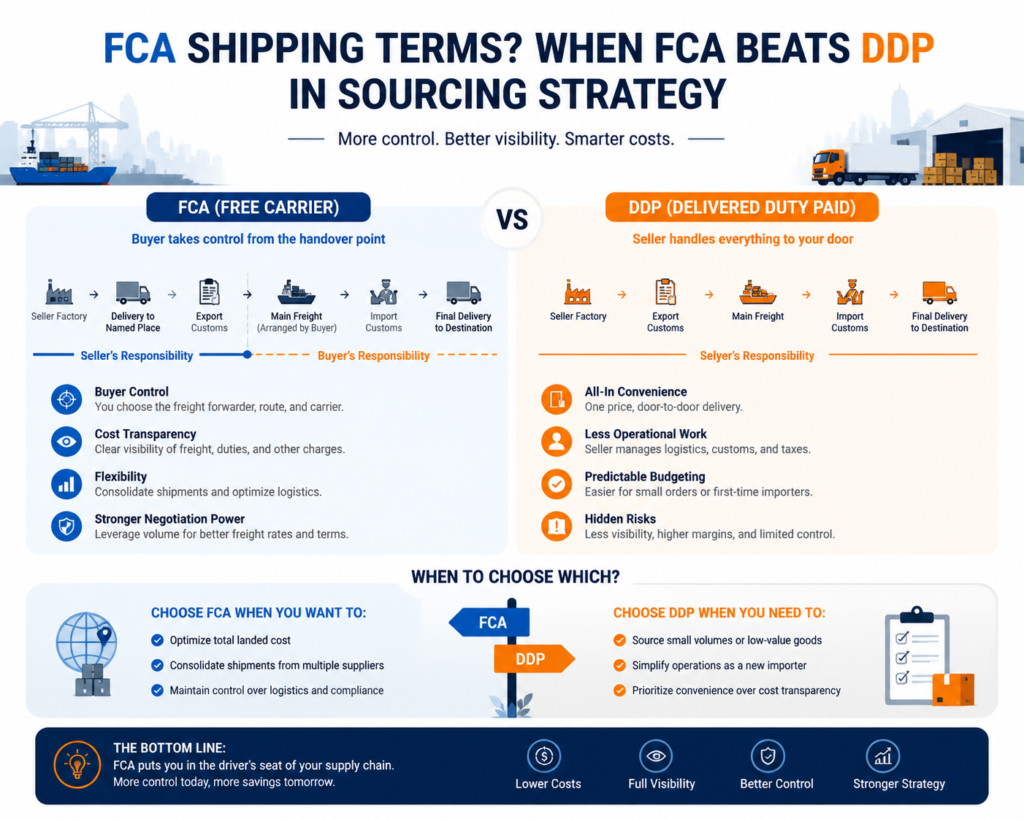
The seller clears the goods for export and hands them to the carrier you nominate at an agreed place. Risk transfers at that handover. FCA works for sea, air, rail and truck — and unlike FOB, it handles container cargo properly, because the carrier takes over at the terminal rather than “on board” a ship.
For containerised shipments out of China, FCA is usually the correct modern alternative to the old FOB habit. We explain the difference in detail in FCA shipping terms.
CPT — Carriage Paid To (named destination)
The seller contracts and pays for carriage to the named destination, but risk passes to the buyer as soon as the goods are handed to the first carrier. The buyer arranges insurance. On a China-to-Europe rail shipment, for example, risk transfers when the container is loaded at the Chinese terminal — even though the seller paid the rail freight all the way to Duisburg.
CIP — Carriage and Insurance Paid To (named destination)
Same as CPT, but the seller must also arrange insurance. Incoterms 2020 raised the bar here: under CIP the seller must provide Institute Cargo Clauses (A) cover — the broad “all risks” level — where Incoterms 2010 only required the narrower Clause (C). If your supplier quotes CIP with basic cover, that is a 2020 compliance issue worth raising. (ICC changes overview)
DAP — Delivered at Place (named destination)
The seller delivers to a named place — a warehouse, a terminal, even a buyer’s premises — with the goods still on the arriving vehicle, ready for the buyer to unload. Import duties and taxes are the buyer’s responsibility. This is the term most often paired with “DAP Los Angeles, Incoterms 2020” in cross-border e-commerce.
DPU — Delivered at Place Unloaded (named destination)
New in Incoterms 2020, replacing DAT (Delivered at Terminal). The seller not only delivers to the named place but also unloads the goods there, then hands them over. The old DAT restricted this to a terminal; DPU allows any named place, including a buyer’s own facility. If your seller has no way to unload at your site, do not use DPU.
DDP — Delivered Duty Paid (named destination)
The seller takes on the maximum obligation: export clearance, main carriage, import clearance, duties and taxes, and delivery to the named place. For the buyer it is the simplest term — goods arrive at the door with nothing left to pay. It is also the term most freight forwarders build their DDP shipping service around, because it means controlling the entire chain.
Two cautions. First, the seller must be able to import into the buyer’s country — many Chinese suppliers cannot, so they quote DDP through a forwarder who can. Second, if the seller cannot recover import duties, DDP stops being viable and you should switch to DAP. We cover this trade-off in DDP vs DDU and define the term in plain language in what DDP shipping means.
Group 2: The four sea-and-inland-waterway rules
These four must only be used for sea or inland waterway transport, where the point “on board the vessel” actually exists. Using FOB for air freight is technically meaningless and causes real disputes.
FAS — Free Alongside Ship (named port of shipment)
The seller places the goods alongside the vessel at the named port — on the quay or on lighters. Risk transfers at that point. The buyer takes over from loading onward. FAS suits bulk commodities, heavy project cargo and break-bulk, where goods are not containerised.
FOB — Free On Board (named port of shipment)
The seller clears the goods for export and loads them on board the vessel named by the buyer. Risk transfers the moment they are on board. FOB is the most quoted term in traditional China bulk trade, but for containerised cargo it has a flaw: containers are handed to the carrier at the terminal days before loading, creating a gap where the seller has handed over physical control but still technically carries the risk. That gap is why the ICC recommends FCA for containers.
CFR — Cost and Freight (named port of destination)
The seller pays the ocean freight to the destination port but risk passes at the loading port, the moment goods are on board. The buyer must arrange and pay for insurance. If the buyer forgets, there is no cover for the voyage — a classic and expensive mistake.
CIF — Cost, Insurance and Freight (named port of destination)
CIF adds one obligation to CFR: the seller must arrange marine insurance to the destination port. Under Incoterms 2020 the required level is still Institute Cargo Clauses (C) for CIF — the narrower cover, distinct from the Clause (A) requirement under CIP. Risk, as with CFR, transfers at the origin loading port. Buyers who assume CIF means “covered all the way, seller liable for loss” are in for a surprise. Our cargo insurance guide explains what the different clauses actually pay for.
What changed from Incoterms 2010 to 2020
Four changes matter in daily practice:
- DAT became DPU. The name changed from Delivered at Terminal to Delivered at Place Unloaded, and the delivery point is no longer limited to a terminal. Contracts still saying “DAT” should be updated.
- CIP now requires fuller insurance. Institute Cargo Clauses (A) instead of (C). CIF keeps Clause (C) — the two are no longer equivalent in cover.
- FCA and on-board bills of lading. Incoterms 2020 added a mechanism for the seller to obtain an “on board” bill of lading under FCA when a letter of credit demands one. This removed a long-standing practical headache in container trade.
- Clearer cost allocation. Incoterms 2020 groups every cost item explicitly in the A/B clauses and spells out that DDP includes import clearance and duties — reducing room for “that’s not included” arguments.
Existing contracts that name “Incoterms 2010” stay valid, but new ones should reference 2020. If a supplier’s quotation just says “FOB” without a version year, ask them to specify.
How to choose the right Incoterm in four steps
- Start with who controls the supply chain. If you, the buyer, have a reliable forwarder in China, terms that keep you in control (EXW, FCA, FOB) cost less in service fees. If you want one party to own the whole move, go DDP.
- Match the term to the cargo. Containerised, air or rail cargo → FCA/CPT/CIP are the correct modern set. Bulk commodities on a vessel → FAS/FOB/CFR/CIF.
- Decide who insures. Under EXW/FCA/FOB/CFR/CPT/DAP/DPU/DDP the buyer insures. Under CIF/CIP/DDP the seller arranges it (verify the level). Under DDP the seller effectively carries the risk, so check their cover.
- Check the destination reality. Can the seller legally import into your country? Do you have a licence to import? If not, DDP through a qualified forwarder or DAP with your own broker are the realistic options. Our international shipping guide walks through the documentation side.
Mistakes we actually see at the port
After years of moving cargo out of China, a few patterns repeat:
- FOB quoted for air shipments. It has no meaning in air freight. The correct term is FCA at the airport or warehouse.
- CIF treated as “seller liable for everything.” Risk passed at the loading port. The buyer still needs insurance and a claim path.
- EXW with no China entity. The buyer cannot clear export customs. Costs balloon with last-minute agency arrangements.
- DDP quoted by a supplier who cannot import. They sub-contract to a forwarder, margins stack up, and nobody owns the problem when cargo stalls at customs.
- Insurance left out under CFR/CPT. The seller has no obligation to insure, and the buyer assumes it was included.
None of these are exotic. They are all avoidable by naming the exact term, the version and the named place in writing.
Incoterms and DDP shipping from China
For importers buying from China, the practical choice often comes down to FCA (you control the chain) versus DDP (the forwarder controls it end to end). DDP is not an Incoterm trick — it is a service built on the DDP rule, where the forwarder handles export clearance, main carriage, import clearance and duty payment, then delivers to your door.
That model works especially well for China-to-USA shipping and China-to-Europe routes, where duty and tax rules change often and a local importer of record is required. If you are comparing quotes, read why shipping prices differ — the Incoterm is usually the hidden variable.
Frequently asked questions
What are the 11 Incoterms 2020?
The eleven rules are EXW, FCA, FAS, FOB, CFR, CIF, CPT, CIP, DAP, DPU and DDP. Seven work for any transport mode; four (FAS, FOB, CFR, CIF) are for sea and inland waterway only.
What is the difference between DAP and DDP?
Under DAP the seller delivers to the named place but the buyer pays import duties and handles customs clearance. Under DDP the seller pays duties and clears import customs as well. DDP is the higher-obligation term.
Which Incoterm is best for container shipping from China?
FCA is usually the correct choice for containerised cargo, because the carrier takes over at the terminal. FOB leaves a risk gap between terminal handover and actual loading on board.
Does CIF include insurance?
Yes. The seller must arrange marine insurance to the named destination port, at Institute Cargo Clauses (C) level under Incoterms 2020. Risk still passes to the buyer at the origin loading port.
What does FOB mean in shipping?
Free On Board: the seller clears the goods for export and loads them on the buyer’s nominated vessel at the named port. Risk transfers when the goods are on board. It applies to sea and inland waterway only.
Is DPU the same as DAT?
DPU replaced DAT in Incoterms 2020. Both require the seller to unload at the destination, but DPU allows delivery at any named place, not only a terminal.
Can I use Incoterms 2020 for domestic shipments?
Incoterms are designed for international sales. For domestic moves, local commercial terms and local law apply instead.
Do Incoterms transfer ownership of goods?
No. They cover cost, risk and delivery obligations only. Ownership transfer must be stated separately in the sales contract.
Related reading on Jazlog
- What does DDP shipping mean?
- DDP vs DDU: which term fits your shipment?
- FCA shipping terms explained
- EXW: what it really means for China shipments
- Cargo insurance and shipping risks
- Freight forwarder meaning and services
- US import documentation checklist
- International shipping guide
Need help choosing the right term for your next shipment? Jazlog is a China freight forwarder handling DDP shipping, dangerous goods and multimodal transport to the USA, Europe, Australia, Africa and Latin America. Get a free quote — our team is online 24/7.
Sources: International Chamber of Commerce, Incoterms 2020 rules and guidance (iccwbo.org). This article is general information, not legal advice; always name the exact rule, version and place in your contract.