Table of Contents
1. Mexico LCL Optimization for Stable Supply Chains: Market Overview
LCL role in cross-border trade flows
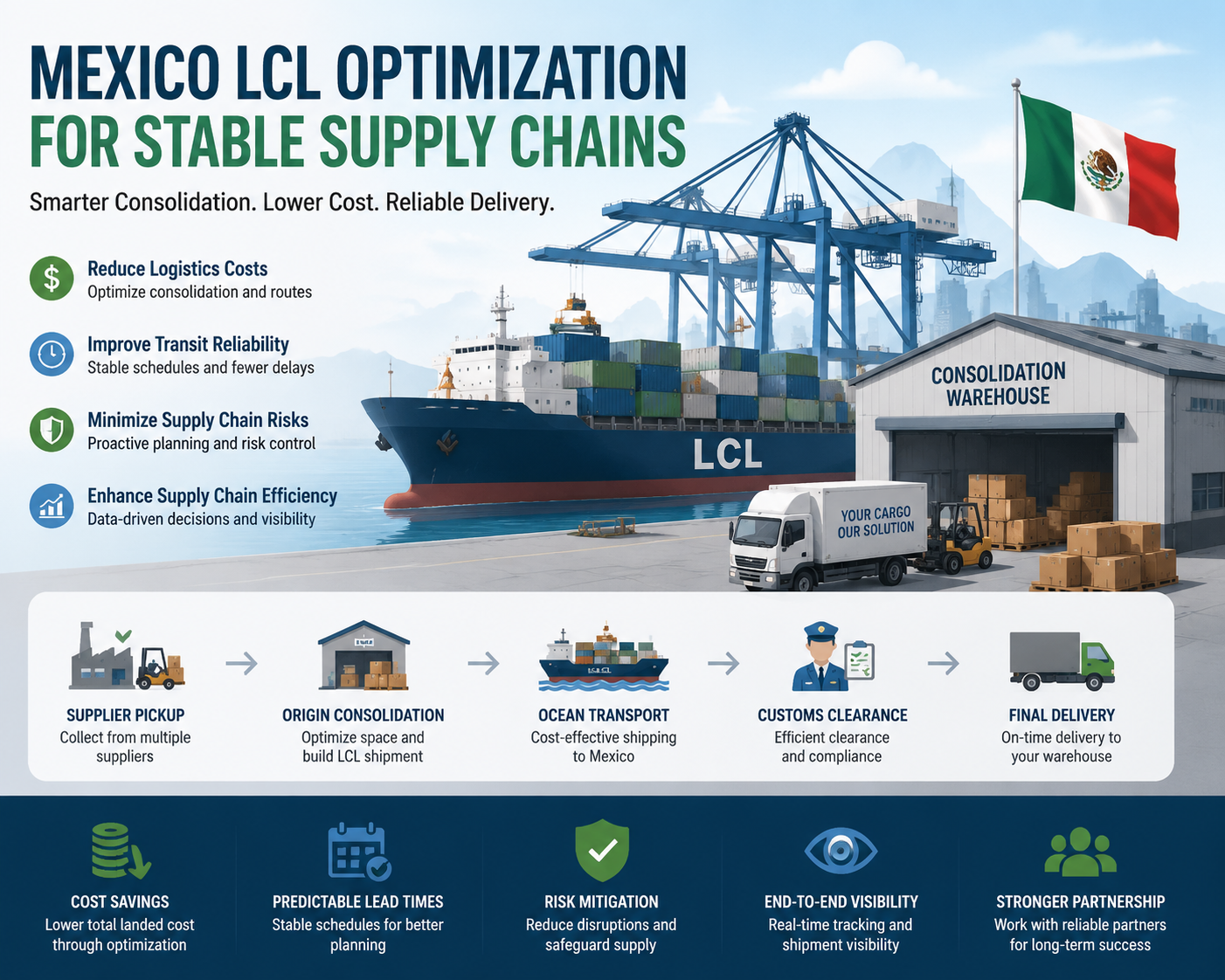
Less-than-container-load shipping has quietly become the backbone of flexible cross-border sourcing into Mexico, especially when procurement teams are juggling fragmented supplier bases across Asia. Instead of waiting to fill a full container, cargo gets stitched together like a patchwork quilt of SKUs, enabling faster procurement cycles and far less capital sitting idle in transit. In real-world operations, this is the difference between “waiting for volume” and “moving now,” and that delta often defines competitiveness in retail and industrial supply chains.
Mexico import demand trends for consolidated cargo
Mexico’s import ecosystem has been showing a steady tilt toward diversified sourcing, with brands no longer betting everything on single-origin bulk shipments. Electronics components, auto parts, apparel inputs, and packaging materials increasingly move in smaller, more frequent batches. This creates a structural tailwind for LCL demand, where consolidation hubs act like nerve centers feeding Mexico’s manufacturing corridors. Procurement teams often remark that “the small stuff now moves the big business,” and that sentiment is increasingly accurate.
Impact of volatility on procurement planning
Volatility—whether from freight rate swings, port congestion, or geopolitical tremors—has made procurement planning more of a chess game than a spreadsheet exercise. LCL helps absorb shockwaves by spreading risk across multiple sailings and suppliers, but it also demands sharper coordination discipline. Without it, lead times become elastic in the worst possible way, stretching unpredictably and wreaking havoc on production schedules. The winning approach is less about predicting stability and more about engineering resilience into every shipment layer.
2. Understanding LCL Shipping Structure in Mexico
Consolidation and deconsolidation process
At its core, LCL is a two-act performance: consolidation at origin and deconsolidation at destination. Cargo from multiple suppliers is pooled into a shared container, optimized like a 3D puzzle where every cubic centimeter counts. Once it arrives in Mexico, it is dismantled and redistributed to final consignees. The efficiency of this choreography depends heavily on warehouse discipline, labeling precision, and synchronization across time zones.
Cost components in LCL shipments
LCL pricing is rarely a single number—it is a layered architecture of origin handling, ocean freight allocation, destination charges, and administrative fees. Each layer can shift depending on volume density, commodity type, and routing complexity. Procurement professionals often discover that the “cheap freight rate” narrative evaporates once destination fees enter the equation, making total landed cost the only metric that truly matters.
Key stakeholders in LCL logistics chain
The LCL ecosystem involves freight forwarders, origin consolidators, ocean carriers, customs brokers, terminal operators, and inland transport providers. Each plays a distinct role, yet none operate in isolation. Misalignment at any node can cascade into delays or cost overruns. In practice, successful procurement teams treat these stakeholders as an interconnected ecosystem rather than a chain of isolated vendors.
3. Why Procurement Teams Rely on LCL in Mexico Trade
Lower MOQ flexibility for sourcing
Minimum order quantity constraints often dictate supplier selection, especially for fast-moving consumer goods and engineered components. LCL removes the rigidity of full-container economics, allowing procurement teams to source in commercially sensible batches rather than warehouse-bloating volumes. This flexibility is particularly valuable when testing new suppliers or entering volatile demand cycles.
Multi-supplier shipment consolidation benefits
Instead of receiving scattered shipments from multiple vendors, LCL enables a unified consolidation strategy where everything converges into a single logistical flow. This simplifies customs documentation, reduces per-shipment handling overhead, and provides clearer visibility. In procurement terms, it is like replacing a dozen noisy data streams with one clean dashboard.
Inventory risk reduction strategies
Lower shipment volumes mean lower exposure to obsolescence, price erosion, and demand misalignment. LCL becomes a tactical hedge against overstock scenarios, especially in industries with rapid product lifecycle turnover. Many procurement engineers quietly refer to this as “lean without the panic,” where inventory stays agile without starving production.
4. Main Cost Drivers in Mexico LCL Logistics
Origin handling and export charges
Origin-side costs include pickup, warehouse handling, palletization, documentation, and export customs processing. These are often underestimated because they are fragmented across service providers. However, inefficiencies here tend to snowball downstream, turning minor misalignments into major cost leakage.
Ocean freight and surcharge structure
Ocean freight for LCL is typically calculated on chargeable weight or volume, often leading to disputes when cubic optimization is poor. Fuel surcharges, peak season surcharges, and equipment imbalance fees further complicate the equation. Procurement teams often feel like they are navigating a moving target where pricing logic shifts mid-contract.
Destination clearance and inland delivery fees
Once cargo lands in Mexico, the cost narrative shifts dramatically toward terminal handling, customs clearance, storage, and inland trucking. This stage is where “hidden costs” tend to surface. Without tight broker coordination, expenses can escalate quickly, especially in congested gateways.
5. Common Inefficiencies in Mexico LCL Supply Chains
Poor consolidation planning at origin
When consolidation is rushed or unstructured, containers end up underutilized or mispacked, leading to inflated per-unit freight costs. This is often the result of siloed supplier shipments that were never designed to move together. The outcome is simple: wasted space and wasted money.
Unstable carrier scheduling
Irregular sailing schedules and vessel rollovers can disrupt even the most carefully planned procurement cycles. When carriers prioritize full-container loads, LCL shipments sometimes get bumped, creating cascading delays. Procurement teams often describe this as “being on the back foot before the game even starts.”
Hidden destination handling delays
Even after arrival, cargo can sit idle due to warehouse congestion, incomplete paperwork, or broker delays. These inefficiencies are rarely visible at the quoting stage but become painfully obvious during delivery. The result is unpredictable lead times that undermine production planning.
6. Demand Forecasting for LCL Optimization
Data-driven shipment planning methods
Modern procurement operations increasingly rely on predictive analytics to align purchase orders with shipping schedules. Historical shipment data, supplier lead times, and consumption rates feed into models that determine optimal LCL dispatch timing. It is less guesswork and more controlled orchestration.
Seasonality impact on Mexico imports
Mexico’s import patterns fluctuate with retail cycles, manufacturing demand, and holiday-driven consumption spikes. LCL shipments must be timed with surgical precision during peak seasons to avoid congestion premiums. Missing these windows can feel like trying to board a train after the doors have already closed.
Supplier alignment with forecast accuracy
Forecasting is only as good as supplier discipline. Misaligned production schedules or late readiness can derail entire consolidation plans. Strong procurement teams enforce shared visibility, ensuring suppliers understand that timing is not optional—it is contractual DNA.
7. Cargo Consolidation Strategies for Cost Control
Multi-vendor cargo grouping techniques
Grouping cargo from multiple vendors requires meticulous SKU mapping and dimensional harmonization. The goal is to maximize container density while minimizing handling complexity. Done correctly, it transforms fragmented shipments into a single efficient freight unit.
Warehouse consolidation hub selection
Strategic selection of consolidation hubs—often near major Asian export ports—can drastically improve cost efficiency. The right hub acts as a compression point where cargo is optimized before ocean transfer. Poor hub selection, on the other hand, introduces friction and unnecessary handling.
Load optimization for cube utilization
Cube utilization is the silent profit driver in LCL logistics. Every unused cubic meter is effectively lost margin. Advanced load planning tools and experienced warehouse operators ensure that cargo is stacked, layered, and secured with near-engineering precision.
8. Route Selection Optimization for Mexico LCL
Asia to Mexico main trade lanes
The dominant lanes from China, Vietnam, and Southeast Asia into Mexico are heavily influenced by port infrastructure and carrier alliances. Choosing the right lane is not just about distance—it is about reliability, frequency, and transshipment risk.
Port selection impact on transit time
Ports such as Shanghai, Shenzhen, and Ningbo offer different sailing frequencies and congestion profiles. On the destination side, Mexican ports like Manzanillo and Lázaro Cárdenas play equally critical roles. Small differences in port selection can translate into days of variance.
Alternative routing for congestion avoidance
When primary lanes become congested, alternative routing through Pacific hubs or transshipment points can stabilize flow. These contingency routes are essential for maintaining procurement continuity during peak disruption periods.
9. Carrier Selection Strategy for Stable Operations
Reliability vs cost trade-offs
The cheapest carrier is rarely the most stable one. Procurement teams constantly balance rate competitiveness against schedule reliability, often favoring predictability over marginal savings. In practice, stability often pays for itself.
Carrier performance benchmarking
Performance tracking includes metrics like on-time departure, transit consistency, cargo handling integrity, and claim ratios. Benchmarking carriers transforms subjective preference into data-driven selection.
Contract vs spot rate considerations
Contract rates provide stability, while spot rates offer flexibility. The optimal mix depends on demand volatility and procurement strategy maturity. Many organizations use hybrid models to balance both.
10. Improving Transit Time Predictability
Schedule stability and sailing frequency
Frequent sailings reduce waiting time for consolidation completion. Stability in schedules allows procurement teams to align production cycles more precisely with inbound logistics.
Buffer planning for procurement cycles
Buffer time is no longer optional—it is a structural requirement. Well-designed buffers absorb delays without disrupting downstream operations.
Delay risk mitigation methods
Diversified routing, multi-carrier strategies, and proactive tracking systems help mitigate delay exposure. The objective is not to eliminate risk but to distribute it intelligently.
11. Customs Clearance Optimization in Mexico
Documentation accuracy requirements
Even minor documentation errors can trigger inspections or delays. Precision in invoices, packing lists, and HS codes is essential for smooth clearance.
Import compliance risk reduction
Understanding Mexico’s regulatory landscape helps avoid penalties and shipment holds. Compliance is a strategic asset, not just an administrative requirement.
Broker coordination efficiency improvements
Strong coordination with customs brokers ensures faster clearance cycles. Integrated communication systems reduce friction and accelerate release times.
12. Reducing Hidden Costs in LCL Shipments
Terminal handling charge transparency
THC fees often vary widely between providers. Transparency in these charges is critical for accurate landed cost calculation.
Destination fee negotiation strategies
Negotiating bundled destination fees can significantly reduce variability. Procurement leverage increases with volume consolidation.
Demurrage and detention avoidance
Efficient pickup scheduling and documentation readiness are key to avoiding costly storage penalties. Time discipline becomes a financial safeguard.
13. Warehouse and Distribution Integration Strategy
Cross-docking for faster flow
Cross-docking eliminates unnecessary storage by moving goods directly from inbound to outbound transport. This reduces handling time and accelerates delivery cycles.
Bonded warehouse utilization
Bonded facilities allow deferred duty payment and flexible inventory positioning. This is especially useful for high-value or uncertain-demand goods.
Last-mile delivery synchronization
Aligning inbound logistics with last-mile distribution ensures seamless flow from port to end customer. Synchronization reduces idle inventory and improves responsiveness.
14. Technology in Mexico LCL Optimization
Shipment visibility platforms
Real-time tracking platforms provide end-to-end visibility across consolidation, transit, and delivery stages. This transparency is essential for modern procurement governance.
Predictive analytics in logistics planning
Predictive tools forecast delays, cost fluctuations, and capacity constraints. These insights enable proactive decision-making rather than reactive firefighting.
EDI integration with suppliers
Electronic data interchange ensures seamless communication between suppliers, forwarders, and procurement systems. It reduces manual errors and accelerates coordination.
15. Risk Management in LCL Supply Chains
Cargo damage and loss prevention
Proper packaging standards, handling protocols, and insurance coverage reduce exposure to physical loss. Prevention is always cheaper than remediation.
Carrier disruption contingency planning
Backup carriers and alternative routes form the backbone of disruption resilience. Flexibility is the antidote to uncertainty.
Geopolitical and port congestion risks
External shocks such as policy shifts or port strikes can disrupt flow. Diversified routing strategies help absorb these macro-level risks.
16. Procurement Decision Framework for LCL Optimization
Total landed cost evaluation models
True cost analysis includes freight, duties, handling, and risk exposure. Procurement decisions should always be grounded in total landed cost, not headline rates.
Supplier logistics performance scoring
Suppliers should be evaluated not only on price and quality but also on logistics readiness. Delivery reliability becomes a competitive differentiator.
Long-term contract optimization strategy
Strategic contracts with carriers and forwarders stabilize cost structures and improve priority allocation. Long-term alignment creates operational predictability and procurement leverage.
External References