Table of Contents
1. Introduction to China to Europe Multimodal Shipping
1.1 Definition of Multimodal Shipping
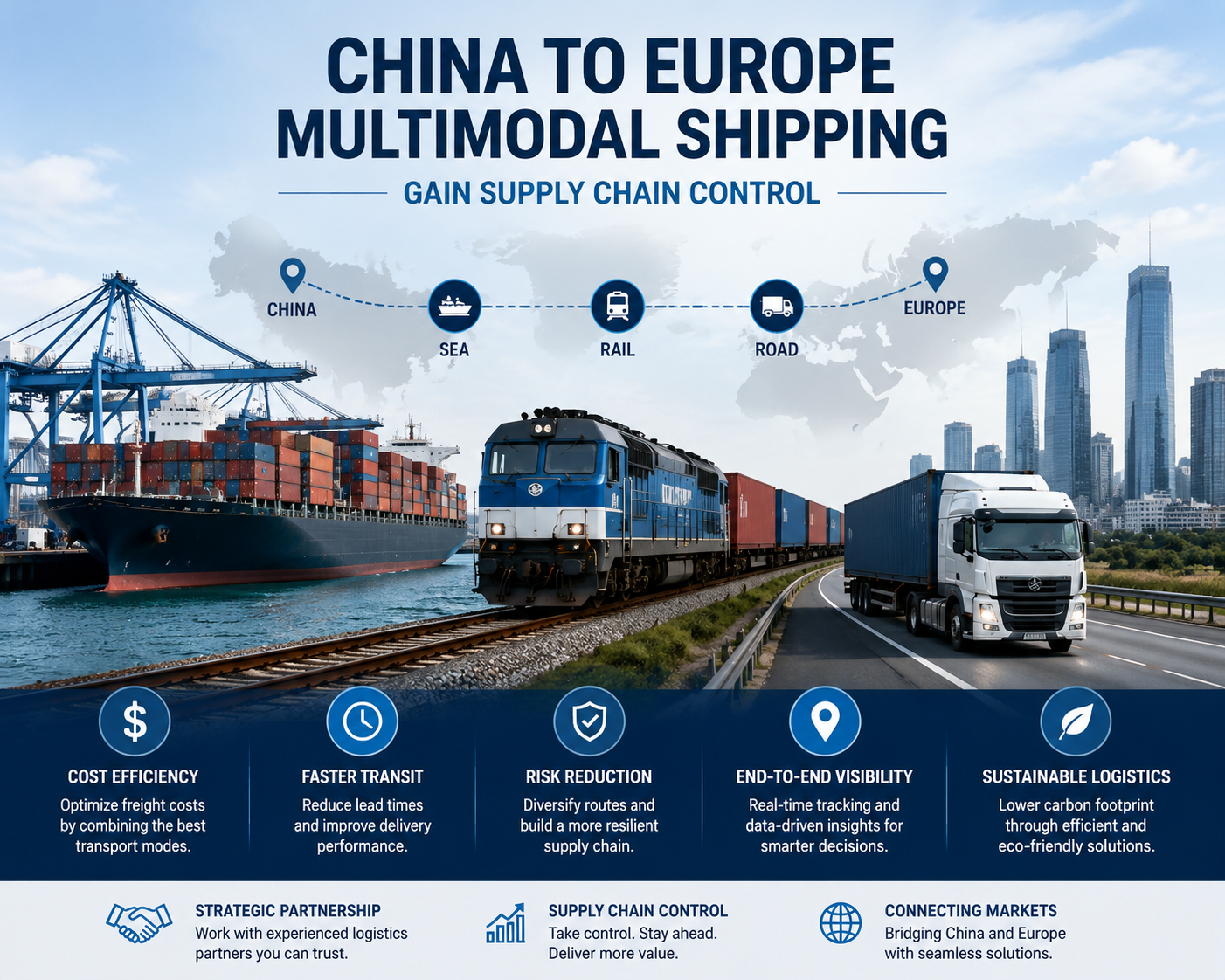
Multimodal shipping refers to the movement of cargo using two or more transportation modes under a single transport contract. A shipment may begin at a manufacturing facility in China, travel by truck to a rail terminal, continue via rail across Eurasia, and then be transferred onto road transport for final delivery in Europe. Despite involving multiple transportation methods, the shipment remains under one logistics arrangement managed by a single service provider.
For procurement professionals, multimodal transportation represents far more than a logistics buzzword. It is a sophisticated orchestration of transport assets designed to optimize transit times, reduce costs, increase flexibility, and create a more resilient supply chain architecture. In an era where supply chain disruptions can emerge from geopolitical shifts, labor shortages, port congestion, or extreme weather events, multimodal transportation provides an invaluable layer of operational agility.
1.2 Importance for Global Supply Chains
Modern supply chains are no longer linear systems. They have evolved into interconnected networks spanning continents, involving numerous suppliers, manufacturing partners, distribution centers, and end markets. China remains one of the world's most important manufacturing hubs, while Europe continues to be a critical consumer market for industries ranging from electronics and automotive components to fashion and industrial machinery.
As supply chains become increasingly complex, transportation strategies must adapt accordingly. Sole reliance on ocean freight or air freight can expose companies to capacity constraints, volatile freight rates, and service disruptions. Multimodal transportation addresses these challenges by combining the strengths of different transport modes into a unified logistics solution.
Many procurement teams have learned the hard way that putting all their eggs in one basket can create unnecessary vulnerabilities. Diversified transportation strategies are rapidly becoming a competitive necessity rather than a luxury.
1.3 Why Brand Procurement Professionals Should Care
Procurement professionals are evaluated based on cost control, supplier performance, inventory availability, and risk mitigation. Transportation directly influences all these metrics.
When multimodal solutions are implemented effectively, procurement teams gain greater control over lead times, improve inventory planning accuracy, reduce logistics expenditures, and strengthen supplier reliability. This increased visibility enables organizations to make proactive decisions instead of reacting to supply chain disruptions after they occur.
In today's highly competitive market environment, maintaining product availability while controlling costs is often the difference between gaining market share and losing customers to competitors.
2. Current Trade Landscape Between China and Europe
2.1 Key Trade Volumes and Commodities
Trade between China and Europe remains one of the largest commercial corridors in the world. Billions of dollars worth of products move annually across this route.
Common exports from China include consumer electronics, industrial machinery, automotive components, home appliances, textiles, furniture, and renewable energy equipment. European imports into China often include luxury goods, automotive products, pharmaceuticals, industrial technologies, and specialty chemicals.
The sheer scale of these trade flows necessitates highly efficient transportation systems capable of handling large shipment volumes while maintaining predictable transit schedules. For more information, see China-Europe rail network.
2.2 Major Transport Routes and Hubs
Several critical logistics hubs facilitate China-Europe trade. Major Chinese export gateways include Shanghai, Ningbo, Shenzhen, Qingdao, Guangzhou, and Xiamen. Key European logistics hubs include Rotterdam, Hamburg, Antwerp, Duisburg, Warsaw, and Budapest.
Rail corridors connecting China and Europe have transformed inland transportation options. Strategic hubs such as Xi'an, Chongqing, Chengdu, and Zhengzhou play increasingly important roles in Eurasian rail logistics.
2.3 Regulatory and Customs Considerations
Every shipment moving between China and Europe encounters a complex regulatory environment. Procurement teams must understand product compliance requirements, customs declarations, import duties, VAT obligations, product certifications, trade sanctions, and security screening procedures.
Failure to comply with customs regulations can result in shipment delays, unexpected costs, cargo holds, and reputational damage. For more details, refer to World Trade Organization customs resources.
3. Understanding Multimodal Transportation
3.1 What Qualifies as Multimodal Transport
A shipment qualifies as multimodal transport when multiple transportation modes are used under a single contractual arrangement. Examples include Truck + Rail, Sea + Truck, Rail + Truck, Sea + Rail + Truck, and Air + Road. The critical distinction is centralized responsibility. One logistics provider manages the entire transportation chain from origin to destination.
3.2 Advantages Over Single-Mode Shipping
Single-mode transportation often lacks flexibility. Ocean freight offers low costs but longer transit times. Air freight provides speed but comes with premium pricing. Rail delivers a balanced middle ground but may not cover final destinations. Multimodal transportation combines the strengths of each mode while minimizing their respective weaknesses, creating a highly adaptive logistics framework capable of responding to changing market conditions.
3.3 How Multimodal Integrates Sea, Rail, and Road
Consider a shipment of consumer electronics from Shenzhen to Germany. The cargo may travel by truck from the factory to a rail terminal, then by rail through Central Asia into Europe, and finally by truck from the rail terminal to the distribution center. Alternatively, goods may travel by sea to Rotterdam before being transferred onto rail networks and then delivered by truck. This integration creates optimized transportation corridors tailored to specific procurement objectives.
4. Benefits of Multimodal for Brand Procurement
4.1 Cost Efficiency and Freight Optimization
Transportation costs frequently represent a substantial portion of landed product costs. Multimodal solutions enable procurement teams to select lower-cost transport segments, avoid premium air freight, optimize container utilization, consolidate shipments, and reduce storage expenses. Over time, these efficiencies generate significant savings across procurement operations.
4.2 Faster Transit Times and Reliability
Rail transportation often provides transit times approximately half those of traditional sea freight while remaining significantly less expensive than air freight. This allows brands to reduce inventory carrying costs, improve replenishment cycles, respond faster to market demand, and improve customer satisfaction. Predictable delivery schedules also improve production planning and inventory forecasting.
4.3 Risk Reduction and Contingency Planning
Supply chain disruptions are inevitable. The question is not whether disruptions will occur but when. Multimodal strategies provide alternative routing options that help organizations maintain continuity during port congestion, labor strikes, geopolitical tensions, natural disasters, and capacity shortages. This flexibility significantly improves supply chain resilience.
5. Sea Freight Component
5.1 Key Ports in China and Europe
China's major ports provide access to global maritime networks. Leading Chinese ports include Shanghai, Ningbo-Zhoushan, Shenzhen, Qingdao, and Tianjin. Major European destinations include Rotterdam, Hamburg, Antwerp-Bruges, Felixstowe, and Le Havre. These ports serve as essential gateways for multimodal operations.
5.2 Container Options and Sizing
Common container types include 20-foot containers, 40-foot containers, 40-foot high cube containers, refrigerated containers, open-top containers, and flat rack containers. Selecting the correct container configuration directly impacts freight costs and cargo protection.
5.3 Shipping Schedules and Lead Times
Ocean freight schedules vary according to route, carrier, and seasonal demand. Typical China-Europe transit times range between 25 and 45 days. Procurement teams should account for port handling times, customs processing, peak season congestion, and equipment availability. Building schedule buffers can prevent costly stock shortages.
6. Rail Freight Component
6.1 China-Europe Rail Corridors
Rail transportation has emerged as one of the most significant developments in Eurasian logistics. Key rail corridors pass through Kazakhstan, Russia, Belarus, and Poland. Alternative routes increasingly utilize the Middle Corridor through Central Asia and the Caucasus region.
6.2 Transit Time Comparison with Sea and Air
Typical transit times include:
| Mode | Transit Time |
|---|---|
| Air Freight | 3-7 Days |
| Rail Freight | 12-20 Days |
| Sea Freight | 25-45 Days |
Rail occupies the sweet spot between speed and cost.
6.3 Freight Capacity and Volume Considerations
Rail freight supports substantial shipment volumes while maintaining faster transit than ocean transport. It is particularly suitable for electronics, machinery, consumer goods, and automotive parts. However, capacity limitations during peak seasons should be carefully monitored.
7. Road Freight Component
7.1 Last-Mile Delivery Challenges
The final transportation leg often determines overall service quality. Challenges include urban congestion, delivery restrictions, appointment scheduling, and warehouse availability. Efficient last-mile planning prevents unnecessary delays.
7.2 Cross-Border Regulations and Permits
European road transport involves various regulations governing driver hours, vehicle standards, environmental compliance, and border documentation. Experienced logistics providers help navigate these complexities.
7.3 Cost and Flexibility Advantages
Road transport offers exceptional flexibility. It enables door-to-door delivery, route adjustments, rapid response to schedule changes, and customized distribution strategies. For procurement teams, this flexibility can be a game changer.
8. Air Freight Integration
8.1 When to Consider Air for Multimodal Shipments
Air freight becomes attractive when inventory shortages threaten sales, product launches have fixed deadlines, high-value cargo requires rapid delivery, or seasonal demand spikes occur. Strategic use of air freight can prevent significant revenue losses.
8.2 Cost-Benefit Analysis for Urgent Shipments
While air freight costs substantially more than other modes, the decision should focus on total business impact rather than transportation cost alone. A missed product launch can cost far more than expedited transportation.
8.3 Handling Sensitive or High-Value Goods
Air freight is particularly suitable for medical devices, luxury goods, semiconductors, and precision equipment. Enhanced security and shorter transit times reduce exposure to risk.
9. Choosing the Right Multimodal Provider
9.1 Criteria for Evaluating Freight Forwarders
Key evaluation criteria include global network coverage, industry expertise, customs capabilities, financial stability, and customer service responsiveness. Selecting the wrong provider can create expensive operational challenges.
9.2 Service Level Agreements and KPIs
Important performance indicators include on-time delivery rates, transit reliability, customs clearance success, claims ratios, and tracking accuracy. Strong SLAs create accountability.
9.3 Technology and Tracking Capabilities
Modern logistics increasingly depends on digital visibility. Advanced platforms provide real-time shipment tracking, predictive ETAs, exception alerts, and analytics dashboards. Visibility reduces uncertainty and improves planning.
10. Supply Chain Visibility and Tracking
10.1 Importance of Real-Time Tracking
Real-time visibility transforms logistics management from reactive to proactive. Procurement teams can identify issues before they become major disruptions.
10.2 Digital Platforms and Dashboards
Modern dashboards provide centralized access to shipment status, transit milestones, inventory movements, and cost metrics. Data-driven decisions become significantly easier.
10.3 Reporting for Procurement Decision-Making
Comprehensive reporting supports supplier evaluations, budget forecasting, risk assessments, and strategic sourcing initiatives. Reliable data is often worth its weight in gold. For more guidance, see Inbound Logistics analytics insights.
11. Customs Clearance and Documentation
11.1 Common Documents Required
Essential documents typically include commercial invoices, packing lists, bills of lading, certificates of origin, and import licenses. Accuracy is crucial.
11.2 Tips for Smooth Customs Clearance
Best practices include early document preparation, classification verification, compliance reviews, and customs broker coordination. Small errors can trigger significant delays.
11.3 Managing Duties, Taxes, and Compliance
Proper planning minimizes unexpected costs and protects supply chain continuity.
12. Risk Management Strategies
12.1 Identifying Potential Delays and Disruptions
Continuous monitoring helps identify port congestion, weather events, capacity shortages, and regulatory changes.
12.2 Insurance Options for Multimodal Shipments
Comprehensive cargo insurance protects against damage, theft, loss, and general average claims.
12.3 Contingency Planning for Procurement Teams
Robust contingency plans include alternative carriers, backup routes, and emergency inventory buffers.
13. Sustainability and Green Logistics
13.1 Reducing Carbon Footprint in Multimodal Shipping
Rail transportation often generates substantially lower emissions than air freight.
13.2 Eco-Friendly Transport Modes
Companies increasingly prioritize rail freight, alternative fuels, and electrified transportation.
13.3 Aligning with Corporate Sustainability Goals
Sustainable logistics supports ESG objectives and strengthens brand reputation.
14. Cost Optimization Techniques
14.1 Comparing Different Multimodal Routes
Route optimization should evaluate cost, transit time, reliability, and risk.
14.2 Volume Consolidation Strategies
Consolidation improves container utilization and reduces per-unit transportation costs.
14.3 Negotiating Rates with Carriers
Long-term partnerships often produce better pricing and service consistency.
15. Case Studies of Successful Multimodal Procurement
15.1 Brand Examples Optimizing China-Europe Logistics
Many global brands have reduced lead times by integrating rail freight into traditional sea freight networks.
15.2 Lessons Learned from Delays and Disruptions
Organizations with diversified transportation strategies consistently outperform those relying on a single mode.
15.3 Measurable Performance Improvements
Benefits often include lower logistics costs, improved inventory turnover, higher service levels, and reduced stockouts.
16. Future Trends in China to Europe Multimodal
16.1 Emerging Rail and Sea Routes
New infrastructure investments continue expanding transportation options across Eurasia.
16.2 Technology-Driven Logistics Innovations
Artificial intelligence, predictive analytics, and digital twins are transforming logistics planning.
16.3 Evolving Procurement Strategies for Global Brands
Procurement teams increasingly prioritize resilience, visibility, and sustainability alongside traditional cost objectives.
17. Practical Tips for Brand Procurement Teams
17.1 Planning Shipments in Advance
Early planning secures capacity and minimizes premium transportation expenses.
17.2 Leveraging Multimodal Analytics
Analytics reveal optimization opportunities that are often hidden within complex transportation networks.
17.3 Building Strong Relationships with Freight Providers
Strong partnerships improve communication, responsiveness, and long-term performance.
18. Conclusion and Actionable Takeaways
18.1 Summarizing the Benefits of Multimodal Shipping
China to Europe multimodal transportation provides a powerful combination of cost efficiency, operational flexibility, risk mitigation, and enhanced supply chain visibility.
18.2 Key Steps to Gain Supply Chain Control
Organizations should diversify transportation modes, improve shipment visibility, strengthen risk management, optimize routing strategies, and partner with experienced logistics providers.
18.3 Final Recommendations for Brand Procurement Professionals
The most successful procurement organizations no longer evaluate freight solely through the lens of transportation cost. Instead, they assess logistics as a strategic enabler of business performance. By leveraging multimodal transportation solutions between China and Europe, procurement professionals can build supply chains that are faster, more resilient, more sustainable, and ultimately more competitive in an increasingly volatile global marketplace.